




Recap of the 70th IT Press Tour in Silicon Valley
With 8 organizations: Clockwork, Cohesity, CTera, DDN, Hammerspace, Phison, ScaleFlux and VergeIO
By Philippe Nicolas | October 20, 2026 at 2:01 pmThe 70th edition of The IT Press Tour took place in Silicon Valley early October.
With this edition, new records have been beaten: 372 distinct companies met since the 1st edition in June 2010, organized 639 sessions, met 1600+ CxO for more than 28k articles generated. Designed as a press-focused event, it brings together media representatives and a diverse range of enterprises and organizations for in-depth conversations spanning IT infrastructure, cloud computing, networking, cybersecurity, data management and storage, big data and analytics, and the growing role of AI across all these fields.
Eight companies joined that edition, listed here in alphabetical order: Clockwork, Cohesity, CTera, DDN, Hammerspace, Phison, ScaleFlux and VergeIO.
Clockwork
During its first participation, Clockwork.io presented its vision of Software-Driven AI Fabrics, a programmable software layer designed to improve GPU cluster observability, fault tolerance and utilization. Led by CEO Suresh Vasudevan and a founding team with strong Stanford and VMware roots, the company recently raised $31M, bringing total funding to $73M.
Clockwork addresses a critical challenge in large AI infrastructures: GPU failures, network disruptions and performance stragglers can significantly reduce effective computing capacity. Distributed AI workloads synchronize thousands of GPUs, meaning a single faulty component can slow or interrupt an entire job. Industry studies highlight the problem, with Meta reporting a mean time to failure of just 7.9 hours for 1,024-GPU jobs and ByteDance observing significant slowdowns in 42.5% of jobs.
Click to enlarge
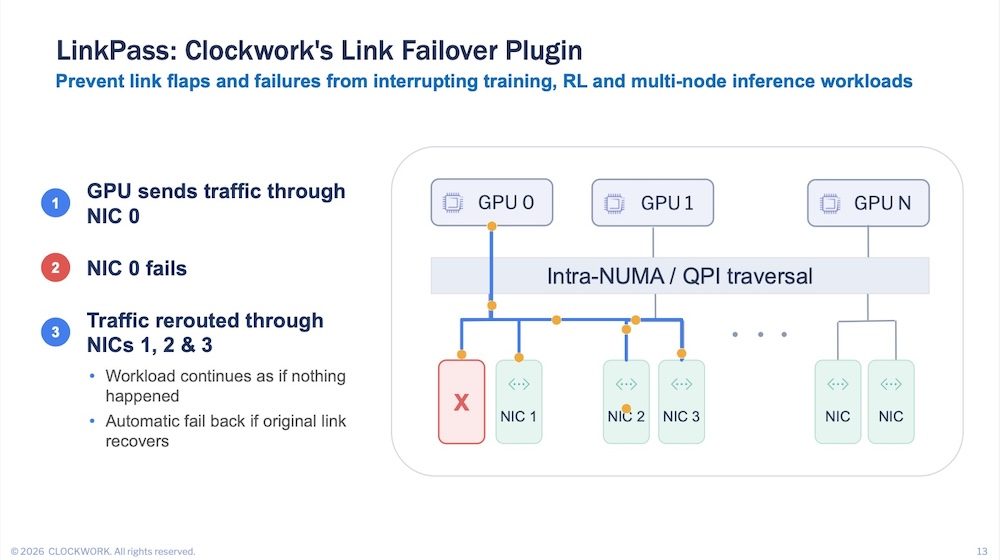
Traditional checkpoint-restart mechanisms can require up to 90 minutes to recover, wasting valuable GPU resources. Clockwork positions fault tolerance as a “goodput multiplier,” maximizing productive GPU processing rather than simply increasing hardware utilization.
Its flagship FleetIQ platform, generally available since September 2025, combines detection, diagnosis and automated recovery across AI training, inference and reinforcement learning. Clockwork claims 30–50% higher GPU utilization and 90% fewer disruptive checkpoint restarts.
FleetIQ integrates several complementary technologies. FleetAudit validates GPU clusters before deployment, examining networks, accelerators, PCIe topology and communication infrastructure. FleetLens continuously monitors production environments using Clockwork’s highly accurate synchronization technology and an out-of-band probing system, identifying network problems at microsecond granularity and pinpointing faulty links, switches or NICs.
On the recovery side, LinkPass, an NCCL plugin, automatically reroutes traffic around failing network interfaces without interrupting workloads. TorchPass introduces live GPU workload migration, transferring running jobs from faulty or degraded nodes to healthy resources without restarting applications. It supports both proactive maintenance and unexpected hardware failures.
Another innovation is TorchPass snapshots, which capture distributed workloads without requiring application modifications. Platform snapshots complete in under 20 seconds, while integrated model checkpoints take under five seconds, both with approximately 1% overhead at their respective recommended frequencies.
Clockwork also demonstrated growing commercial traction. LinkedIn uses LinkPass in production, reportedly avoiding tens of thousands of GPU-hours of downtime monthly. Together AI is integrating TorchPass and LinkPass into its GPU cloud services, while WhiteFiber uses FleetAudit to detect infrastructure defects before customer deployment. Additional customers and partners include Wells Fargo, Nebius, Nscale and DCAI.
The broader market implication is significant. As AI clusters expand to tens of thousands of accelerators, infrastructure reliability becomes as important as raw GPU performance. Improving goodput can deliver substantial economic benefits by reducing wasted computing cycles, recovery delays and operational intervention.
Clockwork’s software-driven approach could therefore become an important component of next-generation AI factories, helping operators extract greater value from increasingly expensive GPU investments while improving service reliability and operational efficiency.
Cohesity
During its fifth participation, Cohesity presented its latest corporate strategy and product developments, with CEO and President Sanjay Poonen and CPO Vasu Murthy outlining a vision centered on three pillars: Protection, Security and AI. The company’s mission has evolved toward protecting, securing and extracting AI insights from enterprise data, under the broader ambition of “Resilience Everywhere”.
With approximately 12,000 customers, primarily among Global 2000 organizations, and 200EB of protected data, Cohesity positions itself at the intersection of cybersecurity and data management. Poonen compared its strategy to combining CrowdStrike or Palo Alto Networks with Databricks or Snowflake. The company is profitable, while a potential IPO remains on the horizon without a confirmed timeline.
Click to enlarge
The first pillar, protection, follows a “no workload left behind” philosophy, covering virtual machines, databases, files, identities, SaaS applications and AI agents. Eighteen months after merging with Veritas, Cohesity claims the industry’s broadest workload connector portfolio, emphasizing rapid recovery as a key differentiator.
The second pillar, security, introduces a five-stage cyber resilience framework encompassing comprehensive protection, cyber vaulting, threat scanning, clean-room recovery and the Minimum Viable Company concept. This approach prioritizes restoring critical business operations following cyberattacks rather than relying exclusively on threat prevention.
Cohesity is also strengthening its cybersecurity capabilities through advanced AI models. Its participation in Anthropic’s Project Glasswing enables vulnerability analysis using Mythos, complemented by evaluations involving OpenAI, Google and Nvidia technologies. Poonen expects new security products leveraging these models in the coming months.
The third pillar, AI, builds on the Cohesity Data Cloud, combining its control plane, NetBackup and DataProtect data movers, and SpanFS architecture. Murthy emphasized that trustworthy enterprise AI requires collaboration between autonomous agents, deterministic systems and human oversight.
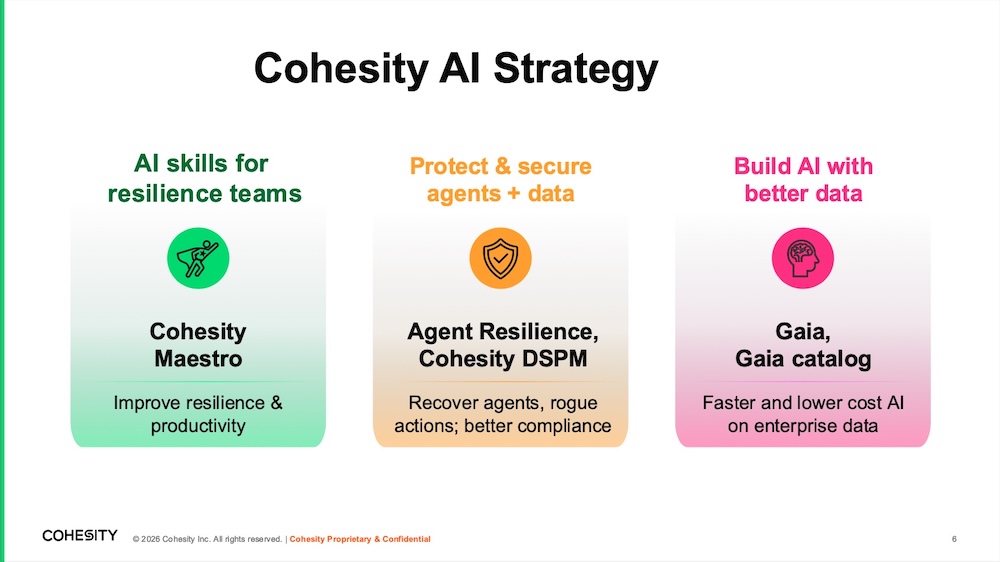
Three major product initiatives support this strategy.
- Cohesity Maestro introduces AI-powered operational capabilities for resilience teams. Through MCP integration, agents can identify protection gaps, recommend corrective actions and execute approved operations while maintaining human control over privileged activities
- Agent Resilience and Data Security Posture Management (DSPM) extend protection to AI agents, including their configurations, memory, tools and vector stores. Initial support targets Amazon Bedrock, with near-continuous backups approximately every five minutes. Future integrations with ServiceNow and Datadog will automate recovery following suspicious activities or destructive events
- Cohesity Gaia and Gaia Catalog transform protected backup repositories into a semantic data layer for generative AI. Using zero-copy access, Cohesity claims 80–90% lower token consumption and more than 40% reductions in AI infrastructure costs. Planned integrations include Databricks and Microsoft Fabric, while the Dutch government agency Rijkswaterstaat illustrates Gaia’s on-premises deployment capabilities
The strategic implication is clear: Cohesity wants to move beyond traditional backup and recovery toward an integrated data security and AI platform. Its extensive protected data footprint represents a competitive asset, potentially turning immutable backup repositories into valuable enterprise knowledge sources while reinforcing cyber resilience in an increasingly agent-driven world.
CTera
During its ninth participation, CTera presented its latest strategy and innovations, with co-founder and CEO Oded Nagel and co-founder and CTO Aron Brand highlighting the company’s evolution toward an AI-ready enterprise data platform. Founded in 2008, CTera employs approximately 200 people and has raised $180M.
The presentation focused on the “AI Value Gap”, the disconnect between massive enterprise AI investments and limited measurable returns. Despite widespread AI adoption, many organizations remain stuck in pilot projects. CTera identifies three major obstacles: data readiness, security and skills shortages. Its central argument is that enterprise AI challenges originate primarily from data management rather than AI models themselves.
Click to enlarge
CTera advocates bringing AI to governed enterprise data instead of moving sensitive information into external AI environments. This approach preserves existing permissions, strengthens sovereignty and reduces unnecessary data transfers and infrastructure costs.
The company’s updated positioning revolves around four pillars: Unify, Protect, Understand and Activate. The first two represent CTera’s traditional strengths in global file systems, distributed collaboration, snapshots and cyber resilience. The newer capabilities, Understand and Activate, introduce metadata intelligence, semantic search, classification and AI-driven content services.
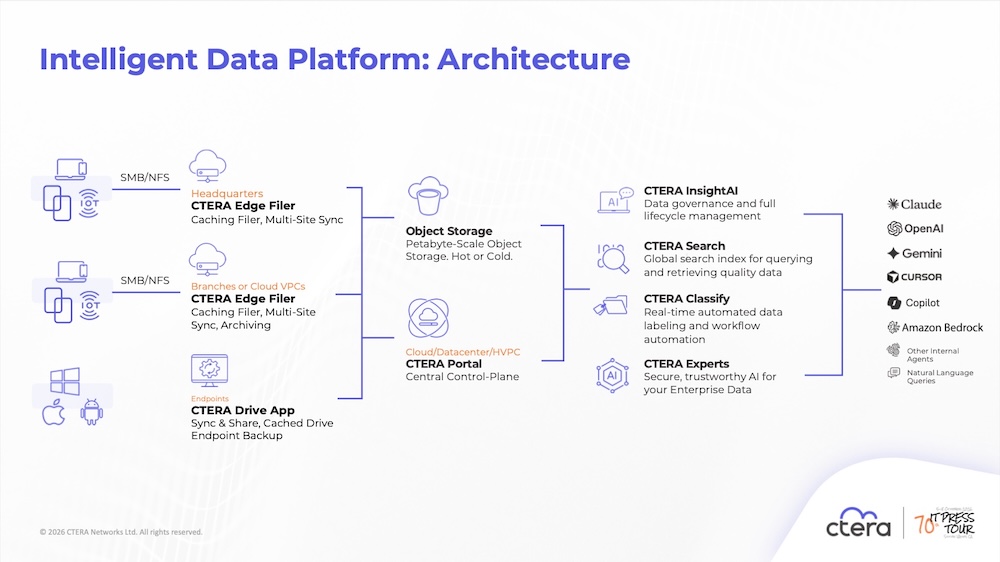
The architecture combines the CTera Portal control plane, Edge Filers, endpoint applications and object storage, complemented by several AI services. InsightAI delivers metadata-based governance and analytics, CTera Search provides global indexing, CTera Classify automates labeling and workflows, while CTera Experts enables secure semantic search and RAG.
Through MCP integration, these services connect enterprise data to Microsoft Copilot, Claude, Gemini, Cursor and proprietary AI agents. CTera anticipates that AI agents will eventually generate most enterprise data access requests, making agent-ready file systems increasingly essential.
Several customer examples illustrated this strategy. A manufacturing company managing more than 1PB across four regions uses InsightAI to analyze file metadata, identify obsolete content and optimize storage without reading files or generating data egress costs. A mortgage lender uses Content Services to activate 27TB of Azure Blob data, automate personally identifiable information classification and build AI-powered business workflows. A medical-legal organization applies CTera Classify to transform handwritten medical documents into structured case narratives.
Another significant announcement was CTera Forward Deployed Engineering (FDE), a new professional services initiative designed to move enterprise AI projects from experimentation into production.
Small teams combining Forward Deployed Engineers and Deployment Strategists work directly within customer environments to identify use cases, prepare governed data, integrate AI into existing workflows and transfer operational ownership. Typical engagements last approximately one month, with an initial team of around ten specialists.
This represents a strategic shift for CTera, historically focused on minimizing professional services. Unlike consulting-centric approaches, CTera emphasizes ownership of the underlying data infrastructure and intends to remain primarily a technology company.
The broader market implication is significant. CTera is expanding beyond distributed file services and cyber storage to become a trusted enterprise AI context layer. By combining unified data management, governance, AI activation and implementation expertise, the company aims to close the gap between AI experimentation and measurable business value, positioning unstructured enterprise data as a strategic asset for the emerging agentic AI economy.
DDN
During its tenth participation, DDN presented its strategy for improving AI infrastructure economics, emphasizing GPU productivity rather than raw storage performance. The session also introduced several recently appointed executives, including Kevin Delane, president and CRO, reflecting the company’s rapid expansion and organizational transformation.
DDN’s positioning is summarized by its tagline: “We don’t make GPUs faster. We make them work, profitably”. This approach reflects a major market shift as AI inference overtakes training in infrastructure spending. According to Gartner, AI-optimized IaaS spending should reach $42B in 2026, with inference representing 55% of that market, increasing to 59% in 2027.
Click to enlarge
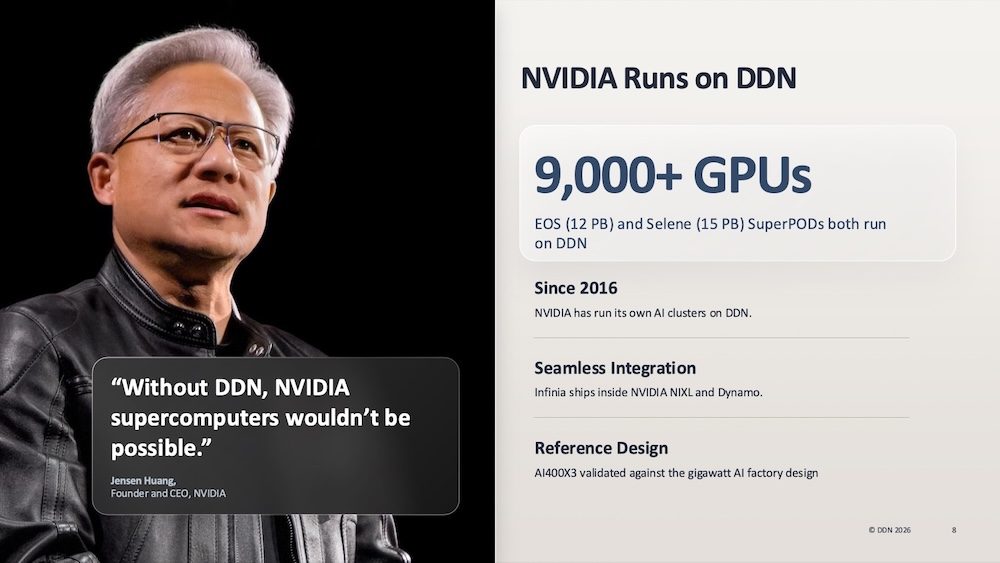
The company highlighted its growing customer base across AI clouds, sovereign AI infrastructures, government, healthcare, financial services and enterprise environments. Its strategic relationship with Nvidia remains central, spanning nearly a decade and several major supercomputers, including Selene, Eos and Cambridge-1. DDN technologies are integrated into Nvidia’s AI ecosystem, including DGX SuperPOD, Dynamo, NIXL and future Rubin-based infrastructures.
DDN identifies eight major inefficiencies affecting GPU economics, from data starvation and checkpoint delays during training to repeated context computation, scalability limitations and tenant isolation challenges during inference.
To address these issues, DDN combines two complementary storage engines under a unified namespace, managed through its Horizon control plane: EXAScaler for AI training and Infinia for inference and agentic AI workloads. Both solutions are available through DDN appliances or qualified third-party hardware.
- EXAScaler, based on the Lustre parallel file system, delivers high-throughput, low-latency access for large GPU clusters. DDN reports up to 99% GPU utilization and 96% network utilization in Nvidia DGX B200 SuperPOD configurations, with 190GB/s per 2U appliance. On Google Cloud Managed Lustre, EXAScaler reportedly accelerates checkpointing by 15x, improves training performance by 1.5x and reduces training costs by 42%. India’s Shakti Cloud demonstrates multi-tenant capabilities across 8,000 B200 GPUs while maintaining data sovereignty and high utilization
- Infinia, DDN’s distributed object storage platform, addresses inference economics through a scalable architecture combining object, file and KV-cache services. Its distributed-hash design eliminates traditional metadata bottlenecks and enables parallel data access across hundreds of nodes. Integrated with Nvidia NIXL and Dynamo, Infinia supports KV-cache offloading and reuse, reducing expensive context recomputation. DDN reports 4.2x faster time to first token for 100,000-token contexts and estimates that unnecessary context recomputation could cost a 4,096-GPU cluster $186,000 daily
A major reference deployment involves a frontier AI laboratory operating 700PB of Infinia storage across approximately 960 nodes. The platform delivers peak throughput of 6.4TB/s andMs of object operations per second.
The strategic message is clear: storage is becoming a decisive factor in AI profitability. By combining mature parallel file storage with a modern distributed object architecture, DDN aims to maximize GPU efficiency across training and inference, reduce operational costs and support increasingly demanding AI factories.
Hammerspace
During its seventh participation, Hammerspace presented its latest strategy and technology developments, with Floyd Christofferson, VP, product marketing, emphasizing that AI infrastructure is increasingly constrained by data availability rather than computing power alone.
Traditional enterprise storage architectures remain fragmented across applications, locations and infrastructure platforms. AI workloads, however, require seamless access to distributed datasets while GPUs dynamically move between environments. Data migrations and replication introduce delays, additional costs and sovereignty concerns, often preventing AI projects from progressing beyond proof of concept.
Hammerspace addresses these challenges through a standards-based data orchestration platform that unifies existing storage resources without requiring proprietary clients or disruptive migrations.
Click to enlarge
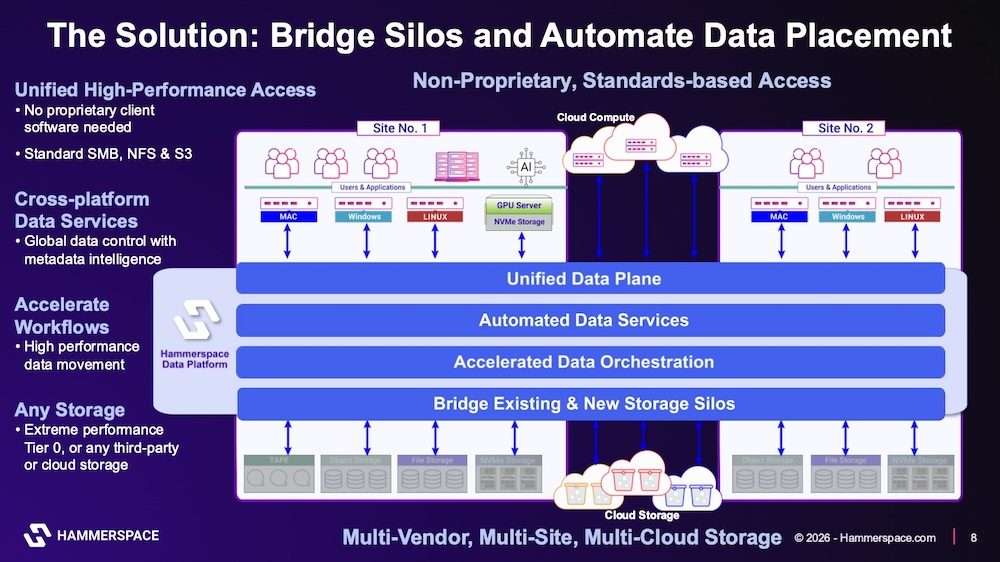
Its architecture leverages Linux-native technologies, including NFSv4.2, pNFS with Flex Files, LOCALIO and nconnect. Recent innovations include Striped Flex Files and NFS Direct, with additional capabilities such as client-side erasure coding planned following the Rozo Systems integration.
The platform combines five fundamental capabilities: data discovery and assimilation, a unified global namespace, metadata-driven policies, continuous data orchestration and a standards-based parallel file system. It supports simultaneous NFS, SMB and S3 access across on-premises, cloud and edge environments, while maintaining unified permissions and automated data placement.
A major innovation is Tier 0 storage, which transforms underutilized NVMe capacity inside GPU servers into a shared, protected storage tier. This approach reduces dependence on expensive external storage and network resources while accelerating data access and checkpoint operations.
Hammerspace claims external networked storage can be 2.4 to 10 times slower than local Tier 0 on-premises, with even greater differences in cloud environments. For example, a 500GB checkpoint completes in 4.5 seconds on local NVMe compared with 11.1 seconds over a 400Gb/s network.
Several customer deployments illustrate the platform’s capabilities and economics.
- Vanderbilt University’s ACCRE HPC facility uses Hammerspace across approximately 10PB, combining Tier 0, primary storage and archival capacity. The institution reports storage cost reductions of approximately 48%
- A major hyperscale AI laboratory is planning a 30PB deployment across AWS and on-premises infrastructure, with initial tests demonstrating 36% faster checkpoint loading and threefold improvements in large-file operations
- Other references include a European healthcare AI provider expanding beyond 1,000 GPUs, a communications company running 2PB on Oracle Cloud Infrastructure, and a US life sciences organization consolidating distributed storage across 26 laboratories
Hammerspace measures its economic value through three dimensions: time to very first token, time to first token and time per token. By eliminating migrations, optimizing placement and improving data accessibility, the company claims AI deployment preparation can accelerate more than tenfold, while GPU utilization can increase from 18% to 87%.
The broader market perspective reinforces the growing importance of open parallel file technologies. NetApp’s increasing commitment to pNFS validates this architectural direction, while competition remains intense against Vast Data, Weka, DDN and established storage vendors.
Hammerspace differentiates itself through non-disruptive data assimilation, Linux-native protocols and Tier 0 economics, positioning data orchestration as a critical component of efficient AI factories.
Phison
During its third participation, Phison presented its expanding AI strategy, highlighting exceptional revenue growth, advances in memory extension technologies, enterprise SSD developments and emerging opportunities in orbital data centers. Michael Wu, president of Phison USA, outlined the company’s transformation from an SSD controller specialist into a broader AI infrastructure provider.
With more than 5,000 employees, 75% dedicated to R&D, and over 20% of the global client SSD controller market, Phison is experiencing remarkable momentum. Revenue reached $2.345B in 2025, while the first half of 2026 alone generated approximately $3.4B. AI-related products accounted for 38% of second-quarter revenue, reflecting accelerating demand for enterprise SSDs, AI servers, memory expansion and networking components.
Phison believes NAND demand is undergoing a fundamental transformation, moving beyond traditional PC and smartphone capacity requirements toward AI-driven consumption. As AI factories generate increasing volumes of tokens, flash storage becomes essential throughout the AI lifecycle.
Click to enlarge
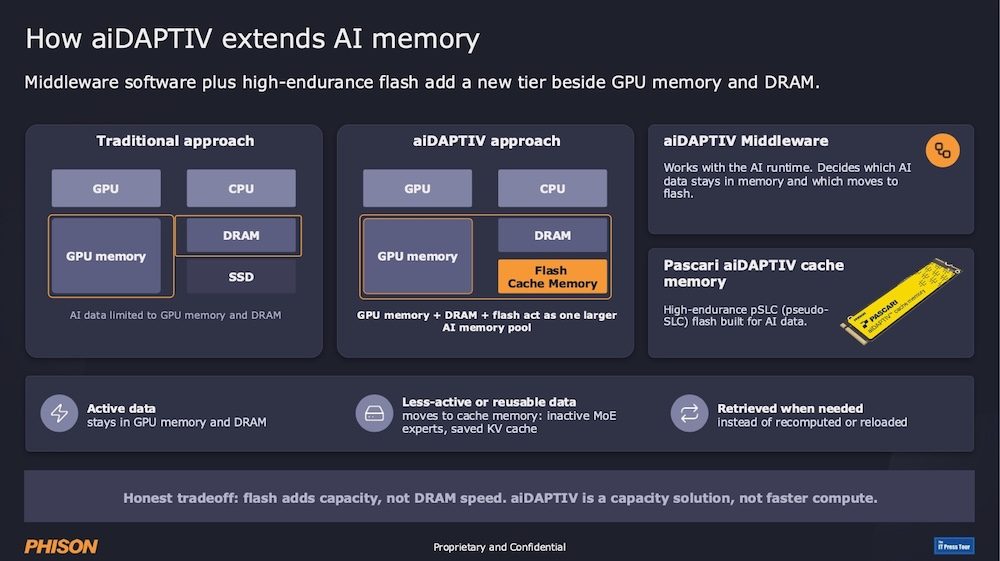
A central innovation is aiDAPTIV, Phison’s software and flash-based solution addressing the growing memory wall. Combining middleware with high-endurance pSLC NAND, aiDAPTIV extends effective memory capacity beyond expensive HBM and DRAM without requiring application modifications.
The technology supports three major use cases: dynamic mixture-of-experts model offloading, KV-cache reuse and fine-tuning larger AI models on existing hardware. In one demonstration, memory consumption dropped from 23.5GB to 15.9GB, enabling a model to run on a 16GB laptop. Another test reduced retrieval-augmented generation time to first token from 55 seconds to 1.4 seconds, representing a 39-fold improvement.
Phison is collaborating with Intel to integrate aiDAPTIV into AI PCs, including Intel AI Playground, with additional support planned for llama.cpp and OpenVINO. By September 2026, eight PC manufacturers were engaged, with seven programs approaching or entering mass production. Opportunities also extend to Nvidia Jetson edge systems and enterprise AI servers.
The second strategic pillar is Pascari, Phison’s enterprise SSD brand launched in 2024. Its portfolio addresses performance, density, boot storage and specialized AI workloads.
The X-Series delivers up to 14.8GB/s and 3.3M IOPS, with endurance reaching 60 DWPD for checkpoint-intensive applications. The D-Series emphasizes density, reaching 245.76TB, while additional SATA and PCIe Gen5 products address broader enterprise requirements.
Phison also highlighted its growing enterprise presence, with Pascari shipping to 21 customers across cloud providers, OEMs, AI infrastructure vendors and semiconductor companies.
An emerging opportunity involves orbital data centers, where space-based computing could potentially overcome terrestrial power, cooling and land constraints. Phison sees demand for specialized storage capable of operating in extreme environments, building on its experience supplying SSD technology for lunar missions.
The broader market implication is significant. Phison is evolving beyond its traditional controller business toward an integrated AI infrastructure strategy combining silicon, storage hardware and software. Its approach positions NAND flash as a critical resource for reducing AI infrastructure costs, extending memory capacity and supporting increasingly diverse computing environments, from AI PCs to hyperscale and orbital systems.
ScaleFlux
During its second participation, ScaleFlux presented its evolving strategy and latest innovations, with CEO Hao Zhong, Pichai Balaji, VP, products and marketing, and Saeed Raja, VP, products, outlining the company’s transformation from a computational storage specialist into a broader semiconductor provider for AI infrastructure.
Founded in 2014 and headquartered in Milpitas, California, ScaleFlux initially differentiated itself through computational storage drives featuring transparent inline compression. Over time, the company developed extensive intellectual property covering NVMe controllers, NAND interfaces, error correction, DRAM protection and write-reduction technologies.
Today, ScaleFlux is expanding beyond finished SSDs toward a silicon-centric business model, supplying controllers, firmware and reference designs for storage and memory products.
Click to enlarge
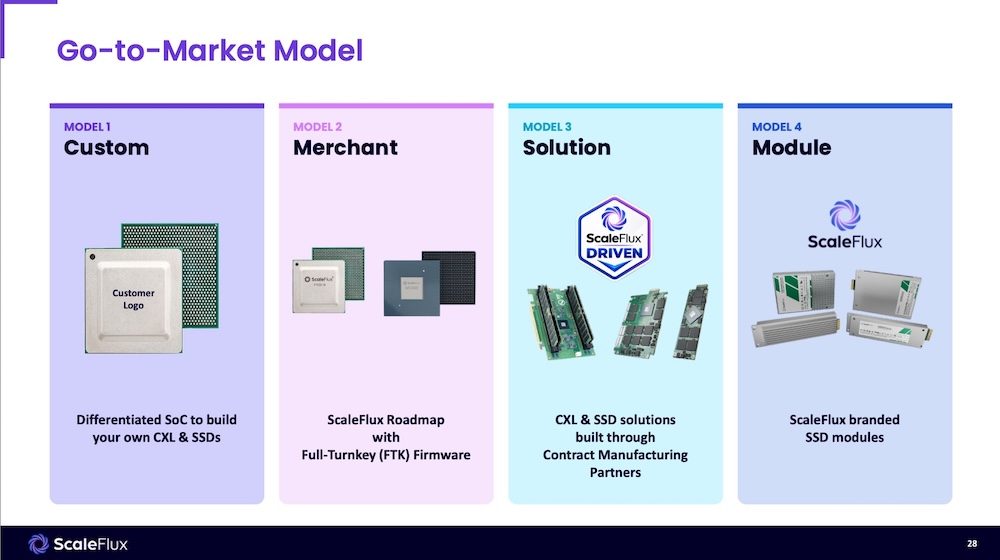
Its updated vision focuses on eliminating data movement bottlenecks between compute, memory and storage, addressing the growing memory wall affecting AI infrastructure.
ScaleFlux identifies three major industry challenges: GPUs waiting for data, increasing pressure on NAND and DRAM supply chains, and highly differentiated capacity and performance requirements across AI workloads.
These requirements range from high-bandwidth storage for compute nodes to large-capacity SSDs for training, inference, KV-cache management and enterprise data storage.
To address this fragmentation, ScaleFlux introduced a modular “Lego” approach, allowing customers to combine its controllers and firmware with NAND or DRAM components from different manufacturers. Customers can also select their preferred manufacturing partners and customize firmware according to application requirements.
This component-agnostic strategy aims to improve supply-chain flexibility, accelerate product development and reduce total cost of ownership.
Two product families illustrate this positioning.
- The FC6116 PCIe 6.0 NVMe controller represents ScaleFlux’s latest generation of enterprise SSD silicon. Supporting 16 NAND channels and capacities ranging from 512GB to 256TB, it delivers up to 28GB/s sequential reads, 25GB/s writes and 7 million random read IOPS, with approximately 9W power consumption. The controller supports advanced security features, including firmware attestation, OCP Caliptra 2.0 and post-quantum cryptography. Integration with Nvidia’s CMX context memory architecture and support for more than 200 Flexible Data Placement streams target emerging AI inference and KV-cache workloads. Its predecessor, the PCIe 5.0 FC5116, is already in production
- The MC600 CXL 3.2 memory controller addresses another critical AI infrastructure challenge: expanding effective memory capacity economically. Supporting PCIe 6.0, DDR4 and DDR5, it offers capacities up to 2TB, approximately 60ns latency and power consumption below 9W. ScaleFlux positions CXL as an intermediate memory tier between conventional DRAM and SSDs, enabling memory expansion, pooling and tiering. Transparent compression and DDR4 reuse further improve memory economics
The company’s go-to-market strategy emphasizes independence from memory manufacturers, flexible production models and collaboration across semiconductor, server and AI software ecosystems.
The broader market implication is significant. ScaleFlux is repositioning itself as an enabling silicon provider for next-generation AI infrastructure rather than simply an SSD manufacturer. By combining PCIe 6.0 storage controllers, CXL memory technologies and modular product development, the company aims to improve data movement efficiency, supply-chain resilience and infrastructure economics as AI workloads continue to reshape memory and storage architectures.
VergeIO
During its second participation this year, VergeIO presented significant corporate and product developments, reinforcing its ambition to capture market share in the rapidly evolving virtualization infrastructure market.
A major announcement was the appointment of Parag Patel as CEO, effective September 8, 2026, replacing Yan Ness, who joined the board. Patel brings extensive VMware experience, having previously led worldwide vSAN sales and expanded its customer base to approximately 25,000 organizations.
VergeIO also strengthened its board with former VMware executives Kit Colbert and Zia Yusuf, both investors, while appointing Rémi Bargoing as VP of EMEA Sales to accelerate international expansion.
These appointments reflect a significant market opportunity created by Broadcom’s VMware strategy. Patel estimates that approximately 300,000 VMware customers could seek alternatives as licensing costs rise and existing agreements expire.
Click to enlarge
VergeIO’s central differentiation is VergeOS, a unified infrastructure operating system integrating virtualization, storage, networking, backup and disaster recovery on standard x86 servers.
Unlike traditional infrastructure stacks assembled from separate products, VergeOS provides a single installation, upgrade process and management environment. Its compact architecture reportedly supports 25–30% more virtual machines per server.
Licensing is based on physical servers rather than processors, cores or storage capacity. VergeIO claims average savings of approximately 45% compared with VMware, with some deployments achieving substantially greater reductions. Topgolf, for example, reportedly reduced infrastructure costs by 96% while consolidating hardware across 110 locations.
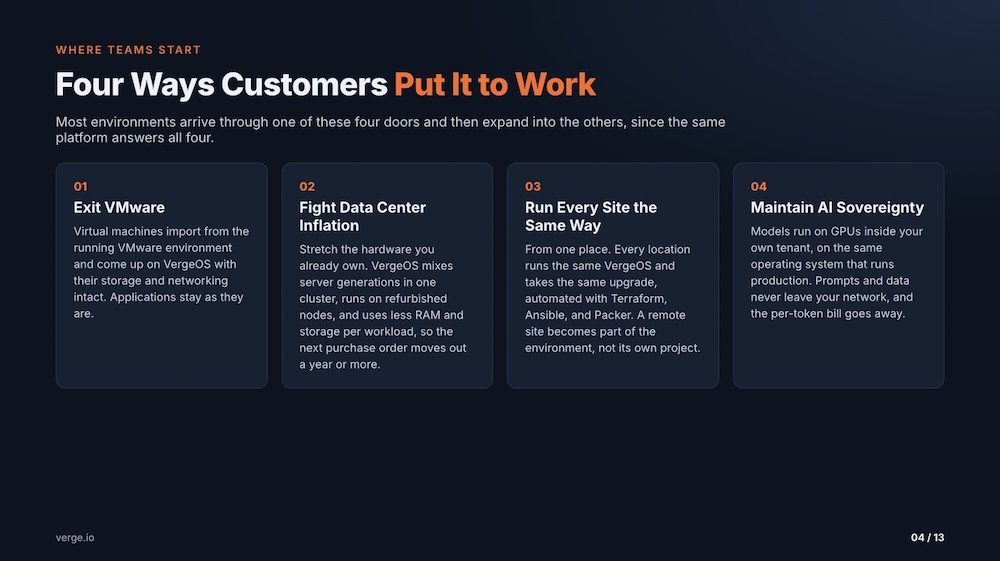
The company identifies four primary adoption scenarios.
- First, VMware migration enables organizations to progressively replace existing hypervisors while preserving virtual machine configurations and reusing hardware.
- Second, infrastructure cost optimization allows heterogeneous servers, including refurbished equipment, to operate within unified clusters. Dynamic storage tiering further reduces expenses by moving workloads between NVMe and HDD without service interruption.
- Third, distributed infrastructure management provides consistent deployment, upgrades and automation across headquarters, branches and remote locations.
- Fourth, sovereign AI infrastructure enables organizations to run private AI models on locally controlled GPUs, maintaining data confidentiality while avoiding external inference charges.
Several product enhancements reinforce this positioning.
VergeOS 26.2 improves VMware migration throughput by 120%, introduces shared-disk support for Windows Failover Clustering and enables simplified single-server deployments at remote sites.
Another important milestone is integration with Veeam Backup & Replication 13.1, providing incremental backups, granular application recovery and cross-platform restoration. Although replication, continuous data protection and Instant Recovery remain unsupported, the integration removes a significant obstacle for enterprise adoption.
The competitive environment remains intense, with Nutanix, Proxmox, Red Hat OpenShift Virtualization, Microsoft, HPE and Scale Computing pursuing VMware customers.
Nevertheless, VergeIO combines several attractive characteristics: unified infrastructure management, predictable server-based licensing, hardware independence and integrated data protection.
The broader market perspective is favorable. VMware’s changing commercial model has reopened a substantial virtualization market, creating opportunities for alternative platforms. VergeIO’s strengthened leadership, mature technology and expanding ecosystem position it as a credible contender, particularly for organizations seeking lower costs, operational simplicity and infrastructure sovereignty without replacing existing hardware.




 Subscribe to our free daily newsletter