







IT Press Tour 70: Hammerspace
Putting enterprise data to work for AI
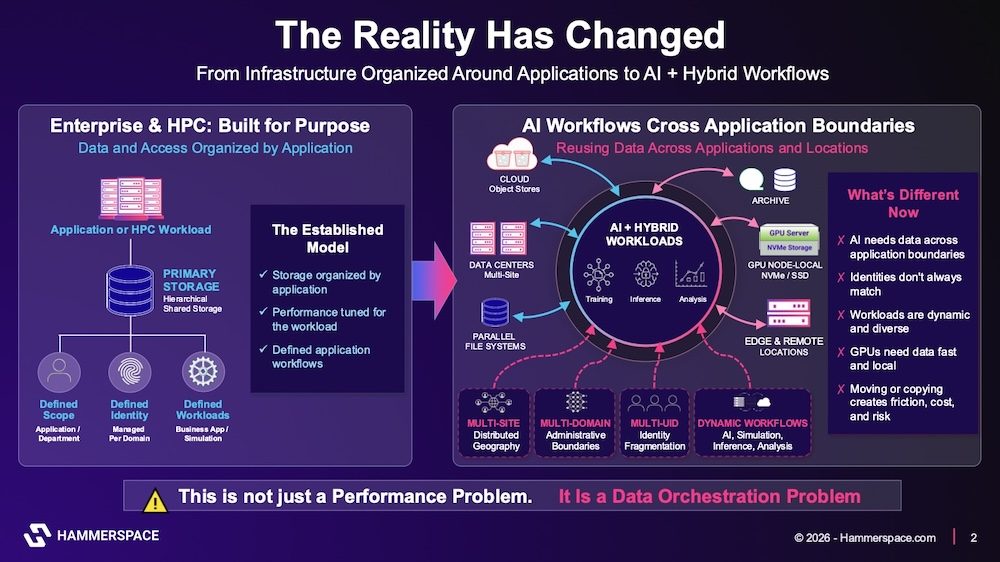
By Philippe Nicolas | October 15, 2026 at 2:00 pmHammerspace joined The IT Press Tour for the 7th times and we had the opportunity to get an company and solution update form Floyd Christofferson, VP, product marketing. We have to mention that we also met Primary Data, the previous entity, 4 times and Rozo Systems, 2 times. The session started with the famous statement “AI is limited by data, not only by compute”. Hammerspace’s starting point is that enterprise and HPC storage was organized around individual applications, each with its own scope, identity system and workload. AI breaks that model:
- AI needs data from across application boundaries and sites
- User identities don’t match from one system to another
- Workloads move to wherever GPUs are available
- Every copy or migration adds cost, delay and sovereignty risk
Click to enlarge
The consequences at scale are idle GPUs, wasted power and money, deployment delays, and sprawling copies that are hard to govern. The fix is usually a pile of point products: tiering, AI data staging, cloud gateways, migration tools and data protection. Hammerspace calls this “a data orchestration problem”, not a performance problem, but it seriously impacts costs, quality of services and objectives.
Christofferson cited a Berkshire Hathaway group CTO who estimated that about 70% of enterprise AI projects fail between proof of concept and production. The main reason is that companies cannot disrupt existing operations to get data ready.
Click to enlarge
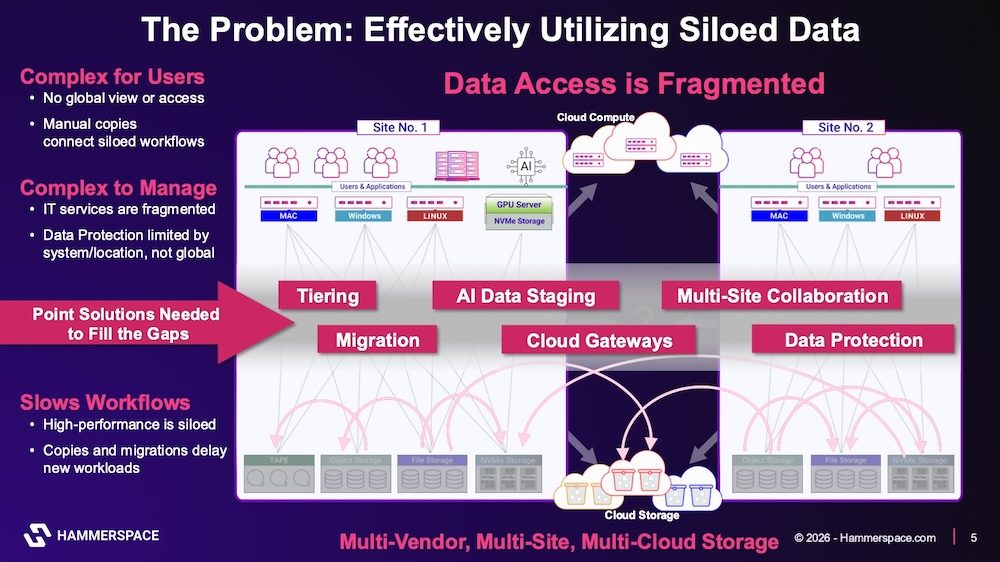
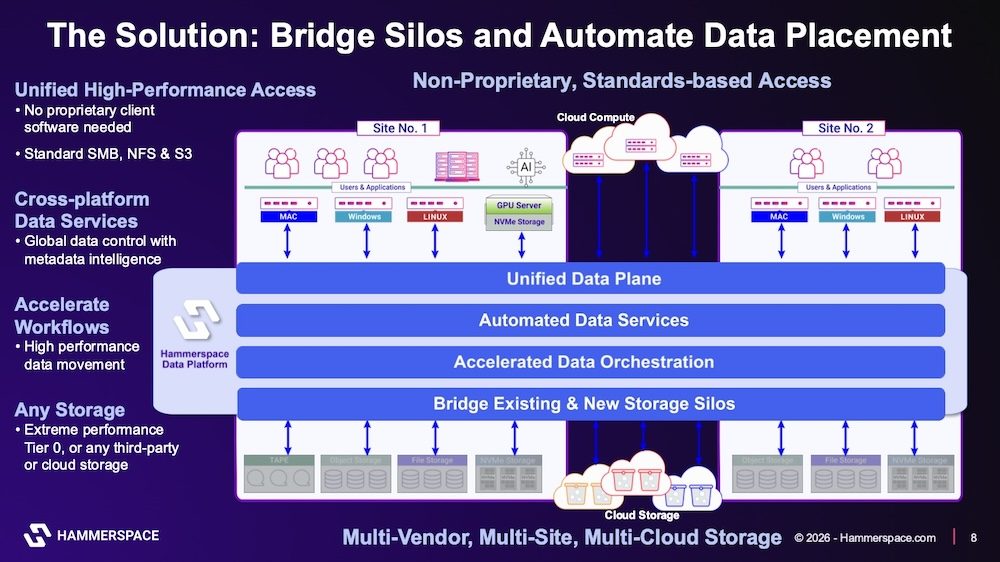
Addressing this silos and fragmented situation, Hammerspace promotes open standards.
Hammerspace has built its performance into the standard Linux kernel. Features include NFSv4.2, pNFS with Flex Files, LOCALIO and nconnect. Striped Flex Files and NFS Direct are new, and pNFS N-to-1 and client-side erasure coding are coming next, thanks to Rozo Systems intelligent client software. As a result, customers “never have to install proprietary client software” or change their existing storage servers. Christofferson put it this way: the client is “already installed in every data centre on the planet” and a migration is “changing a mount point”.
The platform has five building blocks:
- Discover and assimilate: existing data on any vendor’s storage is brought into the namespace where it sits
- Unified global namespace: one view across on-premises, cloud and edge, accessible over NFS, SMB and S3 at the same time with unified permissions
- Metadata and policy: “Objectives” act as a desired-state engine that controls where data is placed and how it is protected
- Continuous orchestration: data moves between Tier 0, Tier 1, object storage and archive without disruption
- Standards-based parallel file system: Anvil servers handle metadata and DSX nodes handle data services
S3 support covers multipart upload, tags, object lock and legal hold, multiple S3 servers, AD or local user mapping, and multi-site replication.
Click to enlarge
A nice innovation, Tier 0 to leverage stranded NVMe in GPU servers. A central theme is the NVMe inside GPU servers, which usually goes unused, isn’t shared and isn’t protected. The company turns it into a shared, protected Tier 0 within the global namespace. This reduces load on expensive Tier 1 storage and on the network.
Its comparisons claim that networked external storage is 2.4 to 10 times slower than Tier 0 on-premises, and 10 to 62 times slower in the cloud. For example, a 500 GB checkpoint takes 4.5 seconds on local NVMe against 11.1 seconds over a 400 Gb/s network. Christofferson added that “tiering is back,” which Hammerspace calls active data orchestration.
We also see several customer examples deployments examples:
- Vanderbilt University ACCRE: the campus HPC facility has 750 compute nodes including 80 GPU nodes, about 40PB of storage, and serves 2,750 researchers. Its 10 PB Hammerspace cluster combines Tier 0, 500TB of Tier 1 and petabytes of archive. Storage costs fell about 48%, and roughly 10 PB of stranded NVMe was put back to use
- Global communications technology company: a 2PB cluster on Oracle Cloud Infrastructure, with Tier 0 on 144 GPU nodes and tiering to OCI Object Storage
- Major hyperscale AI lab: about 30 PB planned across AWS clusters to replace FSx for Lustre, extended to the lab’s own data center. In the AWS pilot, checkpoints loaded 36% faster and large-file operations ran 3 times faster. Researchers prefer NFS mount points to S3
- European healthcare AI company: builds an oncology clinical assistant on Azure and Nebul and is growing from 128 to more than 1,000 GPUs. Hammerspace assimilates its existing NAS and tiers checkpoints between Tier 0 and object storage. The customer’s name will be unveiled at SC26 mid November
- Neocloud: a global namespace across three sites for an inference-as-a-service offering. Each site has two metadata servers and two DSX nodes, and data moves between sites through a shared object bucket
- US life sciences organization: 5PB on aging PowerScale arrays and 2PB on AWS Glacier, spread across 26 labs, were unified. Manual copying and 12-hour archive retrievals were eliminated, and older arrays got a second life as lower tiers
Regarding economics, 3 key metrics are important. Hammerspace frames its value around three clocks:
- Time to very first token. With silo-based approaches, getting data AI-ready can take 3–6 months of procurement, weeks of client deployment and a bulk migration. Hammerspace claims a more than 10x reduction because data is used in place
- Time to first token. Data is placed according to policy ahead of demand and read in parallel
- Time per token. The goal is to keep GPUs busy. Hammerspace contrasts an average of 18% GPU utilization today with 87% under orchestration. Its line: “The AI race won’t be won by the company with the most GPUs… but the fewest idle GPUs”
Click to enlarge
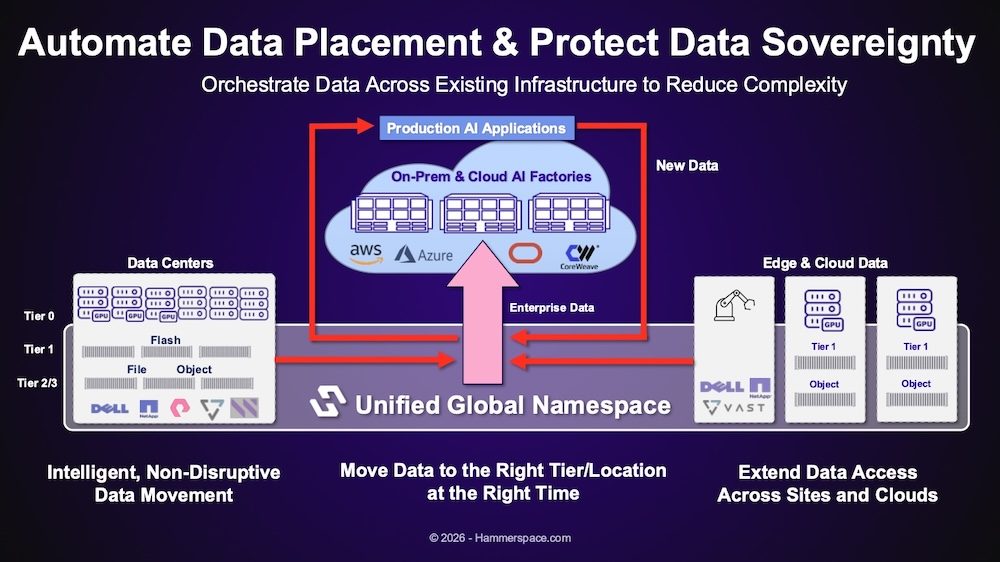
Hammerspace’s differentiation is being an open standard: pNFS in the Linux kernel and data assimilated in place, with no proprietary clients. That is a strong argument for enterprises that want to keep their existing storage. NetApp’s pending acquisition of peak:AIO and its Novus launch in September confirm that pNFS is gaining ground as an AI file protocol. Christofferson welcomed this as validation rather than competition.
Hammerspace still competes with Vast Data, WEKA and DDN for AI data performance, and with Dell, Pure and hyperscaler file services for enterprise budgets. Its main proof points are hyperscaler and AI-lab references, its OCI and AWS cloud deployments, and the Tier 0 economics while flash prices rise.
We anticipate some key news at SC26 mid-November in Chicago, IL.







 Subscribe to our free daily newsletter