








IT Press Tour 70: CTera
Closing the "AI value gap" at the data layer
By Philippe Nicolas | October 12, 2026 at 2:01 pmCTera joined The IT Press Tour for the 9th times and the team always reserves news for the tour. The session was given by co-founder and CEO Oded Nagel and co-founder and CTO Aron Brand. Nagel has been with the company since day one and became CEO almost four years ago, Liran Eshel, also co-founder, becoming chairman at that time. Today, CTera has about 200 employees. R&D headcount has stayed flat thanks to AI-driven productivity, while marketing and sales headcount have roughly tripled. Founded in 2008, the company has raised a total of $180M as of today according to Crunchbase.
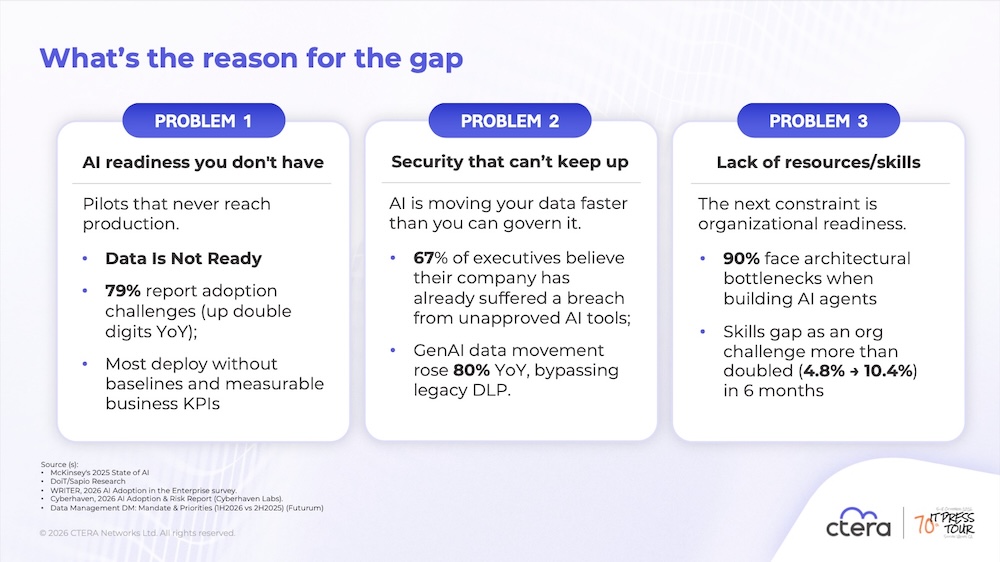
The session started with a market problem many users don’t really consider but some observers and players tried to tackle, including CTera. Nagel and Brand called it the “AI value Gap”: “everyone is buying AI, almost no one can prove it has paid off”. Nearly 90% of enterprises use AI, but most never get past pilots. Large banks, insurers, government agencies and healthcare providers struggle to measure ROI on heavy spending for GPUs, storage and tokens. CTera sees three causes:
- AI readiness. 79% of organizations report adoption challenges. CTera’s own survey found that only about 4% of enterprise file data is actively accessed. Sending a whole petabyte to AI is costly and slow, and it does not produce better answers
- Security. 67% of executives believe unapproved AI tools have already caused a breach at their company, and GenAI data movement rose 80% year on year, bypassing legacy DLP. AI must respect existing file permissions and data sovereignty
- Skills. 90% of organizations face architectural bottlenecks when building AI agents, and the skills gap more than doubled in six months
Click to enlarge
CTera’s conclusion is that “this is a data problem, not a model problem”. Enterprises should bring AI to their governed data instead of copying data out to AI services. Nagel predicted that, as happened with cyber storage, enterprise storage will soon need built-in AI capabilities, and that most data access will eventually come from AI agents.
On cyber storage, the team described backup as “defense”. CTera’s ransomware engine detects attacks by behavior and blocks them at the edge within seconds. With attacks moving toward exfiltration, InsightAI can reconstruct which files were accessed, which matters for GDPR disclosure. We should see further cyber storage announcements in the coming weeks.
Click to enlarge
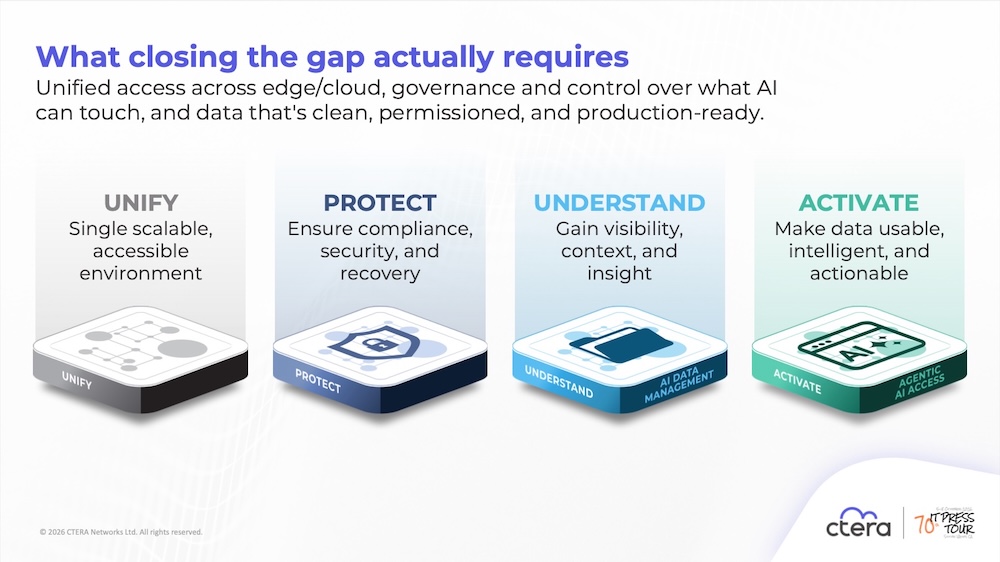
The team has updated its product message and positioning. CTera describes itself as unifying unstructured enterprise data into a secure data fabric that connects data to business outcomes. Its four pillars are Unify, Protect, Understand and Activate. According to presenters, until about two years ago CTera covered Unify and Protect: the global file system, multi-site collaboration, snapshots, versioning and cyber storage. The new layers are Understand (InsightAI) and Activate (Content Services). The speaker insisted that CTera is the only platform that delivers all four in a single pane of glass.
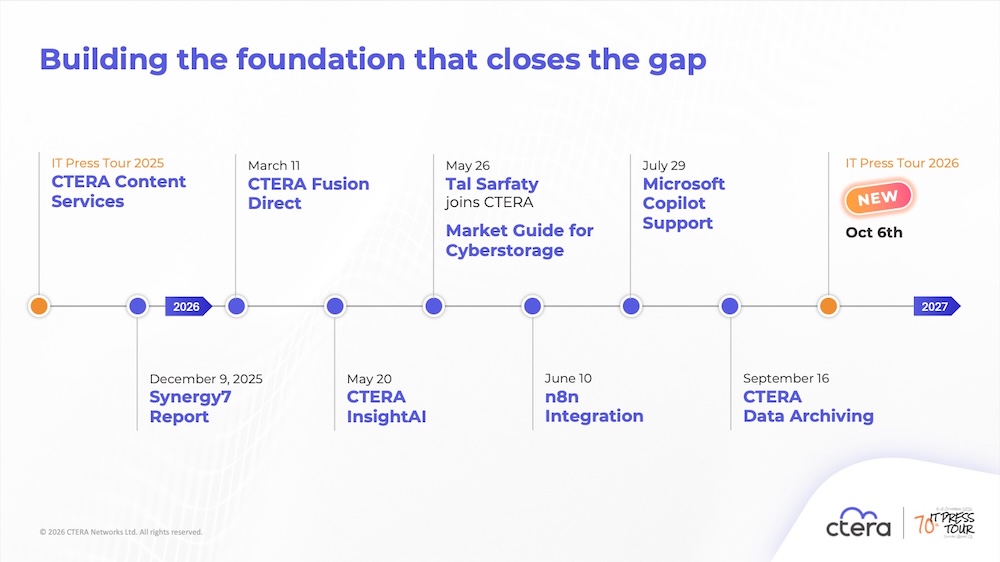
Milestones over the past year: Content Services; the Synergy7 ransomware validation report; Fusion Direct, which mounts existing S3 buckets into the global file system in both directions without migration; InsightAI; the Gartner Cyberstorage Market Guide; the n8n and Microsoft Copilot integrations; and Data Archiving. A reseller partnership with Cloudian targets high-performance AI workloads.
Click to enlarge
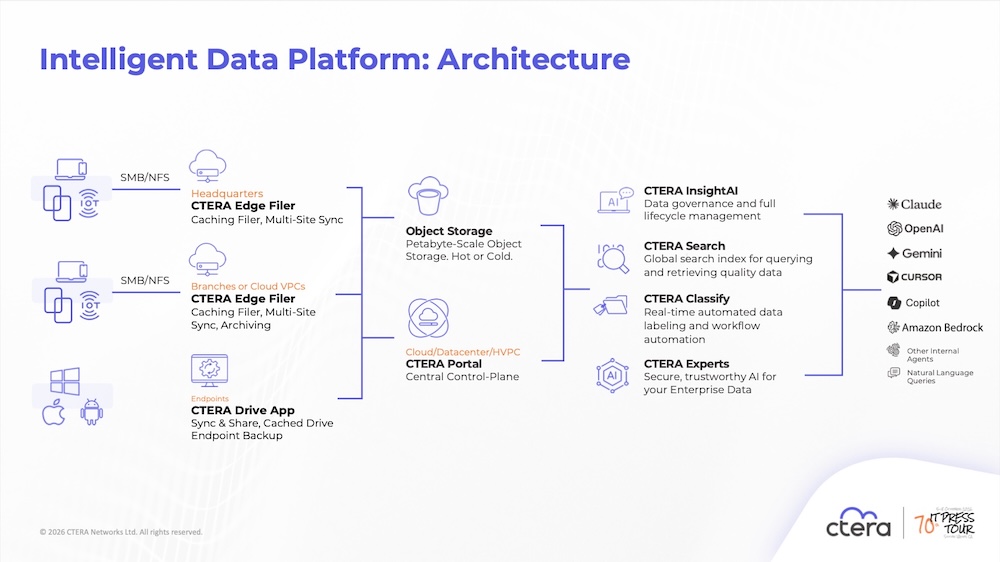
The architecture has the CTera Portal as central control plane, deployable on-premises, in a VPC or as SaaS. It sits on petabyte-scale object storage, hot or cold. Edge Filers handle caching, multi-site sync and archiving at headquarters, branches or cloud VPCs, and the CTera Drive app handles endpoints (sync and share, cached drive, endpoint backup). The AI services sit on top:
- CTera InsightAI: governance and lifecycle management from metadata
- CTera Search: a global index
- CTera Classify: real-time automated labeling and workflow automation
- CTera Experts: secure semantic search and RAG over enterprise data
These services are exposed to Microsoft Copilot, Claude, Gemini, Cursor and in-house agents through MCP and natural-language queries. Brand predicted that within a few years most data access will come from AI agents, not people, so file systems must be “AI-agent ready”.
Click to enlarge
During the session the CTera team detailed three customer cases:
- Metadata-first intelligence in manufacturing. The customer has more than 1 PB across four regions and 33 filers, with no visibility into growth, staleness or access. InsightAI analyzes metadata only (no file reads, no egress fees) and infers meaning from names, types and access patterns. For example, it can tell a music library, which is a risk, from call-center recordings, which are high-value. It provides growth analytics, archiving recommendations and fast forensic queries through chat, scheduled reports or MCP. It is read-only for now, with human-approved actions in development. Brand said it returns results in minutes, where one customer’s DSPM tool needs two months per classification pass
- Activating mortgage data. A lender has 27 TB on Azure Blob with edge filers in Minneapolis and Washington, DC. Content Services provides content-aware loan search, agents in Copilot Studio over MCP, and automated PII tagging, so the lender can build curated “data products” for default-prediction models. The stack uses PostgreSQL text search and Qdrant, runs privately, and works with any LLM. After the first ingest, it processes only changes, and its results respect file permissions. In a demo, call-center audio was turned into JSON artifacts written back next to each file. Claude Code then flagged high-churn-risk calls, cross-checked them against Salesforce and built a dashboard in about 10 minutes
- Medical-legal pipeline. For a small firm, CTera Classify turns handwritten medical scans into case narratives, using custom schemas and regression tests on every model change. A Forward Deployed Engineer delivered the project
CTera also unveiled its last announcement: CTera Forward Deployed Engineering. It is a service that places small CTera teams, each pairing a Forward Deployed Engineer with a Deployment Strategist, inside customer environments. Their job is to bring defined AI use cases into production on the customer’s own unstructured data. The four principles are: start from the data, prepare it so AI can use it safely, build it into existing workflows (MCP, n8n), and transfer ownership. The engagement is complete “when the customer can add the next use case without CTera”.
The phases are discovery, a first use case, scaling and handover. Engagements can be time-based or fixed-scope. Typical duration is about a month after a week of preparation, and large customers may ask for a permanent FDE. The team starts with about 10 people.
Brand called this a major shift for a vendor that has historically tried to minimize professional services. Nagel set it apart from Palantir’s model on one point: CTera owns the whole data stack as well as supplying the engineers. He also said the company is staying technology-led and will not build “an army” of consultants. Nagel saw no competitor offering the full stack. Brand closed by noting that most hallucinations come from poor data or forced answers, which is why curation matters.
The overall message is that CTera wants to be the trusted context layer for enterprise AI, and now also provides the engineers to get customers into production.







 Subscribe to our free daily newsletter