




Taiwan Tour 2026 Report
An interesting trip within the storage and associated technology ecosystem
By Philippe Nicolas | May 15, 2026 at 2:01 pm We had the opportunity to go to Taiwan a few days ago and spent time with several companies to better understand the ecosystem, the business climate, the technology dimension and obviously get a company and product update.
We met AIC, Apacer, Phison, Promise, QNAP, QSAN, Raidon and Silicon Motion at their respective HQ.
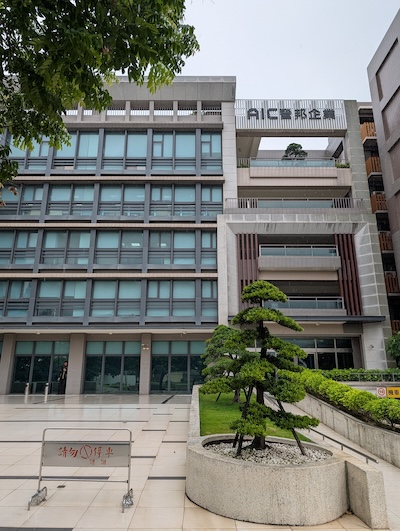
AIC
AIC is a Taiwanese industrial computer company founded 30 years ago, headquartered near Taipei with manufacturing facilities across Taiwan and a new factory near Hanoi, Vietnam. The company went public on the Taiwan stock exchange in 2013 and today employs roughly 900 people globally. AIC maintains offices and subsidiaries in Shanghai, Seoul, California, New Jersey, and the Netherlands, which serves as its European hub covering Germany and surrounding markets. The US remains AIC’s largest market, while EMEA and the broader Asia-Pacific region (including China, Japan, and Korea) account for around 8% of sales. Latin America is limited to occasional business in Brazil. Annual revenue stands at approximately $300 million.
AIC’s business is rooted in the IPC (industrial PC) market, and chassis manufacturing remains its foundational product line, representing about 50% of revenue. On top of that mechanical base, AIC integrates servers and storage controllers, making it a full-platform provider. The company addresses five vertical markets: cloud and data centers (roughly 30% of revenue), networking, security, media and entertainment, and AI/edge computing. AI and edge have grown rapidly and now rival cloud data centers in revenue contribution, approaching 30%, while networking and media/entertainment each represent less than 10%.
AIC operates under a dual model. It sells branded products through channel partners, but a significant portion of its business is ODM work for major storage and infrastructure vendors. The company manufactures systems that ship under other brands, including DDN, Exagrid, and VAST Data. These customers come to AIC with specifications or collaborate on new designs, and AIC’s engineering team handles mechanical design, electronic design, firmware, thermal engineering, system integration, and quality assurance, all in-house. About 25% of AIC’s workforce is dedicated to R&D, reflecting the company’s emphasis on design capability over pure manufacturing scale. AIC also manufactures its own PCBs and runs automated, robotic assembly lines with UL-certified paint rooms and facilities holding ISO 9000 and ISO 14000 certifications.
A key differentiator for AIC is its validated component list, called the AVL. The company pre-qualifies components from major partners including Intel, Nvidia, Broadcom, Phison, Micron, Solidigm, and others, so that when a customer like DDN needs to integrate specific SSDs or HBAs, AIC can confirm compatibility immediately. This reduces qualification cycles and accelerates time to market. AIC positions itself as open to validating as many components as possible, ensuring that potential customers never find their preferred component missing from the list.
On the ODM side, AIC requires a minimum order of roughly 1,000 units per year and charges an NRE (non-recurring engineering) fee for custom designs. Critically, AIC protects the intellectual property of its ODM customers permanently. If a company pays for a custom design, that design is exclusive to them forever, not just for a contractual period. AIC will never sell the same design to a competitor without the original customer’s explicit approval. This permanent IP protection is presented as a core principle of AIC’s business ethics and a reason customers trust the company with sensitive projects.
Competitors include Supermicro (which is roughly 80 times larger in revenue, largely driven by AI server demand), Gigabyte, ASUS, and MSI. AIC acknowledges the size disparity but positions itself as a design-first partner rather than a volume player. While AIC’s brand recognition is lower than Supermicro’s, its strength lies in custom engineering and the ability to deliver tailored solutions that ship under the customer’s own brand.
Apacer
Apacer Technology is a Taiwanese memory and storage module manufacturer founded in 1997, orginally linked with ACER, publicly listed on the Taiwan Stock Exchange since 2010 (8271.TW). The company reported $356 million in revenue for 2025, employs over 600 people, and operates six subsidiaries in the US, Netherlands, China, Japan, and India. Apacer also acquired smaller manufacturer UDInfo to handle smaller-scale customers and complementary business channels.
Apacer defines itself as a “memory module company” covering both SSD and DRAM across three segments: industrial (approximately 70% of revenue), consumer (around 29%), and emerging applications (about 1%, covering IoT and optical inspection). Roughly 98% of production ships under Apacer’s own brand. As a “module house,” the company sources controllers, NAND flash, and DRAM dies from upstream IC makers, then designs and assembles finished products with its own firmware. Key partners include Kioxia and Sandisk for NAND flash (currently mainstream on BiCS 5 with BiCS 8 in development), Micron, Samsung, and SK hynix for DRAM, and Silicon Motion, Phison, and Maxio for SSD controllers. Phison is also an Apacer shareholder. Main competitors include Transcend, ADATA, and Innodisk.
Apacer maintains a clear three-tier industrial product differentiation. Industrial-grade products require a fully fixed bill of materials throughout the product lifecycle. Professional-grade fixes only the controller while allowing flash IC substitution, offering a cost compromise. Consumer products have no fixed components. Rising component prices have pushed some industrial customers toward the professional tier.
The company’s R&D team of over 100 professionals holds more than 200 patents and develops proprietary firmware technologies central to its industrial value proposition. CoreSnapshot is a firmware-based backup and recovery system for remote or unmanned environments, reserving half the SSD’s capacity as a backup mirror. The upcoming CoreSnapshot 3 enables rolling daily backups instead of single-point recovery. CoreVolt stabilizes operating voltage during fluctuations using tantalum capacitors, addressing one of the most common field failures. CoreEnergy lets customers customize PCIe performance settings across 27 combinations to reduce power consumption and heat for thermally constrained devices.
For the Raspberry Pi ecosystem, Apacer created the PT25R-Pi HAT SSD, the first SSD integrating storage directly onto a Pi HAT extension board with industrial-grade features, offering 64GB to 512GB capacity on PCIe Gen3 x1 with 30-40% power savings.
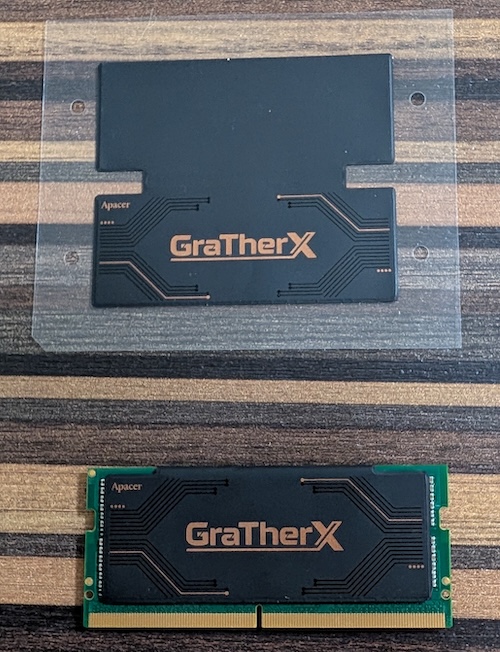
The most significant new product discussed was GraTherX, a patented thermal solution for DDR5 memory modules, that should be officially launched during the coming Computex show in Taiwan. Using a one-piece dual-side graphene-copper architecture at just 0.17mm thick, it reduced backside hotspot temperatures by 23.4°C in lab testing on a fanless edge AI system, narrowing the front-to-back temperature differential from 6.6°C to just 0.8°C. Apacer estimates a 20°C reduction can decrease failure rates by over 60% and approximately triple DRAM lifetime. The product targets IPC and edge computing applications and will be sold bundled with modules.
On ESG, Apacer ranks in the top 5% of TWSE corporate governance evaluations, holds CDP B score, RBA Silver Status, and claims the world’s first fully lead-free SSD.
Phison Electronics
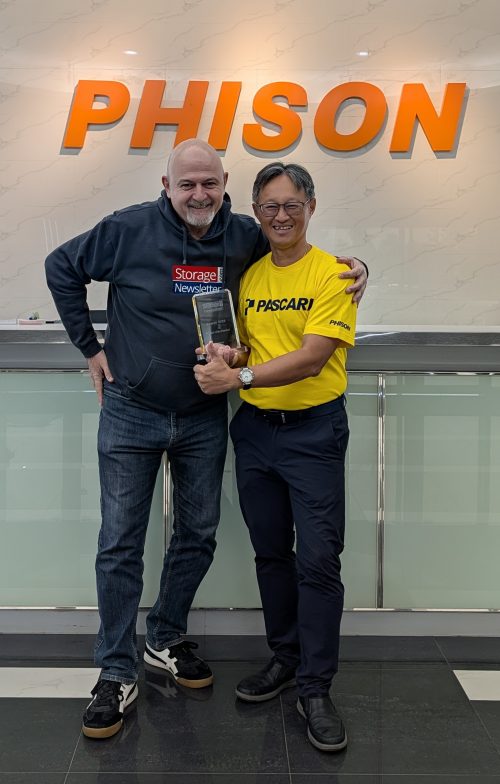
Phison Electronics is a Taiwanese semiconductor company specializing in NAND flash controller design and solid-state storage solutions. Founded by CEO KS Pua at age 26 with $1 million in capital, the company has grown into a publicly listed firm with approximately 4,100 employees, around 3,500 at its Hsinchu headquarters, 200 in a Taipei office, plus teams in Thailand and India. Phison reported roughly NT$40 billion in Q1 revenue, with strong quarter-over-quarter growth. Key shareholders include Kioxia (formerly Toshiba, holding approximately 9% since 2007), Kingston, and SK hynix, all brought in through private placements rather than bank debt.
Phison operates three distinct business models. The original and historical core is selling SSD controllers to third parties, NAND manufacturers and module houses who design their own drives. The second is Pascari, Phison’s own branded enterprise SSD product line launched approximately two years ago. The third is design services, where Phison uses its own controllers but designs complete drives to customer specifications, particularly for hyperscalers who prefer to outsource SSD development rather than invest in the engineering themselves. Controllers are fabricated by TSMC (for leading-edge enterprise products) and UMC (for legacy products), using 6-nanometer process technology for the latest enterprise controllersm a single tapeout costing around $20 million, with over 100 ASIC engineers and 60 firmware engineers required, plus $40 million in validation drives.
For NAND sourcing, Phison works with virtually every major manufacturer: Kioxia, SK hynix, Micron, Samsung, Sandisk, and YMTC. The company positions itself as a neutral common platform serving all NAND makers, which is central to its market value. In third-party SSD controllers, Phison is the clear market leader alongside Silicon Motion, with Maxio, FADU, and Realtek as smaller competitors. Major NAND makers like Samsung, Sandisk, and Solidigm use in-house controllers for enterprise products, though some may consider external options for future Gen6 designs.
Phison’s Pascari product portfolio is organized into five series: X (high performance), D (data center), S (standard), Boot drives, and AI. At Computex, the company planned to announce new products targeting high endurance, high IOPS, high density, high capacity, mor enew very soon now. All products are promised to ship samples within one month of announcement.
Additionally, Phison’s aiDAPTIV technology is clearly a strategic priority. Given the constraints on DRAM availability and pricing, this hybrid approach combining DRAM and NAND flash represents a pragmatic strategy to deliver affordable AI inference capabilities at the edge.
Phison also serves the industrial SSD market through partners like Apacer and Innodisk, who use Phison controllers but brand products under their own names. Approximately 100% of Micron’s client controllers come from Phison, and Kingston remains a top customer.
On market dynamics, KS Pua argued that AI inference, not just training, is driving unprecedented NAND demand, as every GPU and CPU server needs bundled SSD storage for KV-cache operations. He predicted NAND manufacturers will enjoy strong margins comparable to DRAM’s current ~80% gross margins, constrained primarily by equipment availability. Pua controversially suggested YMTC could become the number one NAND producer, leveraging Chinese-made semiconductor equipment that bypasses Western supply constraints created by US export controls.
Strategically, Pua outlined Phison’s global expansion through joint ventures and technology licensing rather than direct subsidiary operations, active JVs exist in China (approaching IPO), India, and Malaysia. Pua expressed strong interest in entering Europe, offering to license Phison’s complete storage technology stack and train local engineers, arguing that storage is a national security concern and that Europe risks losing its technology sovereignty without investment. He mentioned Phison has established a Pascari office in Europe and recruited key personnel, and wishes to actively partner with Europe Commission to advance this strategy.
Promise Technology
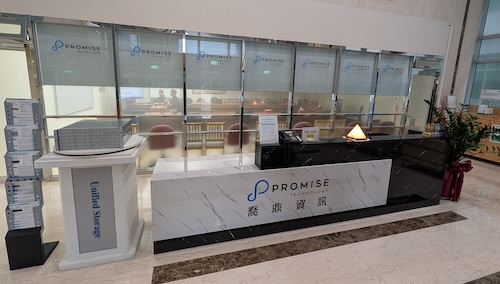
Promise Technology is a Taiwanese-American storage company founded in 1988 in Silicon Valley by engineers from National Semiconductor. Originally a storage chipset company, Promise captured roughly 80% market share for ATA RAID-on-board controllers by the late 1990s and went public in 2002. The company later acquired the Mylex team from IBM to build enterprise storage systems. A pivotal moment came when Apple needed Thunderbolt storage, Promise was the first to deliver, creating the Pegasus product line sold through Apple’s online store.
Today Promise employs approximately 200 people after significant restructuring. The company shed manufacturing operations and a large US software engineering team, deliberately dropping OEM business (formerly over 50% of revenue at sub-10% margins) to focus on branded products achieving approximately 45% margins. Promise now invests heavily in enterprise-grade global services including 24/7 support, on-site service, and local language support across multiple regions.
Promise focuses on three vertical markets. In media and entertainment, the Pegasus brand dominates Thunderbolt storage for Mac-based creative workflows. Promise claims no real competition in hardware RAID 5 Thunderbolt arrays, with unmatched GUI and plug-and-play experience for non-technical users. A new hybrid Pegasus product combines NVMe and HDD in a single Thunderbolt 5 chassis for active work and archiving respectively.
In enterprise video surveillance (1,000+ cameras), Promise competes against HP and Dell with its V-track storage and FACE server platform. The key differentiator is Smart Boost, a patented technology suite addressing the fundamental problem that surveillance data arrives randomly from hundreds of cameras, creating chaotic write patterns where mechanical seek and rotation consume 85% of drive time. Smart Boost’s surveillance-aware buffer reorganizes incoming data by platter location before writing, converting random I/O to sequential. For RAID 5, this dramatically reduces parity update penalties, a 16-drive system normally requiring 212 I/O operations per stripe update can eliminate most unnecessary reads. Practical benefits include equivalent performance on lower-specification hardware and significantly extended drive lifespan. Green Boost achieves 25% energy savings while maintaining uniform 35°C temperatures across all drive positions, validated by Toshiba.
The third focus is AI data center storage, under development for five years with Computex announcements planned. Promise’s proprietary RAID engine, developed over 30 years, remains its core asset, AMD licensed it in 2008 and still pays royalties. The engine supports RAID 0 through 60, with erasure coding acknowledged as a potential future direction for NVMe. Promise positions its enterprise RAID as more affordable than IBM or HP while maintaining equivalent reliability, and notably delivers only genuinely tested capabilities rather than marketing claims.
A recurring theme was the disconnect between Promise’s engineering excellence and market visibility. Pegasus is better known than the Promise brand itself. The founder’s engineering-first culture means exhaustive testing, where competitors test twice, Promise tests 200 times, but this perfectionism has limited commercial scale. As management candidly acknowledged, Promise remains an engineering company rather than a marketing company.
QNAP
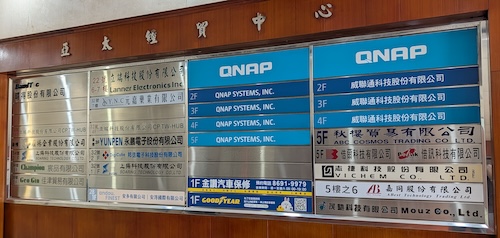
QNAP is a publicly traded Taiwanese company with approximately 1,000 employees, generating around $250 million in annual revenue. Headquartered in New Taipei City, QNAP designs, manufactures, and assembles all NAS products in Taiwan, distributing worldwide through major distributors like Ingram and TD Synnex. Europe is its largest market, followed by Asia Pacific and the Americas.
QNAP serves SMB and departmental markets but is actively expanding into enterprise territory. The product portfolio spans portable NAS units to rackmount systems, full-flash arrays, and dual-controller enterprise systems supporting up to 24 bays with 64TB NVMe drives, scaling to approximately five petabytes through expansion. The company supports Thunderbolt connectivity, 25GbE and 100GbE networking, and hybrid HDD/SSD tiering.
The QTS operating system runs on mainstream Linux with ZFS as the primary file system, a key advantage over competitor Synology, which uses Btrfs. ZFS provides built-in software RAID, snapshots, and replication without hardware RAID controllers. QNAP highlights its HA features as a differentiator, enabling real-time synchronization and automatic failover between NAS units. A notable new capability is VM high availability without separate shared storage: VMs run on QNAP NAS with ZFS snapshots synchronizing to a secondary unit for automatic failover, positioned as a free alternative to VMware-based HA, particularly appealing given VMware’s recent price increases.
The most significant development is QTS Mega, a Ceph-based scale-out clustered storage platform supporting 3 to 96 nodes. Running on Linux with Kubernetes orchestrating services, it provides automatic failover, file/block/object access methods, and erasure coding across nodes. Currently supporting SATA SSDs and HDDs with NVMe planned next, QTS Mega is already deployed at banks and hospitals in Asia Pacific and sold through direct engagement rather than general distribution.
QNAP is also investing in AI NAS models accommodating Nvidia GPUs (AMD and Intel planned), enabling local AI inference for companies wanting to run LLMs without cloud dependency. A dual-GPU model is planned for year-end. AI applications run in containers with GPU passthrough, and a future release will enable direct GPU-to-drive access bypassing the CPU. The system supports multiple open-source AI models including DeepSeek, with AI-powered cross-language document search, GPU-accelerated photo management, and surveillance analytics.
The primary competitor is Synology, with QNAP differentiating through ZFS, broader hardware flexibility (GPU support, Thunderbolt, multiple network speeds), QTS Mega scale-out, and integrated AI capabilities. The key challenge remains ensuring market awareness keeps pace with product innovation, as many observers still associate QNAP primarily with SMB file storage rather than its newer enterprise, AI, and scale-out capabilities.
QSAN
QSAN Technology is a Taiwanese enterprise storage company founded in 2004, employing approximately 85 people at its New Taipei City headquarters. Approaching $25–30 million in annual revenue and profitable, QSAN plans to go public on the Taiwan stock exchange later in 2026. The company began as a silicon company developing its own RAID stack and networking ICs, entered enterprise storage with dual-controller systems in 2009, and shifted from ODM work to over 80% own-brand sales since 2016.
Strategic investors include Gigabyte (financial investor since 2012), Acer (ecosystem partner since 2023 reselling QSAN alongside Acer servers across Asia Pacific and Eastern Europe), and ASUS (since 2025, rebranding QSAN products for global distribution). This provides channel reach without building a large sales organization.
The product portfolio runs on three software platforms: QSM for unified storage (file, block, object protocols), XEVO for dedicated block storage, and KSM for container/edge computing. All software is developed in-house on Linux with a proprietary file system called QFS, replacing their previous ZFS implementation. Hardware ranges from desktop units to rackmount NVMe all-flash and SAS hybrid dual-controller arrays. QSAN sells Phison-supplied NVMe SSDs under its own label, a critical advantage given current dual-port enterprise NVMe scarcity, enabling four-week delivery while competitors face six-month to one-year lead times. Everything is designed and manufactured in Taiwan including drives, advantageous for US government projects like a recent 20-petabyte Navy deployment with partner JetStor.
The 2026 roadmap features four major launches. QScale delivers horizontal scale-out with up to eight nodes sharing a unified namespace (file protocol now, block in 2027). QMetro provides metro cluster disaster recovery with bidirectional real-time synchronization and seamless failover. QSeal implements air-gapped immutable backup where the target initiates connections with rotating IPs to prevent cyber attackers from discovering backup infrastructure. XVault offers agentless VM backup for VMware environments targeting 100–300 VM deployments. QScale and QSeal ship at Computex; QMetro and XVault follow in Q3.
QSAN also supports NVidia GPUDirect Storage through an Altos partnership, achieving sub-100 microsecond latency (6.6x faster than TCP) for AI training and inference workloads.
The go-to-market is channel-only, two-tier distribution. Strongest markets are emerging economies, India, Southeast Asia, Kazakhstan, Eastern Europe, where over 90% of units are SAS hybrid systems for surveillance (300TB to 2PB). NVMe all-flash is growing around a 100TB sweet spot competing against NetApp and Dell. QSAN now targets US and Western European expansion, markets where it has been virtually absent. Current supply chain disruptions are paradoxically creating opportunities, as buyers needing storage expansions discover established vendors cannot deliver while QSAN maintains ready stock. The company holds less than 1% of the $33 billion enterprise storage market but sees the planned IPO as a pivotal moment to accelerate growth into developed markets.
Raidon Technology
RaidonTek is a Taiwanese storage hardware company founded in 2000, operating under two brands: RAIDON for internal RAID storage modules targeting industrial and enterprise markets, and STARDOM for external storage designed for creative professionals.
RAIDON’s core product is the “RAID box”, a compact internal RAID 1 mirroring module fitting standard drive bays, containing a hardware RAID controller IC remarked under RAIDON’s branding. These modules protect data in industrial PCs, automation systems, semiconductor equipment, healthcare, finance, and government installations, selling to system integrators at approximately $200 wholesale ($400+ at end-user level). The company claims virtually no global competition for this category outside Taiwan, with only Accordance/ARAID as a local competitor operating a different business model. RAIDON also produces HBA products and M.2 converters including NVMe to U.2 and PCIe NVMe to MCIO adapters.
The STARDOM brand serves creative professionals with the SOHORAID series (multi-bay hardware RAID with USB 3.2 Gen2 Type-C), SOHOTANK (JBOD-focused for transfer performance), iTank (single-bay), and NVMe products. Differentiators include premium aluminum design, LCD displays, shared tray systems for drive swapping, smart fan control, screwless installation, and plug-and-play operation. Management positions STARDOM as a boutique brand where build quality commands premium pricing, noting Taiwanese users expect ten-year product lifespans.
A significant challenge is the absence of suitable NVMe RAID controller ICs. Current NVMe products ship as JBOD only because available controllers support PCIe Gen 3 while drives run at Gen 5, creating an unacceptable bandwidth mismatch. Thunderbolt is similarly deprioritized, despite being a qualified Thunderbolt 3 ODM for Intel, RAIDON found Apple and Intel allocate identical storage bandwidth across Thunderbolt 3, 4, and 5, making newer versions unjustifiable at higher prices. The four-bay SATA SR4 series with hardware RAID 5 and USB Type-C remains the bestseller, claimed as the first RAID 5 SATA III external product on the market, serving creative teams who physically transport raw footage between locations.
Future plans include AI-focused storage for RAIDON and software/mobile expansion for STARDOM, including an iPhone app for USB-C data transfer already released as a market test. Five to ten new products are planned for 2026 spanning multi-bay, dual-bay, and NVMe categories, featuring tray-based hot-swap designs with OLED displays. The company acknowledges a visibility gap versus its technology depth and is considering the IT Press Tour Taiwan edition in January 2027 to boost international recognition.
Silicon Motion
Silicon Motion Technology (NASDAQ: SIMO) is a Taiwanese semiconductor company established in 2002 in Hsinchu, focused exclusively on NAND flash controller design. With over 2,000 employees, 4,500+ patents, and more than 10 billion controllers shipped, the company holds approximately 30% market share in client SSD and mobile storage controllers as the leading merchant supplier. The founder, formerly at Western Digital, remains CEO.
Silicon Motion is a pure-play controller designer, no NAND manufacturing or finished SSDs. It partners with every major NAND maker (Samsung, Kioxia, SK hynix, Micron, Sandisk, YMTC) as a neutral platform. The relationship is mutually dependent: NAND makers need the controllers, while Silicon Motion must support all vendors to maintain share. Controllers feature in-house SerDes IPs, AI-optimized firmware, and advanced error correction.
In client/edge SSDs (35%+ market share), three controllers are in production: the SM2508 flagship (PCIe Gen5, 8-channel, 14+ GB/s, 2.5M IOPS), SM2504XT mainstream (PCIe Gen5, 4-channel, 12+ GB/s with SCA support), and SM2268XT2 value tier (PCIe Gen4, 7.4 GB/s).
The enterprise MonTitan family covers multiple data center tiers: SM8366 compute SSD (PCIe Gen5 dual-port, 16-channel, up to 256TB, 3.5M IOPS), SM8308 (dual-port, 8-channel, 128TB), SM8388 nearline (single-port, 128TB), SM8008 boot drive (16TB), and legacy SM2271 SATA (16TB). All are in mass production, demonstrated at GTC with Computex launches planned. Samsung currently uses in-house controllers but may consider external options for Gen6 due to escalating development costs.
Embedded eMMC and UFS controllers are adopted by the top 10 Android phone OEMs, with UFS 3.1, UFS 2.2, and eMMC 5.1 models all shipping.
The Ferri family provides single-chip integrated storage (FerriSSD, Ferri-eMMC, Ferri-UFS) for industrial, telecom, and automotive markets, combining controller, firmware, and NAND from Samsung, Sandisk, and Kioxia. Customers include Canon, Siemens, Cisco, Fujitsu, Supermicro, Sony, Audi, and Mitsubishi across applications spanning automotive, servers, medical devices, surveillance, gaming, and factory automation. Ferri demand is growing as NAND shortages make integrated solutions attractive for simplified procurement.
The competitive landscape has Silicon Motion and Phison dominating the merchant controller market, with Maxio (Chinese) growing and FADU (Korean) as a niche player. Samsung, Sandisk, and Solidigm use in-house enterprise controllers. Huawei builds independently using SMIC foundries and YMTC NAND. Silicon Motion’s go-to-market focuses on “mind share”, promoting technology directly to end customers so they specify Silicon Motion-powered SSDs when ordering from module houses.
We hope to visit again soon this territory as we plan a special edition of The IT Press Tour in Taiwan scheduled in January 2027.








 Subscribe to our free daily newsletter