









FADU: Fiscal 1Q26 Financial Results
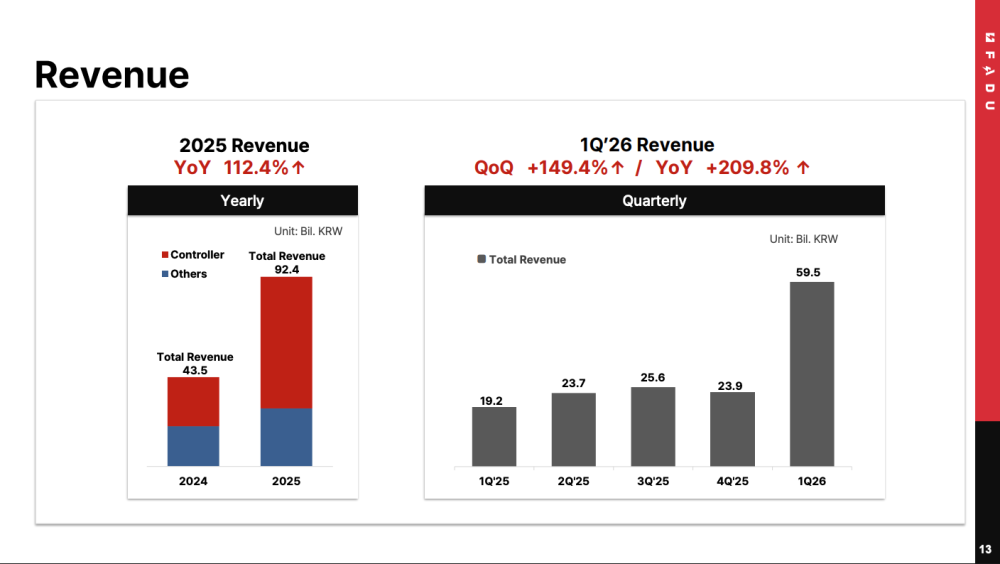
Generating KRW 59.5 billion, up 210% YoY and up 149% QoQ
This is a Press Release edited by StorageNewsletter.com on May 12, 2026 at 2:01 pmSummary:
- Revenue surged 210% YoY to KRW 59.5 billion from KRW 19.2 billion, driven by full-scale mass production for global hyperscalers
- Net income swung to profit, reaching KRW 10.2 billion in Q1 this year from a net loss of KRW 12.1 billion in Q1 last year
- New orders reached KRW 166.3 billion as of April (based on disclosures), with even steeper growth expected in second half of this year
Data center semiconductor company FADU announced through a preliminary earnings disclosure, that the company recorded Q1 revenue of KRW 59.5 billion and operating profit of KRW 7.7 billion, achieving a return to profitability. Following the semiconductor downturn in 2023, FADU has demonstrated its technological capabilities through next-generation products such as PCIe Gen5 solutions. As the company has been fully incorporated into the global hyperscaler ecosystem and steadily increased its market share, its revenue has grown roughly twofold each year – reaching KRW 43.5 billion in 2024 and KRW 92.4 billion in 2025.
In this first quarter, growth accelerated amid rising demand for AI data centers which drove a surge in demand for enterprise solid-state drives (eSSDs). As a result, the company achieved revenue of KRW 59.5 billion, marking an approximately 210% increase from KRW 19.2 billion in the same period last year.
In particular, as mass production of its core controller business for global hyperscalers has ramped up and orders have been increasing rapidly, the company expects even steeper growth toward the second half of the year starting from Q1. As of April, new orders based on disclosures reached KRW 166.3 billion, already surpassing last year’s total revenue of KRW 92.4 billion, with expectations for expansion in terms of orders and earnings in the second half.
Notably, FADU has continuously demonstrated its distinctive technological competitiveness in controllers and has been steadily increasing the share of its controller business in the company’s revenue. Since last year, the company has expanded its controller segment, which accounted for approximately 80% of total Q1 revenue this year, significantly improving its profitability structure. As a result, FADU has shifted from an operating loss of KRW 12 billion in Q1 last year to an operating profit of KRW 7.7 billion this year. Net income also reached KRW 10.2 billion from a net loss of KRW 12.1 billion in the same period last year.
FADU plans to make this year a “quantum leap” year where both revenue and profitability rise significantly and boost efforts for greater growth. The company seeks to diversify its customer base by targeting not only the U.S market but also markets in Asia while expanding its profit structure by developing new growth engines such as Power Management Integrated Circuits (PMICs).
The company is also strengthening its R&D capabilities. In March, FADU appointed Professor Jin-Soo Kim, a leading expert in computer architecture and system software from Seoul National University’s Department of Computer Science and Engineering, as Chief Research Officer and is seeking to develop next-generation storage systems. Beyond simply supplying SSD controllers, FADU aims to evolve into a comprehensive storage solutions company that designs and delivers end-to-end storage architecture optimized for AI workloads.
“The return to profitability is the result of our long-standing commitment to technology excellence and dedication being recognized by our customers,” added Ehyun Nam, CEO, FADU. “Now that we have firmly established ourselves within the global hyperscaler ecosystem, both revenue and profitability are expected to see marked growth. We sincerely thank our shareholders and customers who have trusted and supported FADU over the years. FADU will demonstrate an exemplary success case as Korea’s true leading fabless company.”
Click to enlarge
Comments
Q1 2026 revenue equals roughly $40 million. Full fiscal year 2025 has generated $62 million, so 65% of last year was already delivered in Q1.








 Subscribe to our free daily newsletter