



Sandisk: Fiscal 4Q26 and FY26 Financial Results
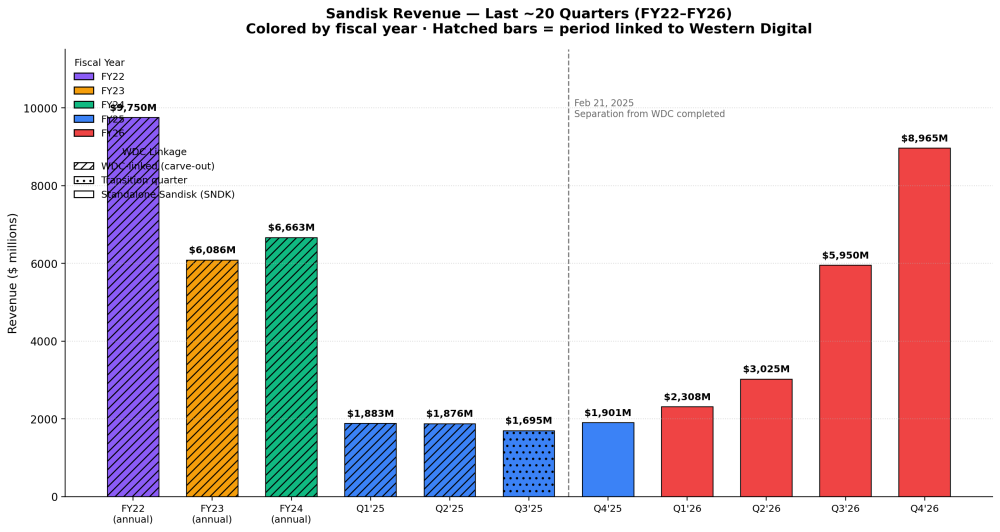
Generating $20.25 billion, up 175% YoY
This is a Press Release edited by StorageNewsletter.com on August 6, 2026 at 2:02 pmSummary:
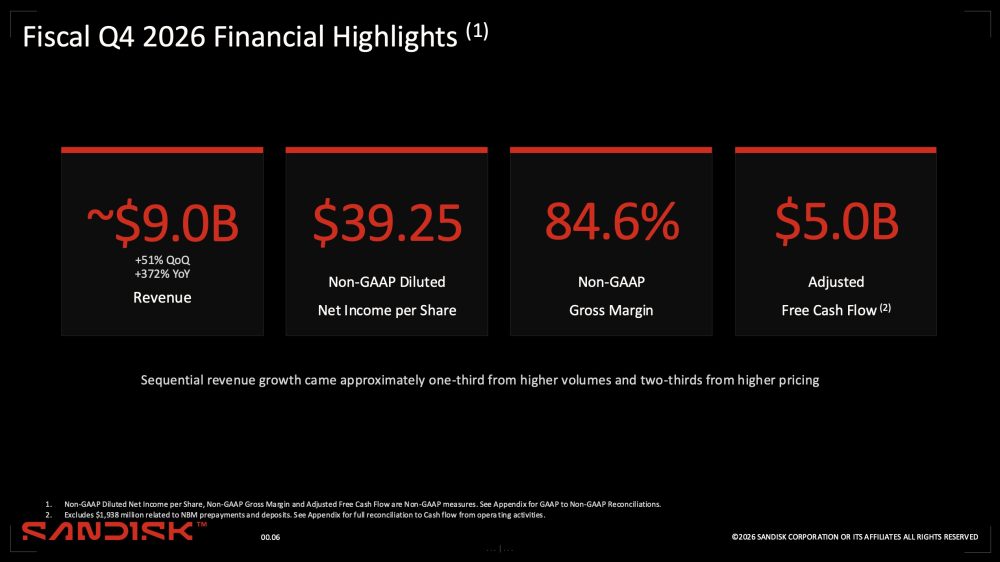
- Fiscal fourth quarter revenue was $8.97 billion, up 51% sequentially, with GAAP net income reported at $6.90 billion ($43.97 diluted net income per share). Sequential revenue growth came approximately one-third from higher volumes and two-thirds from higher pricing. Fourth quarter non-GAAP diluted net income per share was $39.25
- Fiscal year 2026 revenue was $20.25 billion, up 175% YoY, with GAAP net income reported at $11.43 billion ($73.76 diluted net income per share). Revenue outperformance was driven by both our mix shift toward higher-value customers, with Datacenter up 437%, and higher pricing. Fiscal year 2026 non-GAAP diluted net income per share was $70.88
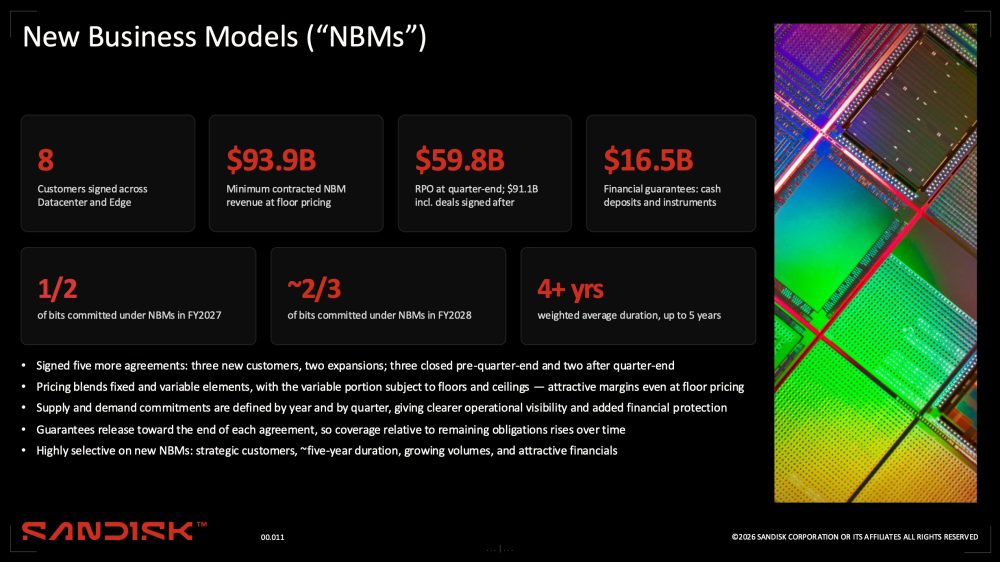
- Since announcing five New Business Model (“NBM”) agreements during our April earnings call, we have signed five additional agreements, including three NBMs with new customers and two deals expanding on previously signed NBMs
- Expanded our share repurchase authorization, with Sandisk’s board of directors approving an additional $14 billion buyback program, bringing total remaining authorization to $15.5 billion
- Expect first quarter 2027 revenue to be in the range of $10.30 billion to $10.80 billion, with expected Non-GAAP diluted net income per share to be in the range of $44.00 to $46.00
 “We closed fiscal 2026 with a leading technology portfolio, established datacenter as a key growth pillar, and deepened our customer partnerships,” said David Goeckeler, chairman and CEO, Sandisk. “Our technology and products are well positioned to create value for our customers and generate growing and durable free cash flow.”
Q4 2026 Financial Highlights
Click to enlarge
Fiscal Year 2026 Financial Highlights
Click to enlarge
Basis of Presentation
On February 21, 2025, Sandisk Corp. completed its separation from Western Digital Corporation (“WDC”) and became a standalone publicly traded company.
Sandisk’s financial and operating results after the separation are presented on a consolidated basis. For periods prior to the separation, Sandisk’s historical combined financial statements were prepared on a carve-out basis and were derived from WDC’s consolidated financial statements and accounting records and prepared as if Sandisk existed on a standalone basis. The financial statements for all periods presented, including the historical results of Sandisk prior to February 21, 2025, are now referred to as “Consolidated Financial Statements” and have been prepared in accordance with U.S. generally accepted accounting principles (“GAAP”).
1. Non-GAAP gross margin guidance excludes stock-based compensation expense, totaling approximately $5 million to $7 million. The Company’s Non-GAAP operating expenses guidance excludes stock-based compensation expense, totaling approximately $54 million to $74 million. Non-GAAP diluted net income per share guidance excludes these items totaling $59 million to $81 million. The timing and amount of these charges excluded from Non-GAAP gross margin, Non-GAAP operating expenses, and Non-GAAP diluted net income per share cannot be further allocated or quantified with certainty. Additionally, the timing and amount of certain other adjustments included in the Company’s Non-GAAP diluted net income per share guidance are dependent on the timing and determination of certain actions or events and cannot be reasonably predicted. Accordingly, full reconciliations of Non-GAAP gross margin, Non-GAAP operating expenses, and Non-GAAP diluted net income per share to the most directly comparable GAAP financial measures (gross margin, operating expenses, and diluted net income per share, respectively) are not available without unreasonable effort
2. Non-GAAP tax expense is determined based on a Non-GAAP pre-tax income or loss. Our estimated Non-GAAP tax expense may differ from our GAAP tax expense (i) due to differences in the tax treatment of items excluded from our Non-GAAP net income or loss; (ii) due to the fact that our GAAP income tax expense or benefit recorded in any interim period is based on an estimated forecasted GAAP tax expense for the full year, excluding loss jurisdictions; and (iii) because our GAAP taxes recorded in any interim period are dependent on the timing and determination of certain GAAP operating expenses
Comments
Sandisk closed fiscal 2026 with a blowout quarter that confirms the company has pivoted from being a legacy NAND/flash supplier still recovering from its 2025 spin-off out of Western Digital into a datacenter-anchored, AI-storage growth story. Q4 revenue reached $8.97 billion, up 51% sequentially and 372% YoY which is spectacular. For the full fiscal year, revenue was $20.25 billion, up 175% YoY, with adjusted free cash flow of $8.7 billion.
Several key strategic decisions and directions have been seriously made.
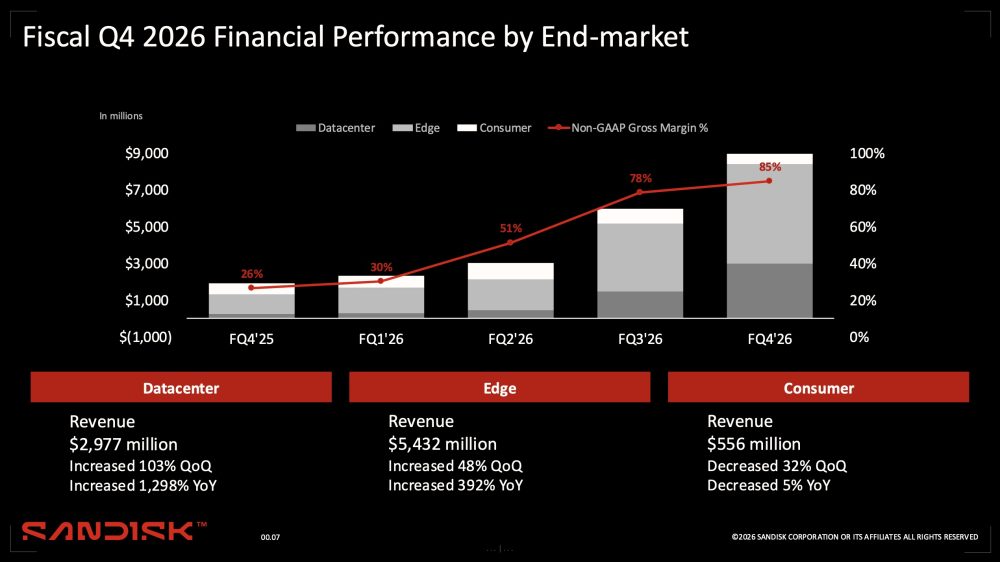
The 1st one is related to address the data center business. The headline structural shift is the collapse of Sandisk's historical PC/mobile/consumer center of gravity in favor of enterprise and AI infrastructure. Datacenter revenue grew 437% for the year to $5.15 billion and jumped 103% sequentially in Q4 to $2.98 billion, while its share of total bits shipped rose from 12% in Q4 FY25 to 38% in Q4 FY26. Management now expects Datacenter to represent roughly 50% of the total NAND TAM in calendar 2026, up from about 30% in CY25, and to keep outpacing the market into CY27. This is a deliberate mix-shift strategy: Sandisk is prioritizing high-capacity, compute-focused TLC enterprise SSDs sold into hyperscale and AI infrastructure customers, at the expense of lower-margin consumer/removable-media volume that historically defined the SanDisk brand. Edge, defined as PC, mobile, automotive, robotics, still grew a healthy 195% for the year on pricing and mix, but Consumer was essentially flat to down, up 29% for the year, but down 32% sequentially in Q4, reinforcing that growth capital and technology roadmap priority are flowing to Datacenter.
The 2nd is related to NBM, what the company named New Business Model with key agreements. Perhaps the most consequential strategic move disclosed this quarter is the expansion of Sandisk's NBM contracting framework: five new agreements signed since the April earnings call (three with new customers, two expansions), bringing the total to eight customers across Datacenter and Edge. This is a strategic response to NAND's historically brutal boom-bust pricing cycles: by trading some upside for guaranteed floor pricing and prepaid deposits, Sandisk is trying to convert a commodity, cyclical business into one with more contracted, annuity-like cash flow, a model closer to what memory/HBM suppliers have begun doing with AI customers, and a direct echo of the "long-term supply agreement" playbook now common across the broader memory industry (DRAM/HBM included).
The 3rd is associated with technology so elements such as BiCS8, Stargate QLC, and HBF. On the product side, Sandisk highlighted that BiCS8, its latest 3D NAND generation using CBA, CMOS-under-array bonding, and hybrid wafer bonding, now accounts for the majority of bit production, and that it began shipping its QLC "Stargate" platform for revenue this quarter, aimed at high-capacity AI data-lake use cases. The company also flagged continued investment in HBF, a nascent flash-based memory architecture positioned as a lower-cost complement to HBM for AI inference workloads that need large, fast-access storage rather than pure DRAM bandwidth, a technology bet that, if it matures, would let Sandisk participate more directly in the AI memory stack rather than remaining purely a storage-tier supplier. The FMS conference this week illustrated directions taken on HBF with acceleration on the specification side.
All flash, NAND and associated market segments plus vendors' results should be read against a NAND market that management says will more than triple to over $300 billion in CY2026 and reach an estimated $500 billion in CY2027, driven by AI inference and agentic AI data-storage needs, a demand narrative parallel to the DRAM/HBM supercycle that has lifted SK hynix, Samsung, and Micron.
Click to enlarge
We tried to build a revenue curve, not easy, as the split from WDC is pretty recent and flash/NAND/SSD business was not clearly given for each quarter.







 Subscribe to our free daily newsletter