







FMS 2026: New 3D Flash Memory Technology from Kioxia and Sandisk Achieves Industry’s Highest Bit Density for QLC NAND
10th-generation QLC 3D flash memory represents a major leap forward for AI storage architectures, cloud platforms, and data intensive innovations
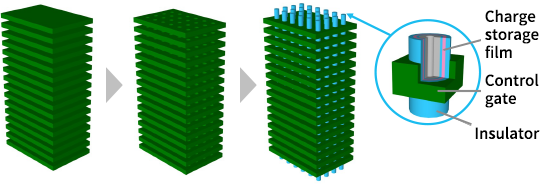
This is a Press Release edited by StorageNewsletter.com on August 5, 2026 at 2:01 pmKioxia Corp., a subsidiary of Kioxia Holdings Corporation and Sandisk Corp. unveiled their next-generation Quad-Level-Cell (QLC) 3D flash memory technology, which delivers up to 60% increase in bit density compared to their 8th-generation, surpassing 37 Gb/mm2 and setting the industry benchmark for bit density, performance and power efficiency. Leveraging the companies’ revolutionary CMOS directly Bonded to Array (CBA) technology which fabricates CMOS logic and the memory array on separate wafers before bonding them together with high-precision wafer-to-wafer alignment, the new generation improves read and write bandwidth compared to the 8th-gen 3D flash memory and becomes the industry’s first QLC 3D flash memory technology to reach a 4.8 Gb/s interface.
Additional interface enhancements improve I/O data-out transfer power efficiency. These large power efficiency upgrades directly address the power and cooling challenges of modern AI and cloud infrastructure.
“As AI continues to underpin the advancement of society, its applications are expanding from generative AI to agent-based and physical AI, while the use of data is becoming increasingly diverse and sophisticated. QLC technology enables the efficient storage of rapidly expanding data volumes, helping deliver greater performance and scalability for AI systems. Kioxia will accelerate development toward the commercialization of its 10th-gen flash memory products incorporating QLC technology,” said Hideshi Miyajima, CTO, Kioxia.
“As AI training, inference, and hyperscale datacenter workloads drive unprecedented growth in data generation, the storage industry faces increasing pressure to deliver greater capacity, higher performance, and improved energy efficiency. By redefining the performance and efficiency envelope of QLC NAND, our 10th-gen QLC 3D flash memory delivers simultaneous gains in density, bandwidth, and energy efficiency and establishes a new paradigm for high‑capacity flash storage to provide a scalable foundation for next‑gen infrastructure applications,” said Alper Ilkbahar, CTO, Sandisk.
Key 10th-generation QLC 3D flash memory technology highlights include:
- 332‑layer architecture and optimized floorplan design deliver up to 60% increase in bit density, achieving >37 Gb/mm² compared to the 8th-generation
- 4.8 Gb/s NAND interface enabled by Toggle DDR6.0 and the Separate Command Address (SCA) protocol to unlock the full potential of fast interface
- CMOS‑directly‑Bonded‑to‑Array (CBA) architecture enhances density scaling, performance, and manufacturing efficiency
- Power‑Isolated Low‑Tapped Termination (PI‑LTT) improves I/O data-out transfer power efficiency







 Subscribe to our free daily newsletter