









Huawei Connect 2026: Huawei Advances Agentic Computing on Multiple Dimensions for SuperPoDs and SuperClusters
Demonstrating new hyperscale dimensions with frontier clusters
This is a Press Release edited by StorageNewsletter.com on September 25, 2026 at 2:01 pmSummary:
- The Ascend open-source communities now offer partners and developers access to shared 10k-NPU-scale compute resources, accelerating innovation from development to deployment and fostering a thriving global AI ecosystem
During Huawei Connect 2026, Zhu Zhaosheng, chief strategy officer for computing, Huawei, delivered a keynote speech on the latest progress of the Kunpeng and Ascend ecosystems. Huawei proposed a new agentic computing development paradigm centered on SuperPoDs and SuperClusters and opened up access to 10k-NPU-scale compute resources for partners and developers, helping them innovate faster and build a global AI ecosystem together. “In the agentic AI era, agents operate at massive scale and execute complex, long-horizon tasks, leading to longer time to first token (TTFT), intense interconnect bandwidth demands, and rapidly growing memory footprints. Computing distribution and interconnect approaches are also changing rapidly. Building on UnifiedBus, Huawei proposed a new agentic computing development approach spanning five dimensions for SuperPoDs and SuperClusters: from single-server to SuperPoD development, from process to ThinkPro-based agent development, from SIMD to new homogeneous SIMD + SIMT development, from HiF8 to low-precision HiF4, and from manual operator programming to agent-based programming and tuning – addressing the transformation of the agentic era. “Our goal is to give developers an open foundation, the freedom to build on their own terms, and the space to innovate,” said Zhu Zhaosheng.
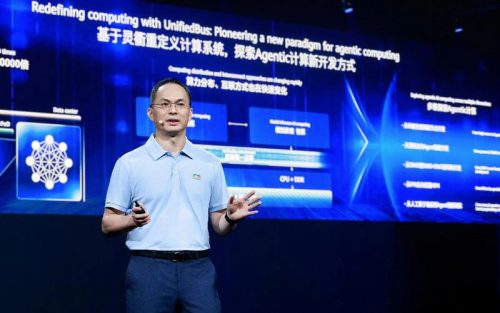
Zhu Zhaosheng, CSO for Computing, Huawei, delivers a keynote speech
SuperPoD development: Offering fine-grained, composable development APIs
As foundation models approach the 10-trillion-parameter scale, SuperPoDs become the natural choice for building ultra-large-scale AI infrastructure. For SuperPoD development, Huawei provides developers with fine-grained, composable development APIs. For discrete, high-frequency small-block compute and communication scenarios, the memory-semantic API, load/store synchronous access across physical nodes, reduces communication overhead across the SuperPoD. The message-semantic API, URMA asynchronous access, supports communication of continuous large data blocks.
Agent development: From processes to ThinkPro, with atomic-level APIs
Running an agent means continuously searching for the best possible solution to an open-ended goal. As agents become mainstream workloads, operating systems must evolve with them. openEuler introduced ThinkProcess (ThinkPro for short) as the atomic unit of agent thinking, execution, exploration, and evolution, providing atomic-level APIs – including user space and kernel space APIs – that abstract state management and hardware resources such as CPU and memory, enabling developers to invoke them flexibly as needed.
Operator development: Upgraded SIMD + SIMT programming with open PTO ISA
Ascend has now passed a key inflection point in its ecosystem development, with CANN emerging as one of China’s most active open-source communities. This year, Huawei upgraded Ascend C for the new Ascend 950 gen, adding SIMD + SIMT programming and Regbase programming to provide developers with a higher-performance, more flexible programming environment. Progress has also been made in opening up the PTO ISA, which now comprises more than 120 virtual instructions across eight categories, including basic operations, data movement, and communication. PTO ISA is a tile-based instruction set architecture that enables compatibility and operator source code portability across processor gens. It provides a comprehensive yet streamlined set of easy-to-use instructions and supports both Auto and Manual optimization modes, giving developers fine-grained control over underlying hardware resources to unlock their full performance.
Huawei has open-sourced end-to-end agent tools to accelerate the deployment of AI-native applications on Ascend, including CANNBot for operator gen, Model Agent for model adaptation, MindStudio Agent for precision tuning, and Solution Agent for industrial deployment.
For the community: Access to 10k-NPU-scale compute resources
The Ascend community now provides 10k-NPU computing resources. At this conference, Huawei officially launched the 100 NPU-Hour Program, providing every developer with a baseline allocation of compute resources for innovation in model training, inference, and other use cases. Huawei also announced an investment of CNY5 billion over the next three years to bring together universities, research institutions, industry partners, and developers to drive collaborative innovation and build a new computing ecosystem powered by open source and open systems.








 Subscribe to our free daily newsletter