








WD: Fiscal 4Q26 and FY26 Financial Results
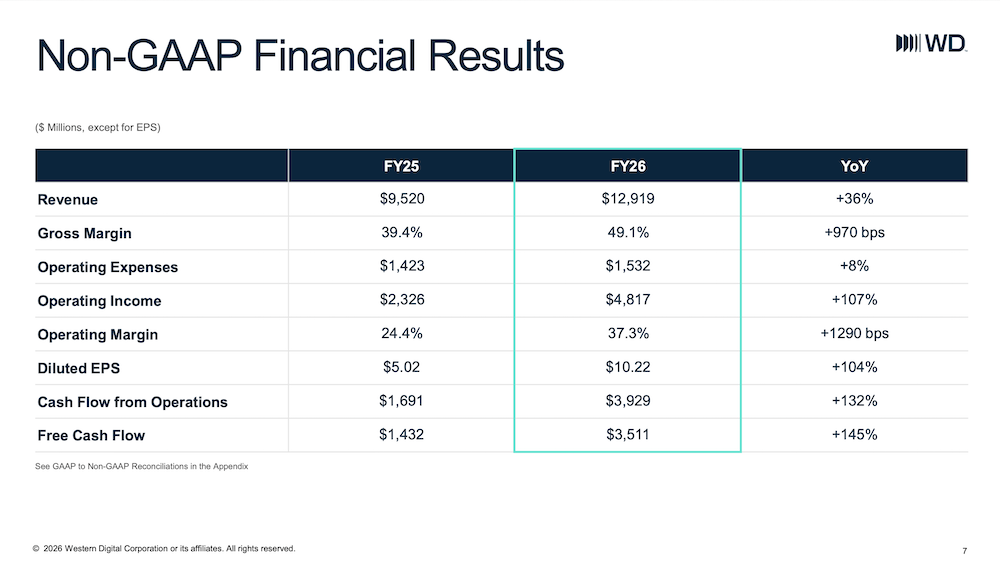
Generating $12.9 billion, up 36% YoY
This is a Press Release edited by StorageNewsletter.com on August 7, 2026 at 2:02 pmSummary:
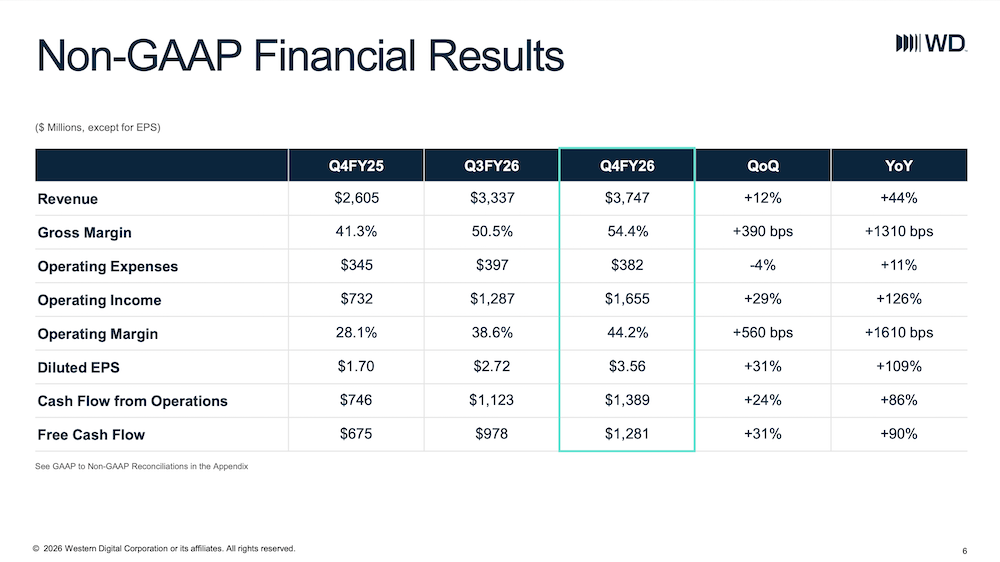
- Revenue of $3.75 billion, up 44% YoY
- GAAP gross margin of 54.1%; non-GAAP gross margin of 54.4%
- GAAP diluted EPS of $8.21; non-GAAP diluted EPS of $3.56
- Cash flow from operations of $1.39 billion; free cash flow of $1.28 billion
- Q1FY27 revenue expected to be up 42% to 49% YoY
Western Digital Corp. reported fiscal fourth quarter and fiscal year 2026 financial results for the period ended July 3, 2026. “WD concluded fiscal year 2026 with strong performance. In our fiscal fourth quarter, revenue increased 44% year over year, gross and operating margins expanded, and earnings per share more than doubled. These results reflect our ability to scale innovation and operational excellence across our global organization, supporting our customers’ growing storage demand,” said Irving Tan, CEO, WD. “As global data creation continues to accelerate, we enter fiscal year 2027 with continued confidence in the durability of demand and with increasing visibility into our business. With our scale, technology leadership, and operational discipline, WD is well positioned to capitalize on the secular data growth opportunity and deliver long-term shareholder value.”
Q4FY26 Financial Highlights
Click to enlarge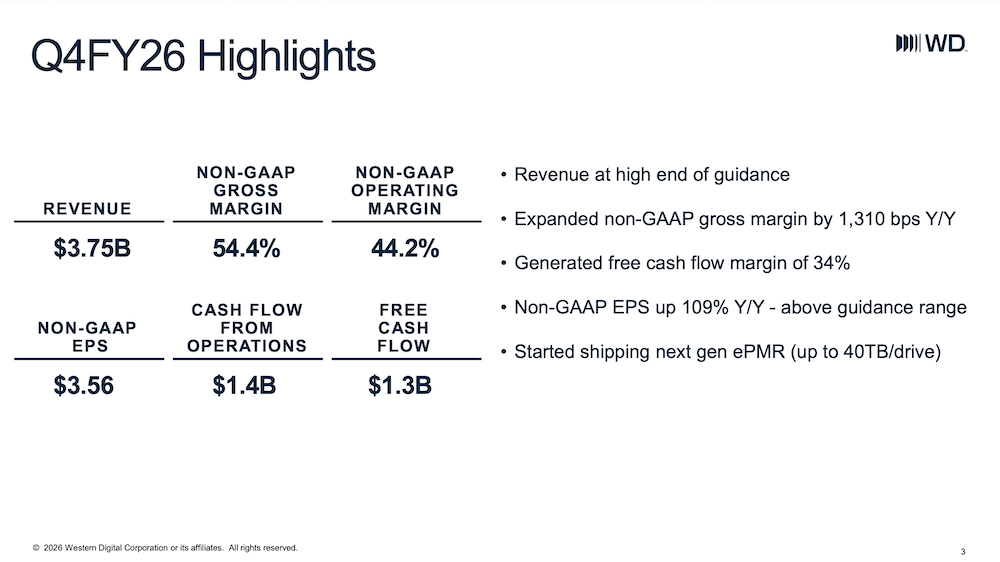
Click to enlarge
Business Outlook for Fiscal First Quarter of 2027
“Fiscal 2026 was an outstanding year for WD, characterized by broadening demand, deeper customer engagement, and disciplined execution across all end markets. As the cloud and other data-intensive workloads continue to expand, we remain confident in the long-term growth trajectory of our business, further margin expansion, and strong free cash flow generation,” said Kris Sennesael, CFO of WD. “For our fiscal first quarter of 2027, at the midpoint of the ranges provided in the table below, we expect revenue of $4.1 billion, non-GAAP gross margin of 55.5%, and non-GAAP EPS of $4.00.”
Dividend
WD’s Board of Directors declared a cash dividend of $0.15 per share of the company’s common stock, which will be paid on September 17, 2026 to stockholders of record as of the close of business on September 8, 2026.
Click to enlarge
Comments
WD closed fiscal 2026 as a pure-play hard disk drive company, delivering its strongest results since the 2025 separation of its flash business into Sandisk. Q4 FY26 revenue reached $3.75 billion, up 44% YoY and 12% sequentially, while full-year revenue climbed to $12.92 billion, representing 36% YoY growth. Guidance for Q1 FY27 points to further acceleration, with revenue expected to reach approximately $4.1 billion, up 42% to 49% YoY.
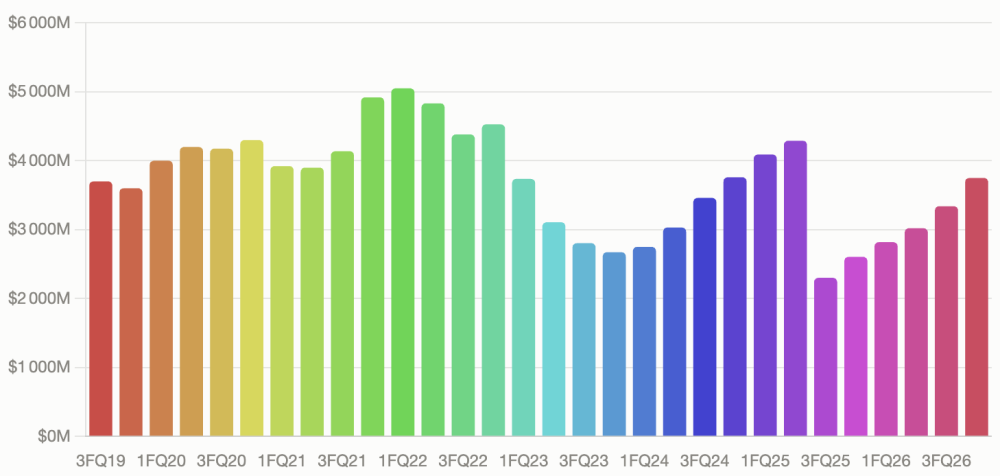
The revenue curve below, covering the last 30 quarters, perfectly illustrates the multiple lives of the company. WD strongly believed for years that combining its historical HDD business with Sandisk's flash operations would create a storage giant with a broad technology portfolio. Interestingly, the latest annual figures highlight the respective scale of the two businesses following the separation: Sandisk reported $20.25 billion in annual revenue, compared with $12.92 billion for WD. Of course, market conditions have changed dramatically, with AI reshuffling demand, technology priorities, capacity requirements and pricing across the entire storage industry.
Click to enlarge
Now, in summer 2026, following the publication of the latest annual results, the decision to separate the two businesses appears increasingly justified. From management's perspective, the split can be viewed as the right strategic move in terms of technology direction, investment priorities, particularly around the Kioxia joint venture, and overall product positioning. WD also received $2.05 billion from Sandisk in Q4 through its equity interest in the flash vendor, bringing the full-year amount to $6.5 billion.
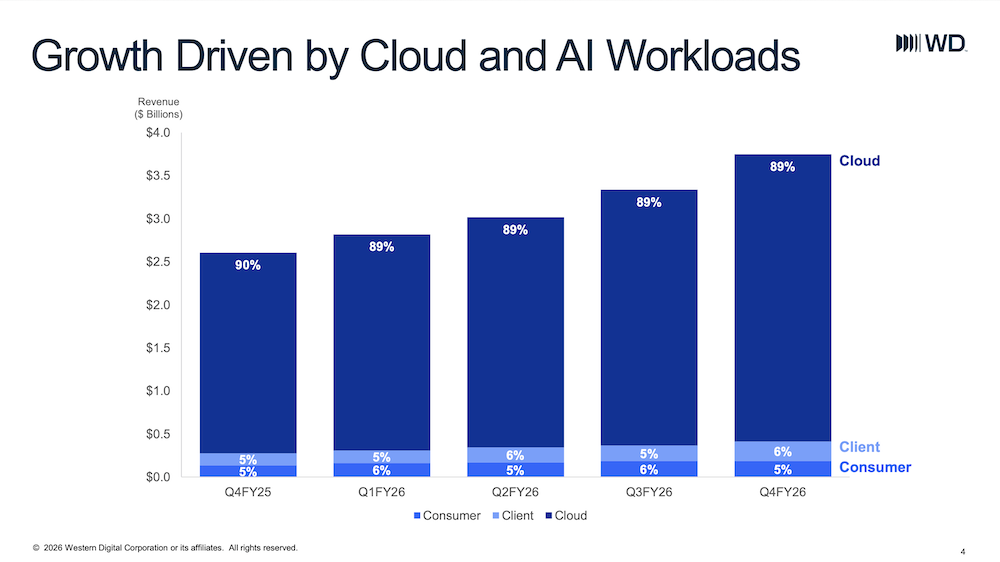
Looking at the product revenue mix, WD now generates almost 90% of its revenue from the cloud segment, while client and consumer products each represent only around 5% to 6%. This concentration confirms how deeply WD, like the other two major HDD manufacturers, depends on hyperscalers and, ultimately, on a relatively small number of very large customers.
Click to enlarge
On the technology side, WD continues to push ePMR toward the 40TB capacity level while preparing for a progressive transition to HAMR. The company also maintains a strong position in SMR, an increasingly important technology for maximizing capacity in hyperscale environments. In terms of HDD market share, WD currently represents approximately 42% of the market, followed closely by Seagate at 41% and Toshiba at 17%.
The HDD market itself has changed profoundly. Nearline drives, once considered a relatively small and specialized segment, have become the industry's primary engine and now account for approximately 60% of unit shipments. This transformation reflects the massive storage requirements of hyperscalers and AI infrastructure, giving HDD technology a renewed strategic role at a time when the industry once expected flash to progressively dominate the storage landscape.







 Subscribe to our free daily newsletter