






South Korea Memory Vendors Samsung and SK hynix Signed Major Deals
Clearly one of the red ocean segment of the industry
This is a Press Release edited by StorageNewsletter.com on August 3, 2026 at 2:00 pmThe single biggest catalyst was South Korean President Lee Jae Myung’s visit to San Francisco, where Samsung and SK Hynix locked in AI chip supply through 2030 via roughly $950 billion in US deals, at a time when HBM capacity from all three major suppliers, SK Hynix, Samsung, and Micron, was fully sold out through 2026. By catalyst, we essentially mean that it reflects a coordinated national South Korea effort, involving every level of the ecosystem, from industry and technology to government and politics.
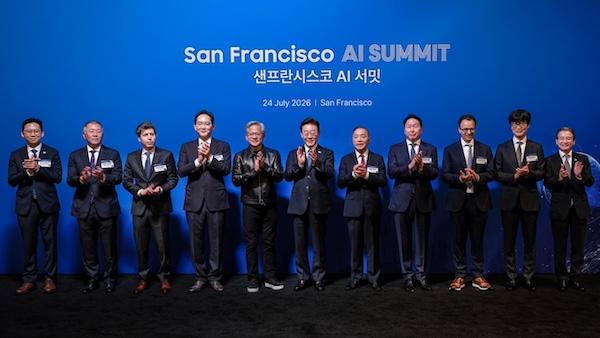
We identify a few key moments that emerged from the summit:
- Samsung–Broadcom: A long-term, multi-dimensional commitment from Broadcom represents a significant validation of Samsung’s HBM4 roadmap and the maturity of its 2-nanometer process node, notable since Samsung lost ground to SK Hynix during the HBM3E generation, with SK Hynix holding roughly 56% of the global HBM market by revenue as of early 2026 versus a substantially smaller Samsung share. Korean press pegs Samsung’s turnkey 2nm/advanced-packaging contract (foundry + memory) at roughly $200 billion, with mass production expected at its Pyeongtaek campus
- SK Group–Nvidia: SK Group and Nvidia announced a $500-billion-plus comprehensive partnership spanning AI factory construction and next-generation memory supply, including an SK Telecom-built 2-gigawatt AI factory powered by Nvidia’s Vera Rubin DSX platform and SK Hynix’s HBM4 memory, with the first facility expected online in 2027. SK hynix separately extended HBM4 supply agreements to Microsoft and others under new five-year contracts
- Nvidia–Naver: Nvidia separately announced a $1 billion investment in Naver to expand GPU supplies for a $10 billion global AI factory, with Brookfield providing up to an additional $9 billion
It also confirms some previous commitments and collaborations:
- October 2025: Samsung and SK Hynix signed a letter of intent with OpenAI for eventual supply of 900,000 DRAM wafers/month to meet Stargate’s memory demands; Samsung was separately in “close discussion” to supply next-gen HBM4 to Nvidia and committed to purchasing 50,000 Nvidia GPUs for an internal AI factory
- Capacity expansion: Samsung targeted a ~50% HBM capacity increase by end-2026, while SK Hynix planned to increase infrastructure investment more than four-fold versus previous guidance; both are building new fabs (Samsung’s P5 in Pyeongtaek online by 2028, SK Hynix’s M15X by mid-2027), against a backdrop the industry describes as a capacity crunch some forecast could last up to two years
- May 2026: SK Hynix reportedly fielded unprecedented proposals from global tech firms offering to directly fund new production lines and equipment
- June 2026: SK Hynix signed a multi-year technology partnership with Nvidia on next-gen AI memory for data centers and supercomputing; Samsung’s total semiconductor capex commitment through 2026 reportedly reached roughly $73 billion (100 trillion won), one of the largest single-company chip investment plans ever announced
All these mega deals change the “classic” rationale pricing cycle and profile:
- Historically DRAM/NAND have been brutally cyclical commodity businesses. The scale and duration of these commitments, supply locked through 2030, capacity sold out through 2026, five-year contracts, multi-hundred-billion-dollar figures, suggest hyperscalers are trying to buy certainty in a genuinely undersupplied market, not just placing routine purchase orders. That’s a meaningfully different demand signal than prior up-cycles
- HBM is now the strategic battleground, and Samsung is trying to close a real gap. SK Hynix’s ~56% HBM revenue share reflects a real technology and yield lead built over the HBM3E generation. The Broadcom deal and Samsung’s capex surge are best read as validation attempts, proof points that Samsung’s HBM4 and 2nm process are catching up, not confirmation that it already has. Whether Samsung actually closes the gap during HBM4 qualification cycles (particularly with Nvidia) is the single most consequential open question for the memory competitive landscape through 2027
- Geopolitics and industrial policy are now inseparable from the commercial story. The timing, deals announced during a state visit, with explicit “strategic investment partnership” and MOU framing alongside pure supply contracts, signals Korea is using its memory dominance (Samsung + SK Hynix ≈ 80% of global HBM) as a diplomatic and strategic asset with Washington, not purely a commercial relationship. That has implications for how durable these commitments are if trade or export-control conditions shift
- Concentration risk is rising on both sides. A handful of buyers (Nvidia, Microsoft, OpenAI, Broadcom) are now responsible for locking up the overwhelming majority of leading-edge memory supply for years out, while a handful of suppliers (effectively three companies) control that supply. This mutual concentration cuts both ways: it gives Samsung/SK Hynix pricing power in the near term (as the DRAM price-hike talk suggests), but it also means any AI capex slowdown at the hyperscaler level would hit memory revenue disproportionately hard, given how much future capacity is now pre-committed to a small buyer set
- Read-through to storage (HDD/SSD). The same underlying dynamic driving Seagate’s record FY26, AI inference and training data pipelines outrunning available capacity, is now visible in memory with even more dramatic pricing and lock-in effects, given HBM’s technical scarcity. Expect continued upward pressure on commodity DRAM/NAND pricing as capacity gets diverted toward HBM, a dynamic worth watching for anyone modeling storage-adjacent component costs into 2027
Read also :
Share this news :







 Subscribe to our free daily newsletter