








SK hynix: Fiscal 1Q26 Financial Results
Revenue at ₩52.5763 trillion, up 60% QoQ and up 198% YoY
This is a Press Release edited by StorageNewsletter.com on April 29, 2026 at 2:01 pmSummary:
- Reports revenues of 52.5763 trillion won, operating profit of 37.6103 trillion won, net profit of 40.3459 trillion won
- Record-high quarterly performance driven by increased sales of high value-added products from strong AI demand
- By launching advanced products, the company will try to address growing market demand in the looming agentic AI era
- Company to secure both stable supply and robust financial conditions through investment aligned with demand
SK hynix Inc. announced that it has recorded 52.5763 trillion won in revenues, 37.6103 trillion won in operating profit (with an operating margin of 72%), and 40.3459 trillion won in net profit (with a net margin of 77%) in the first quarter. Revenue surpassed 50 trillion won for the first time on a quarterly basis, while operating profit and operating margin reached record highs at 37.6 trillion won and 72%, respectively1. Operating profit has nearly doubled compared to the previous quarter, clearly demonstrating an improving profitability.
Click to enlarge
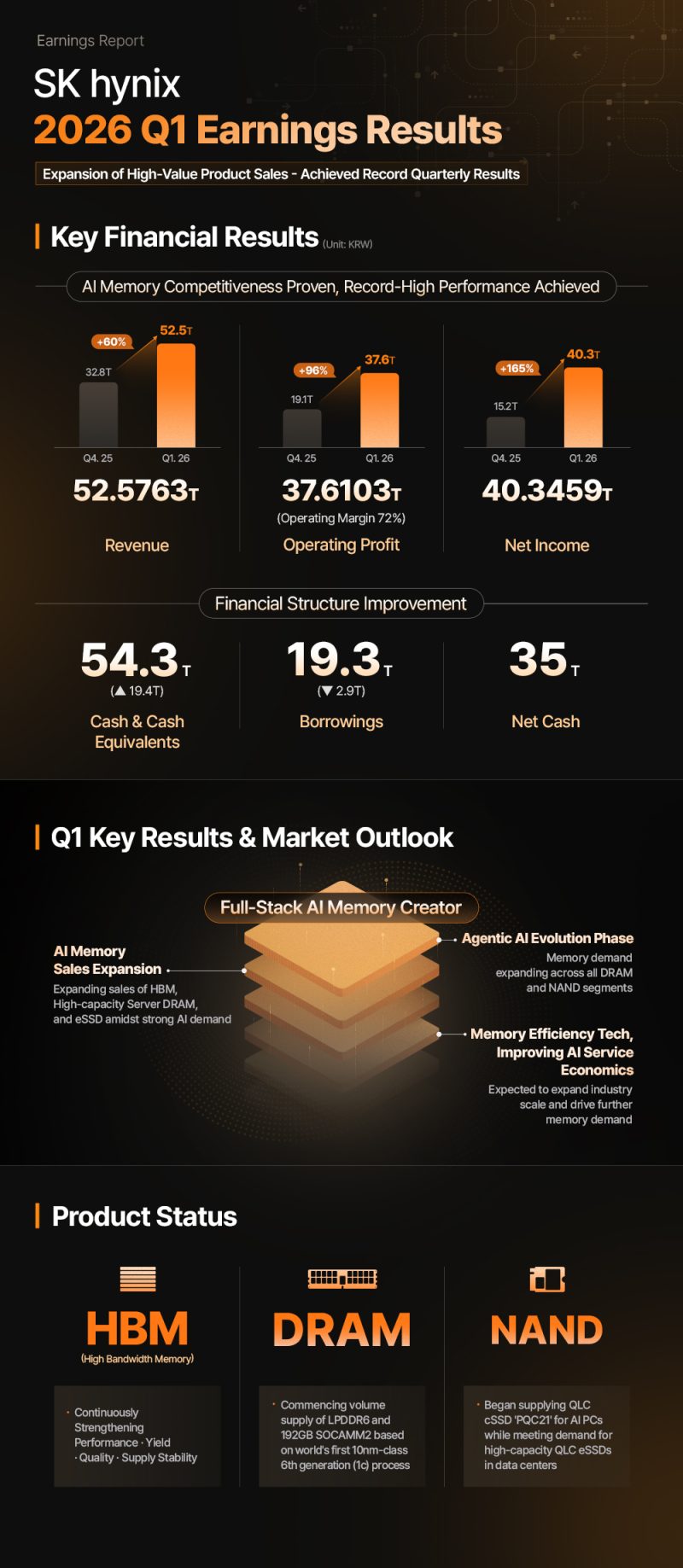
SK hynix noted that despite the fact that first quarter is typically a seasonal downturn, strong demand persisted due to expanded investments in AI infrastructure. The company sustained its upward performance trend by increasing sales of high-value-added products, including HBM, high-capacity server DRAM modules, and eSSDs.
Building on this strong performance, the company’s cash and cash equivalents at the end of the first quarter increased by 19.4 trillion won from the previous quarter, reaching 54.3 trillion won. Meanwhile, interest bearing debt stood at 19.3 trillion won down 2.9 trillion won from the previous quarter, enabling the company to reach a net cash position of 35 trillion won.
The company analyzed that as AI evolves from large model training to the stage of agentic AI, which repeatedly performs real-time inference across various service environments, the foundation for memory demand is expanding across both DRAM and NAND flash.
SK hynix also predicted that the spread of memory efficiency technologies will enhance the economic viability of AI services, leading to an expansion of the overall service scale and further drive memory demand. Based on this, the company forecasted that favorable pricing conditions will continue for both DRAM and NAND flash. To meet this demand, the company, plans to continue rolling out new products across both DRAM and NAND flash to address the diversifying memory demand.
Regarding HBM, the company will further strengthen its capabilities, encompassing performance, yield, quality, and supply stability. In DRAM, the company will fully ramp up the shipment of LPDDR6, which applied 1cnm process, or the sixth-gen of the 10-nm technology, for the world’s first time, and the 192GB SOCAMM2, which is based on the same process and began mass production this month.
For NAND flash, the company will flexibly address AI demand with CTF2 based 321-layer QLC3 cSSD ‘PQC21’, and eSSD lineup of high-performance TLC and high-capacity QLC. Especially, by leveraging synergies with Solidigm, which holds strengths in high-capacity QLC eSSDs, the company plans to strengthen its competitiveness in the AI data center and AI PC storage markets.
Meanwhile, SK hynix emphasized that within the environment where customer demand exceeds supply capacity, securing stable supply capability to meet the structural demand growth of the AI era has emerged as a key competitive advantage.
Accordingly, the company explained that this year’s investment scale will increase compared to the previous year, focusing on the ramp-up of M15X, infrastructure preparation on the Yongin cluster, and securing key equipment such as EUV.
The company highlighted that it will secure both stable supply and robust financial conditions through investment aligned with demand and will strategically expand production bases to proactively respond to long-term demand growth.
1 4Q2025 Revenue: 32.8267 trillion won / 4Q2025 Operating Profit: 19.1696 trillion won
2 Charge Trap Flash (CTF): Unlike floating gate, which stores electric charges in conductors, CTF stores electric charges in insulators, which eliminates interference between cells, improving read and write performance while reducing cell area per unit compared to floating gate technology.
3 Quad-level cell (QLC): NAND flash is categorized as single-level cell (SLC), multi-level cell (MLC), triple-level cell (TLC), QLC, and penta-level cell (PLC) depending on how many data bits can be stored in one cell. As the amount of information storage increases, more data can be stored in the same volume
Comments
SK hynix opened 2026 with a performance that rewrote its own record books. The company reported Q1 2026 revenue of ₩52.5763 trillion, operating profit of ₩37.6103 trillion at a 72% margin, and net profit of ₩40.3459 trillion at a 77% net margin, every metric an all-time quarterly high. Revenue crossed the ₩50 trillion threshold for the first time in company history. What made this especially striking was the seasonal context: Q1 is traditionally the weakest quarter for memory chip demand. AI infrastructure investment overrode those headwinds entirely, with high-value products, HBM, high-capacity server DRAM modules, and enterprise SSDs, sustaining the upward momentum.
Q4 2025 had itself been a record quarter. Revenue rose 34% quarter-on-quarter to ₩32.8267 trillion, operating profit surged 68% to ₩19.1696 trillion, and the operating margin hit 58%. Q1 2026 then surpassed all of it decisively, revenue up another 60%, operating profit up 96%, and net profit up 165% from ₩15.25 trillion to ₩40.35 trillion. The operating margin expanded from 58% to 72% in a single quarter.
FY2025 was the strongest full year in SK hynix's history, revenue of ₩97.1467 trillion (up 47% year-on-year), operating profit of ₩47.2063 trillion (up 101%), and net profit of ₩42.9479 trillion (up 117%). Yet Q1 2026 alone generated more operating profit (₩37.6 trillion) than the entire FY2024 (₩23.5 trillion), and nearly matched FY2025's full-year operating profit total in just three months. At Q1 2026's run-rate, annualized 2026 revenue would exceed ₩200 trillion, more than double FY2025.
The underlying force is AI, and specifically its evolution. In FY2025, HBM was the primary engine, with HBM revenue more than doubling year-on-year. Server DRAM and enterprise SSDs strengthened in the second half, and NAND posted its highest-ever annual revenue despite a slow start to the year.
By Q1 2026, a new dynamic amplified demand further: the shift from AI training to agentic AI. Unlike batch training workloads, agentic AI performs continuous real-time inference across many service environments, making it far more memory-intensive per cycle. SK hynix sees this as a structural expansion of the demand base, moving beyond a handful of hyperscalers to a much broader universe of AI deployments, and expects favorable pricing to persist across both DRAM and NAND.







 Subscribe to our free daily newsletter