







Back to The CXMT IPO
A spectacular trajectory
This is a Press Release edited by StorageNewsletter.com on August 3, 2026 at 2:01 pmWe published recently several articles (1, 2 and 3) about CXMT (ChangXin Memory Technologies), founded in 2016 being an integrated DRAM manufacturer, its large deal with Tencent and some about the prepared IPO.
Now the IPO is done in a crazy market pricing pressure, it’s worth to come back on the impact of it, the size and role of CXMT in the industry.
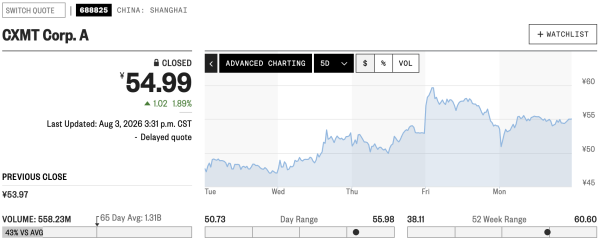
CXMT started to be listed on Shanghai’s STAR Market on July 27, 2026, in what became the largest A-share IPO of 2026, raising RMB57.92 billion (roughly $8.6 billion) at a price of RMB8.66 per share, with around 6.69 billion shares issued. That made it the second-largest Star Market fundraising since the exchange’s 2019 launch, trailing only SMIC’s RMB53.2 billion listing in 2020.
The level of demand was extraordinary, highlighting just how critical memory has become in the AI era. Retail investors oversubscribed the offering by 212 times, while only 6.73% of the company’s shares were freely tradable at the time of listing. On its market debut, the stock opened at RMB49.5, soaring 471.6% above the IPO price, and within roughly an hour trading volume had exceeded RMB90 billion, setting a new single-day record for an individual A-share stock. Most of the IPO proceeds will be used to expand memory wafer production capacity.
The market reality, however, remains more nuanced. In 2025, CXMT accounted for only about 8% of the global DRAM market, while Samsung, SK hynix, and Micron together controlled close to 90%. Nevertheless, as the world’s fourth-largest DRAM supplier and China’s leading memory manufacturer, CXMT symbolizes the country’s determination to build an independent semiconductor ecosystem, strengthen its domestic capabilities, and significantly expand its global market share. This ambition is already becoming tangible, with several major IT and technology vendors confirming that they are evaluating or qualifying CXMT memory modules. It also suggests that CXMT is well positioned to dominate the Chinese memory market in the coming years.
The current market environment presents a significant opportunity for DRAM and NAND suppliers. Samsung, SK hynix, and Micron have increasingly shifted manufacturing resources toward high-margin HBM products to satisfy the massive demand generated by hyperscalers and neocloud providers. As a result, conventional DRAM and NAND supply has tightened, driving prices sharply higher over the past several quarters. Although some analysts expect pricing to moderate, demand continues to outpace available production capacity, and new fabrication plants will take years to come online.
CXMT’s trajectory illustrates the profound transformation underway in the memory industry, where AI-driven demand, supply constraints, industrial policy, and geopolitical ambitions are combining to reshape the competitive landscape.







 Subscribe to our free daily newsletter