









History (1998): Optical 14-Inch Disc: Kodak Throws in Towel
As business remained strictly confidential.
By Jean Jacques Maleval | December 30, 2021 at 2:00 pm“Kodak will stop manufacturing its 14-inch optical disk hardware early in 1999.” That’s the official declaration in the press release that terminates 11 years of operations by the Rochester, NY firm in this area.
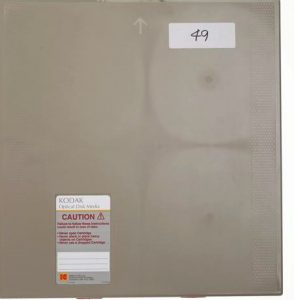
Of course, the company has been quietly heading out of this activity for a long time. It will provide media for another 4 years, and service for another 5.
Kodak even announced that it would go so far as to deliver its previously announced 25GB drives and media by mid-year.
We’re beginning to wonder who would want them. Outside of a handful of major US administrative customer who clearly want a national supplier for strategic applications, 14-inch optical business has remained strictly confidential.
European users can count what they still currently owe on one hand, a hand they will be forced to bite, regardless of what it is feeding them.
Excessively high prices, a completely proprietary format, no second source – what else do you need to discourage customers, even more so when you consider the fact that rival products, certainly with less capacity, are so much cheaper when it comes to 5.25-inches or 12cm optical formats, tape or magnetic disk arrays.
Eastman Kodak also announced its first 14-inch WORM disk with jukebox on March 3, 1987, at the time with capacity of 6.8GB. The device hit 10.2GB in 1991, then 14.8GB in 1994, and 25GB in 1996. The roadmap projected 200GB by the year 2000.
In May 1994, the US Internal Revenue Service signed an enormous image deal with IBM Federal Systems Division, which was subsequently sold to Loreal, for $1.57 billion, to turn a billion pages into electronic images on optical disks. Kodak was Loreal’s main subcontractor for the shipments of scanners, 14-inch drives, jukeboxes and media.
At the time, the Rochester-based company said: “Kodak will earn several hundred million dollars from the contract over its 15-year life.”
This article is an abstract of news published on issue 122 on March 1998 from the former paper version of Computer Data Storage Newsletter.








 Subscribe to our free daily newsletter