



SC26: IO500 Unveiled at the Conference with Intel DAOS and Argonne Aurora Setting New Production Record as HPC Storage Competition Intensifies with the AI Tsunami
New results from Argonne, KISTI, Gluesys and IBM reshape production rankings, while research systems continue to demonstrate exceptional metadata performance
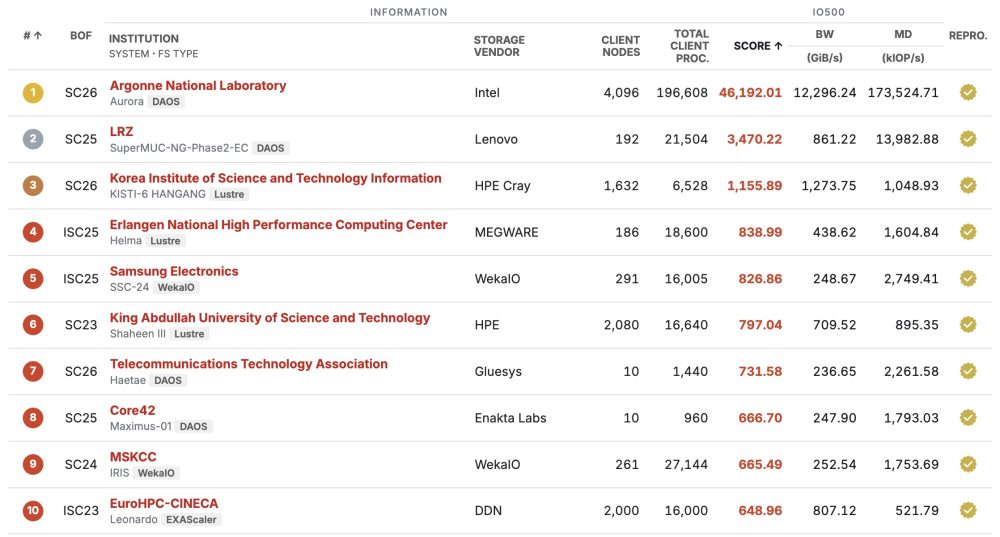
By Philippe Nicolas | November 19, 2026 at 2:02 pmThe IO500 rankings published for SC26 in Chicago highlight the continuing evolution of high-performance storage infrastructure, driven by increasingly demanding HPC and AI workloads. The latest results confirm the leadership of Intel’s Distributed Asynchronous Object Storage (DAOS) technology, deployed on Argonne National Laboratory’s Aurora supercomputer, which achieved an impressive IO500 score of 46,192.01, securing first place in the Production category.
Some players claim that DAOS is not a file system but this ranking is not about file system, it is about storage whatever data is exposed, consumed and designed in terms of layout or format organization on backends.
The rankings also highlight new submissions from South Korea’s KISTI and Telecommunications Technology Association (TTA), as well as IBM’s Storage Scale platform. Meanwhile, research-oriented systems from Huawei, Sugon and several Chinese research institutions continue to occupy leading positions in the broader research rankings.
IO500 publishes five complementary lists: Production, 10 Node Production, Research, 10 Node Research and Full. Together, these provide a broad view of storage performance across different architectures, deployment scales and benchmark configurations. We summarize each of them below with some additional comments and analysis.
Unlike conventional storage benchmarks focused primarily on sequential throughput, IO500 combines bandwidth and metadata performance. Its composite score reflects both dimensions, making it particularly relevant to parallel file systems and distributed storage platforms serving HPC and AI environments.
Production: Aurora extends its lead
Click to enlarge
Source: IO500 SC26 Production List. Rankings include results submitted in previous editions, as indicated by IO500
Argonne’s Aurora achieved 12,296.24 GiB/s of bandwidth and 173,524.71 kIOP/s of metadata performance, using 4,096 client nodes and 196,608 client processes.
Compared with the previous Production leader result of 32,165.90 at ISC26 and SC25, the new score represents a 43.6% improvement. The new test uses a substantially larger client configuration, so the result demonstrates improved measured scale rather than a controlled like-for-like performance gain.
Another significant development is KISTI-6 HANGANG, which enters third place with HPE Cray’s Lustre implementation. Its 1,155.89 score makes it the highest-ranked Lustre system in the Production list, ahead of Erlangen’s Helma and KAUST’s Shaheen III.
Gluesys also makes an important appearance with Haetae, a DAOS-based deployment operated by South Korea’s Telecommunications Technology Association. Its 731.58 score places it seventh overall, illustrating that DAOS adoption extends beyond Intel and Lenovo.
IBM improves its Blue Vela Storage Scale System 6000 result from 291.60 to 336.39, an increase of approximately 15.4%, while Georgia Tech introduces Nexus, a Vast Data-based system, with a score of 89.20.
10 Node Production: DAOS dominates the leading positions
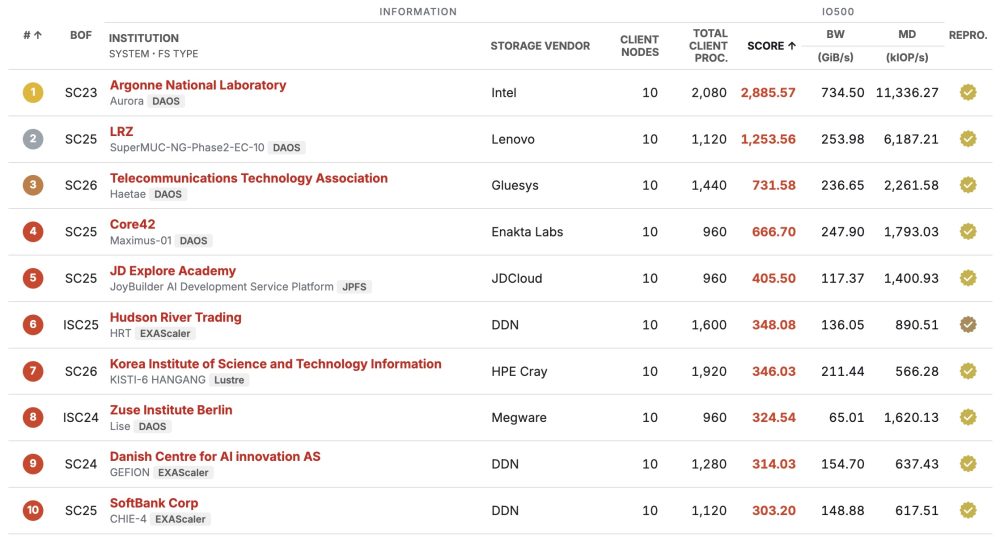
The 10 Node Production ranking offers a different perspective by restricting submissions to exactly ten client nodes, reducing the influence of very large client configurations.
Click to enlarge
Source: IO500 SC26 10 Node Production List
DAOS occupies the first four positions, reinforcing its strength in both bandwidth and metadata-intensive operations. Gluesys’s Haetae is the highest-ranking new SC26 submission in this category, followed by KISTI’s Lustre-based HANGANG system in seventh position.
DDN remains strongly represented through EXAScaler, particularly among established production installations. The diversity of vendors running DAOS also suggests that the underlying software architecture can be deployed across different infrastructure suppliers, rather than being limited to a single integrated storage appliance.
Research: Chinese systems retain their leadership
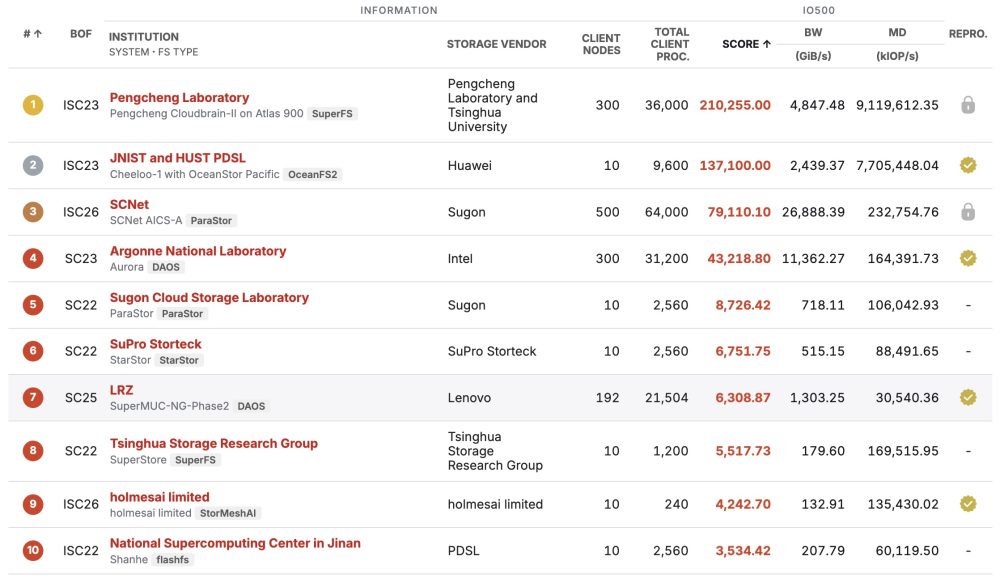
The Research ranking presents a strikingly different picture from Production, with exceptional metadata-oriented results from Chinese research institutions and storage developers.
Click to enlarge
Source: IO500 SC26 Research List. The top ten are historical results retained in the current ranking, not necessarily submissions made at SC26
Pengcheng Cloudbrain-II maintains its leading position with 210,255.00, followed by Huawei’s OceanFS2-powered Cheeloo-1 and Sugon’s SCNet AICS-A.
The gap between these systems and conventional production storage results is particularly significant in metadata performance. However, the Research category should not be interpreted as a direct comparison of commercially deployed, production-qualified file systems.
The presence of older submissions is also important: the first three results originate from ISC23, ISC23 and ISC26, respectively. Their continued appearance in SC26 reflects the historical nature of the published ranking rather than new benchmark records announced in Chicago.
10 Node Research: Huawei, Pengcheng and Sugon lead
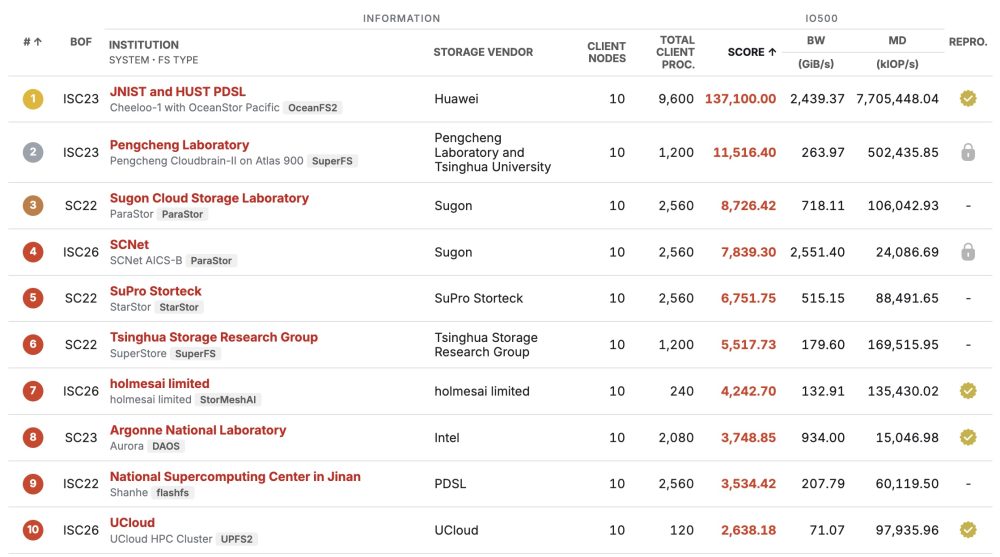
Huawei’s OceanFS2 result continues to lead by a substantial margin. Its IO500 score is almost twelve times that of the second-ranked Pengcheng result.
Sugon holds two of the top four positions, highlighting the strong showing of ParaStor in research benchmarks. StorMeshAI and UPFS2, both originating from ISC26, also remain in the top ten.
These results demonstrate that file-system innovation is not confined to established commercial parallel file systems such as Lustre and IBM Storage Scale. Specialized research implementations can deliver exceptionally high scores, particularly when optimized for metadata-heavy benchmark patterns.
Full List: the largest scores do not necessarily lead Production
The Full List includes multiple submissions for the same system and results that may not qualify for Production or Research classifications.
Its leading entry remains Pengcheng Laboratory’s OceanStor A800-based system, introduced at ISC26, with a score displayed as 603,335.00. This is substantially higher than Aurora’s Production-leading score, but it belongs to a different qualification context.
Click to enlarge
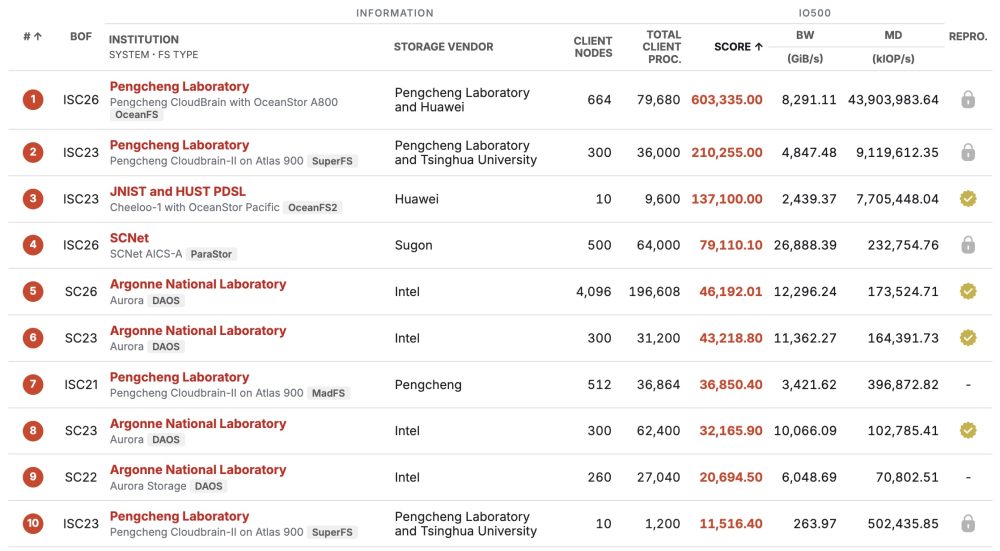
Source: IO500 SC26 Full List
The new Aurora result reaches fifth place in the Full List, behind four research-oriented submissions. This distinction is essential when interpreting the IO500 results: the highest numerical score in the Full List is not equivalent to first place in Production.
The Full List is particularly useful for analyzing the evolution of individual systems because it preserves multiple benchmark configurations and historical submissions.
New SC26 entries and changes since ISC26 and SC25
The following table identifies the most notable SC26-tagged Production entries, including their vendors, file-system implementations and differences from earlier releases.
Click to enlarge
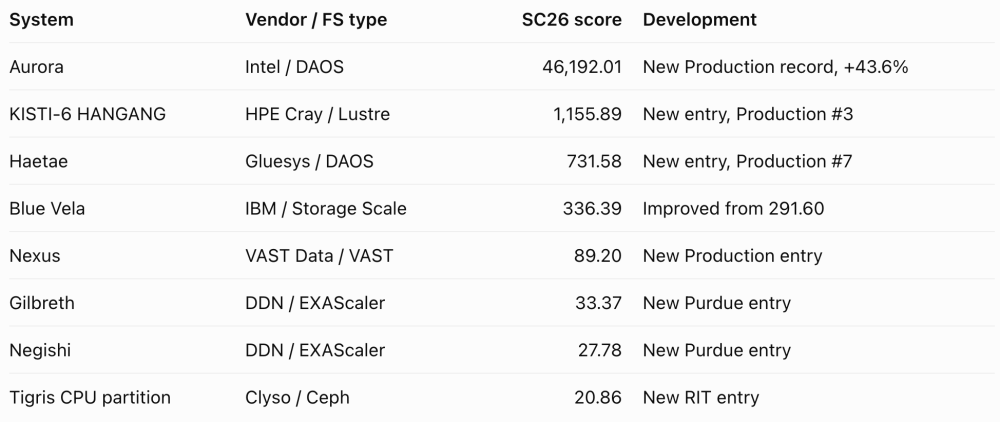
SC26 Production submissions compared with earlier published results
Several important differences emerge when comparing the three releases:
- Aurora widens its advantage. At SC25 and ISC26, its leading Production score was 32,165.90. The new SC26 score increases that to 46,192.01, making it approximately 13.3 times higher than second-ranked LRZ’s SuperMUC-NG-Phase2-EC
- Lustre gains a new high-ranking deployment. KISTI’s HANGANG enters third place, pushing Helma from third to fourth and Samsung SSC-24 from fourth to fifth compared with ISC26
- New vendors and deployments expand the landscape. Gluesys’s Haetae, Georgia Tech’s Vast-based Nexus, and RIT’s Clyso-based Ceph system broaden the architectural diversity of the Production list
- IBM strengthens its position. The new Blue Vela result demonstrates a measurable improvement in IBM Storage Scale performance, while other IBM Storage Scale submissions appear elsewhere in the SC26 results
- The research leadership remains comparatively stable. The strongest Research and 10 Node Research entries continue to originate from earlier releases, particularly ISC23 and ISC26, rather than new SC26 submissions
A further detail appears in the Full List: Haetae has an SC26 submission scoring 1,242.79, compared with the 731.58 result displayed in Production. Likewise, the Full List contains UW-Madison and KLA’s MadRacks Testbed, using NetLab’s EvolveFS, with a score of 1,113.53. These illustrate why the Full List should be examined separately from the qualified rankings.
Storage vendor and file-system landscape
The SC26 rankings illustrate a diverse storage ecosystem, ranging from established HPC storage vendors to newer distributed file systems and specialized research implementations.
Click to enlarge
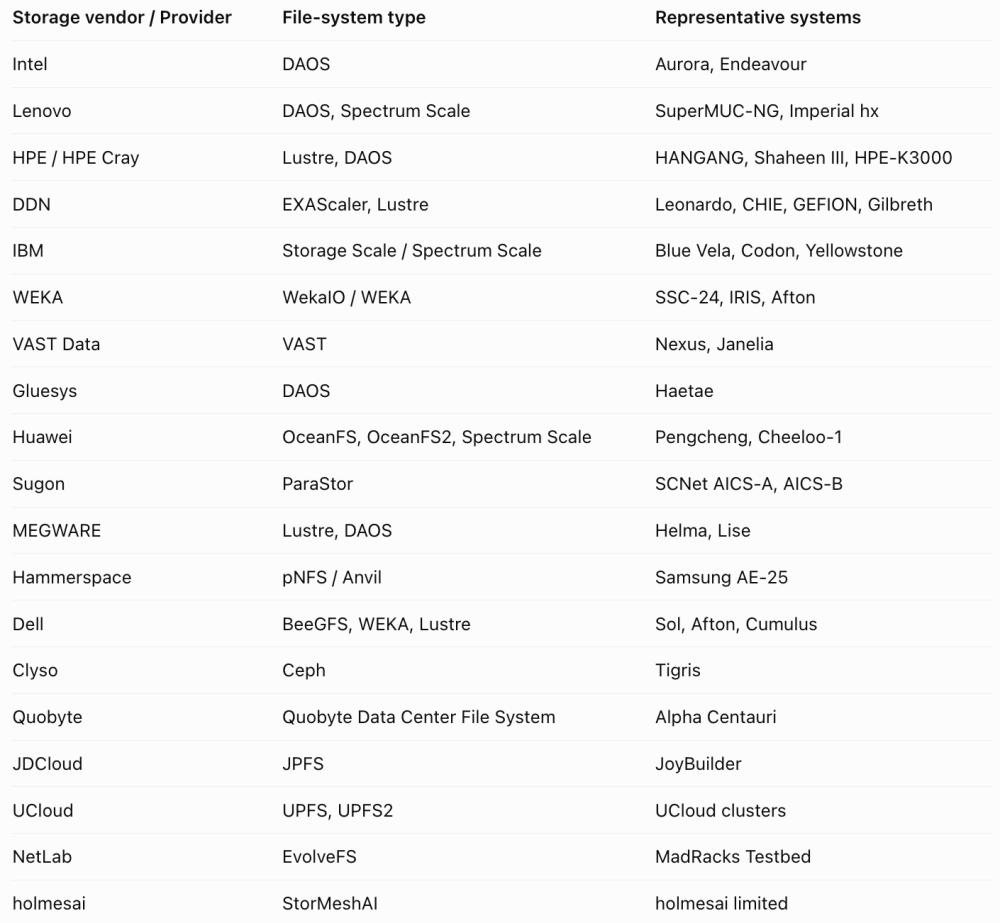
Representative suppliers and implementations appearing across the IO500 SC26 lists. Vendor names reflect the IO500 submissions; a vendor may supply the infrastructure without being the original developer of the file system
Among established commercial suppliers, DDN maintains extensive representation across production HPC installations. Intel’s DAOS technology demonstrates the strongest leading scores, while Lustre remains prominent in large scientific computing environments.
IBM Storage Scale, Weka and Vast Data illustrate the diversity of commercially deployed shared and distributed storage architectures. Hammerspace’s pNFS-based implementation is another notable example, reflecting the industry’s interest in standards-based parallel access.
The presence of Ceph, BeeGFS, Quobyte and specialized research file systems further illustrates that the HPC and AI storage landscape remains highly fragmented, with no single architecture dominating every workload or deployment size.
Market perspective: HPC storage enters a new phase
The SC26 IO500 results highlight several important trends in the high-performance data storage industry:
- Metadata performance has become a critical competitive differentiator. AI training, checkpointing, data preprocessing and large-scale scientific workflows increasingly require storage architectures capable of handling massive numbers of files and concurrent operations. Sequential bandwidth alone is insufficient to characterize these requirements
- DAOS continues to demonstrate the potential of distributed, object-oriented storage architectures. Its leading results, combined with deployments from Intel, Lenovo and Gluesys, reinforce its position as an important technology in the HPC storage ecosystem
- Lustre remains highly relevant. The new KISTI HANGANG result confirms that this mature parallel file system continues to scale to large computing environments. DDN’s EXAScaler deployments further demonstrate Lustre’s established role in production HPC infrastructure
- The results underline the growing importance of Asian research and infrastructure investments. South Korea contributes notable new production deployments, while Chinese institutions continue to dominate several research-oriented benchmark categories
Finally, the difference between Production, Research and Full rankings highlights an essential consideration for end users: benchmark leadership does not automatically translate into application performance, operational maturity, reliability or commercial suitability.
IO500 remains a valuable indicator of storage-system capabilities, but procurement decisions should also consider real application workloads, scalability, data protection, availability, manageability and total cost of ownership.
The main takeaway from SC26 with these IO500 rankings is not simply that Aurora has extended its lead. It is that HPC and AI storage competition increasingly spans several distinct architectural approaches, with DAOS, Lustre with DDN and others, IBM Storage Scale, Weka, Vast, Ceph, pNFS based solutions and emerging research technologies competing on different performance and deployment characteristics.




 Subscribe to our free daily newsletter