




Nvidia: Fiscal 3Q27 Financial Results
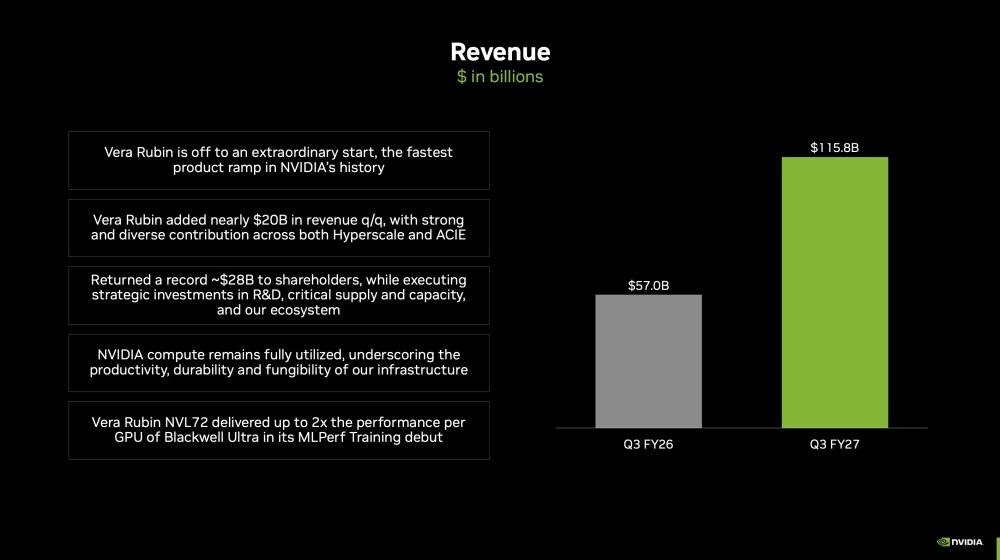
Generating $115.8 billion, up 20% QoQ and up 103% YoY
This is a Press Release edited by StorageNewsletter.com on November 18, 2026 at 2:02 pmSummary:
- Revenue of $115.8 billion, up 103% from a year ago
- Data Center revenue of $107.6 billion, up 110% from a year ago
- Vera Rubin NVL72, the most versatile and advanced computing platform ever built, has shipped
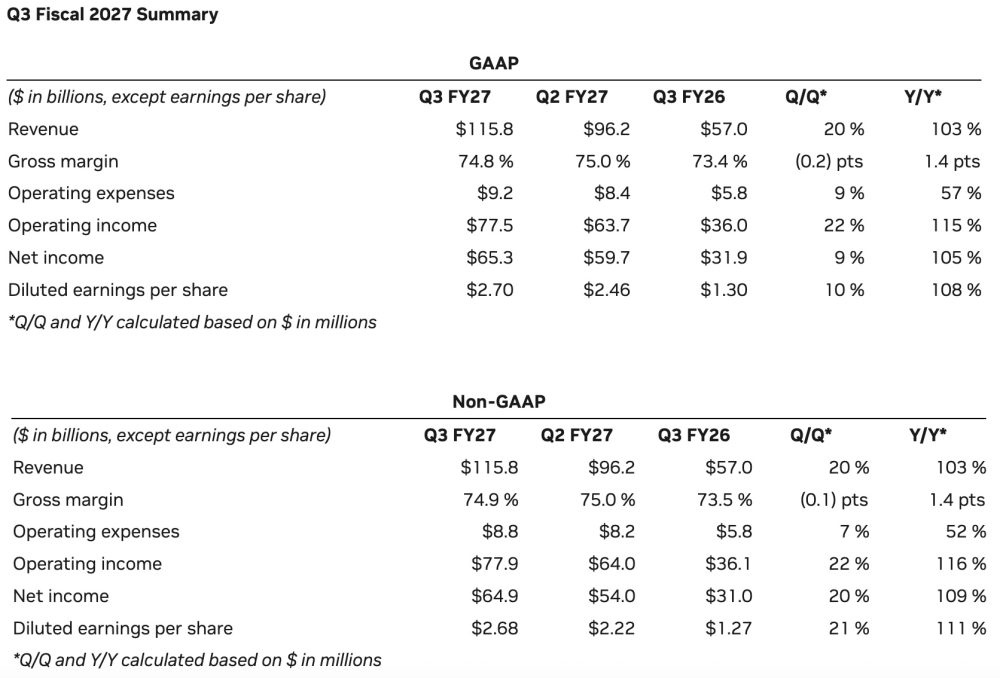
Nvidia Corp. reported revenue for the third quarter ended October 25, 2026, of $115.8 billion, up 20% from the previous quarter and up 103% from a year ago.  For the quarter, GAAP and non-GAAP gross margins were 74.8% and 74.9%, respectively. GAAP and non-GAAP earnings per diluted share were $2.70 and $2.68, respectively.
“Our momentum is real. Nvidia is an exceptional technology leader, powered by the relentless innovation of our people,” said Colette Kress, interim CEO and EVP and CFO of Nvidia. “Vera Rubin is off to an explosive start, our roadmap is on track and our ambition has never been greater.”
In September 2026, Nvidia’s board of directors approved an increase of $150 billion to the company’s share repurchase authorization, without expiration. During the third quarter of fiscal 2027, Nvidia returned $28.1 billion to shareholders in the form of shares repurchased and cash dividends. As of the end of the third quarter, the company had approximately $227.3 billion remaining under its share repurchase authorization.
Nvidia will pay its next quarterly cash dividend of $0.25 per share on December 23, 2026, to all shareholders of record on December 2, 2026.
Q3 Fiscal 2027 Summary
Click to enlarge
Click to enlarge
Outlook
Nvidia’s outlook for the fourth quarter of fiscal 2027, which includes an additional week, is as follows:
- Revenue is expected to be $130.0 billion, plus or minus 3%. Nvidia is not assuming any Data Center compute revenue from China in its outlook
- GAAP and non-GAAP gross margins are expected to be between 71.0% and 72.0%
- GAAP and non-GAAP operating expenses are expected to be approximately $11.0 billion and $10.7 billion, respectively
- For the full year fiscal 2027, Nvidia expects GAAP and non-GAAP tax rates to be between 16.0% and 18.0%, excluding any discrete items and material changes to Nvidia’s tax environment
Highlights
Data Center
- Third-quarter revenue was $107.6 billion, up 21% from the previous quarter and up 110% from a year ago
- Ramped production and began shipping Nvidia Vera Rubin NVL72 — the fastest product ramp in the company’s history — with racks running at partners including CoreWeave, Google Cloud, Microsoft Azure, Oracle Cloud Infrastructure and Nebius, and coming online soon at SpaceXSI
- Expanded the Vera Rubin cloud ecosystem, announcing general availability of Vera Rubin NVL72 systems and Vera CPUs on Oracle Cloud Infrastructure, general availability of Google Cloud’s Vera Rubin-powered A5X instances and the continued buildout of SpaceXSI’s infrastructure
- Announced Vera Rubin open architecture advances to help the industry scale faster, and revealed that Cisco, Google, Meta, Microsoft and Visionbay are joining many technology leaders advancing infrastructure for Vera Rubin
- Revealed that leading AI natives, cloud providers and neoclouds, including CoreWeave, Meta, Nebius, Nscale, OpenAI and Verda, are building with Nvidia Vera CPUs to support the growing computing needs of businesses and developers, joining AWS, Oracle Cloud Infrastructure and SpaceXSI
- Expanded Anthropic’s access to Nvidia Grace Blackwell and Vera Rubin capacity through cloud providers, and continued to collaborate on design and engineering to optimize future Nvidia architectures for Anthropic’s workloads
- Announced the Nvidia Vera CPU rack-scale platform for high-performance computing — combining Nvidia’s first fully custom data center CPU with the gold standard for HPC networking to drive extreme efficiency and throughput for scientific modeling, simulation and agentic science
- Introduced Nvidia Rubin HPC, a new GPU in the Vera Rubin platform designed to accelerate simulation and data processing for science, engineering and analytics workflows
- Expanded collaboration with Meta on AI agent Muse and its family of models, with Meta planning expanded deployment of Vera Rubin, Vera CPUs, Nvidia Spectrum-X networking and Nvidia BlueField-4 to scale training, inference and agents
- Introduced DSX POD, a reference design for complete Vera Rubin AI factories built by partners inside modular containers, integrated and validated before delivery to accelerate infrastructure deployment
- Announced European ecosystem adoption of Nvidia DSX to reduce AI factory power requirements and enable near-zero facility cooling water consumption
- Announced that Nvidia swept every MLPerf Training and Endpoints benchmark, and Vera Rubin NVL72 demonstrated leading inference performance in its MLPerf Inference preview debut
- Launched Nvidia Open Agent Safety Platform and introduced the Nvidia OpenShell Reference Architecture, combining open source OpenShell software, Vera Rubin for model inference, Vera CPUs for agent execution and BlueField-4 DPUs running Nvidia Sentry to independently monitor agent behavior and enforce security policies in silicon
- Announced an agreement to acquire Hugging Face to scale its platform and make intelligence more open, capable and accessible
- Announced plans with global supply chain partners, including Amkor Technology, IBIDEN, King Yuan Electronics, Samsung Electro-Mechanics, Siliconware Precision Industries and Unimicron Technology Corporation, to scale critical manufacturing capabilities to meet demand for Nvidia infrastructure
- Deepened partnership with MediaTek across cloud infrastructure, local computing and automotive, extending Nvidia’s rack-scale platform to custom XPUs through Nvidia NVLink Fusion
- Announced plans with Cisco for USFP, a new optical-module form factor designed to increase bandwidth density and power efficiency for next-generation AI factory networks
- Announced collaboration with Australia’s data center ecosystem on infrastructure supporting a planned buildout of up to 2 gigawatts by 2027 for Nvidia DSX AI factories
- Introduced Nvidia Nemotron for Science to help researchers build specialized agents for scientific discovery, and collaborated with global healthcare and life sciences organizations to advance protein design, accelerate drug discovery and expand precision patient care
- Partnered with Palantir to bring sovereign AI intelligence and Nvidia Nemotron open models to critical supply chains
- Partnered with Firebird to scale the company’s total potential AI infrastructure capacity
- Expanded the open source Nvidia CUDA-Q platform with CUDA-Q Logical for fault-tolerant quantum computing development, and ran a record simulation of a fault-tolerant quantum processor on JUPITER at the Jülich Supercomputing Centre
Edge Computing
- Third-quarter Edge Computing revenue was $8.2 billion, up 14% from the previous quarter and up 42% from a year ago
- Reinvented Windows PCs with Nvidia RTX Spark laptops, now shipping from ASUS, Dell, HP, Lenovo, Microsoft Surface and MSI
- Launched Nvidia DLSS 5 in NBA 2K27 and Hogwarts Legacy, bringing AI-powered, photorealistic lighting and materials to GeForce RTX 50 Series GPUs, GeForce NOW and RTX Spark, and coming soon to Where Winds Meet
- Expanded the Nvidia local AI lineup with a new Nvidia DGX Spark 64GB model, bringing near-frontier AI capabilities to desktops at a more accessible price point, and accelerated leading AI models from Nvidia Nemotron, Black Forest Labs, Liquid AI and Qwen for running AI agents locally, with expanded support for Hermes, OpenClaw and Perplexity
- Introduced new Nvidia Alpamayo development tools and the Nvidia Halos SAFE framework to help developers build and evaluate autonomous-driving systems
- Expanded partnerships with Mercedes-Benz and Volvo Cars to advance safe automated driving
- Announced European mobility leaders — including Bolt with Lucid, Mercedes-Benz, Volkswagen Commercial Vehicles and Einride — are showcasing Nvidia Hyperion use cases for automated vehicles and future robotaxi fleets
- Advanced the Nvidia Isaac robotics platform with new development tools, datasets and runtime, alongside Agile Robots’ introduction of a reference humanoid powered by Nvidia Jetson Thor and built on Isaac GR00T
- Expanded Nvidia Cosmos with tools to train, evaluate and deploy world models for robotics, autonomous vehicles and industrial applications
- Advanced AI-RAN with Nokia and global telecom operators, including T-Mobile’s first AI-RAN call on a commercial network, bringing Nvidia accelerated computing deeper into wireless networks
Comments
The quarter was delivered under an interim CEO, Colette Kress, who also remains CFO. Governance remains an open question even though execution is strong. We also need to mention the petition for the come back of Jensen Huang signed by more than 130k people from various horizons.
Data Center revenue was $107.6B, up 21% QoQ and 110% YoY, which is about 93% of the total. Nvidia now reports only two segments. Edge Computing was $8.2B, up 14% QoQ and 42% YoY. Gaming, ProViz and Automotive are no longer broken out.
The main driver is the Rubin ramp. Vera Rubin NVL72 has begun shipping, with racks running at CoreWeave, Google Cloud, Microsoft Azure, OCI and Nebius. Meta plans a broader deployment of Vera Rubin, Vera CPUs and networking products.
One year ago, networking grew 162% YoY to a record $8.19B, with an attach rate near 90%. Nvidia is now selling whole rack-scale systems (NVL72 with NVLink, Spectrum-X and InfiniBand). That makes the boundary between networking and compute harder to see, and it likely suits Nvidia strategically.
Q4 gross margin falls to 71–72%, which CFO Colette Kress tied to extreme pricing conditions in memory. In practice, value is shifting toward HBM and DRAM suppliers. For the memory and storage industry, that is the most important signal in this report.
Click to enlarge
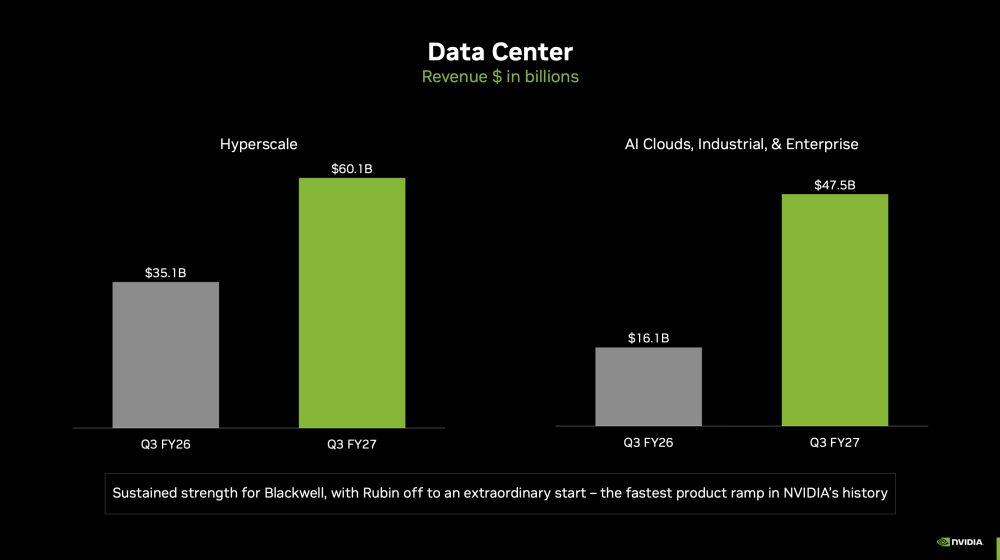
Nvidia doubled revenue year over year at about $116B a quarter, and AI infrastructure is now essentially its entire business. The risks are margin compression from memory costs and less transparency on networking.
Long-term supply and capacity agreements reached $279B, up from $119B one quarter earlier. This locks in growth, but it also adds risk if demand ever slows.
Nvidia returned $28.1B to shareholders in Q3 and agreed to acquire Hugging Face, which pushes it further up the software stack.
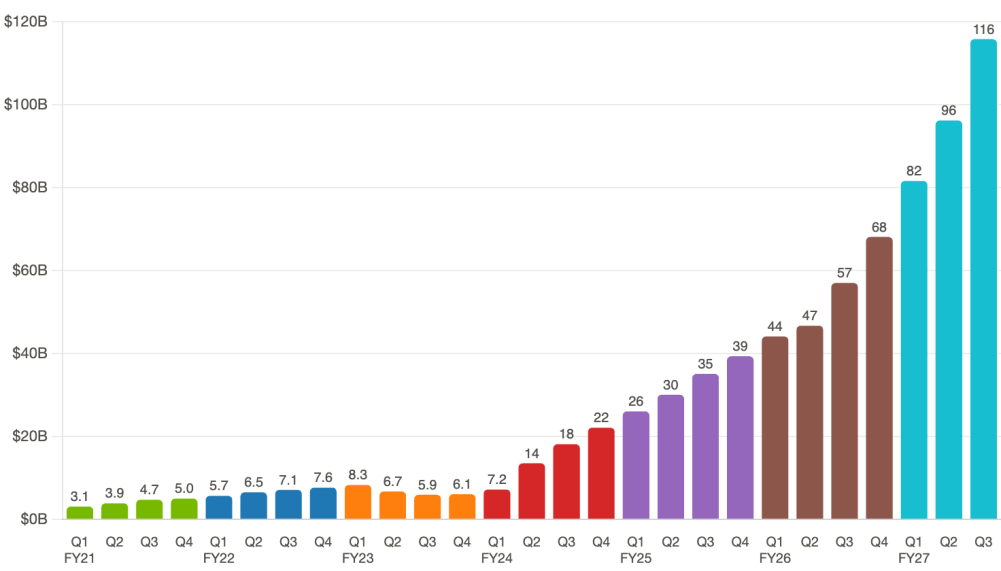
We updated our revenue graph with Nvidia quarterly revenue since 1Q21.
Click to enlarge





 Subscribe to our free daily newsletter