




Nvidia: Fiscal 2Q27 Financial Results
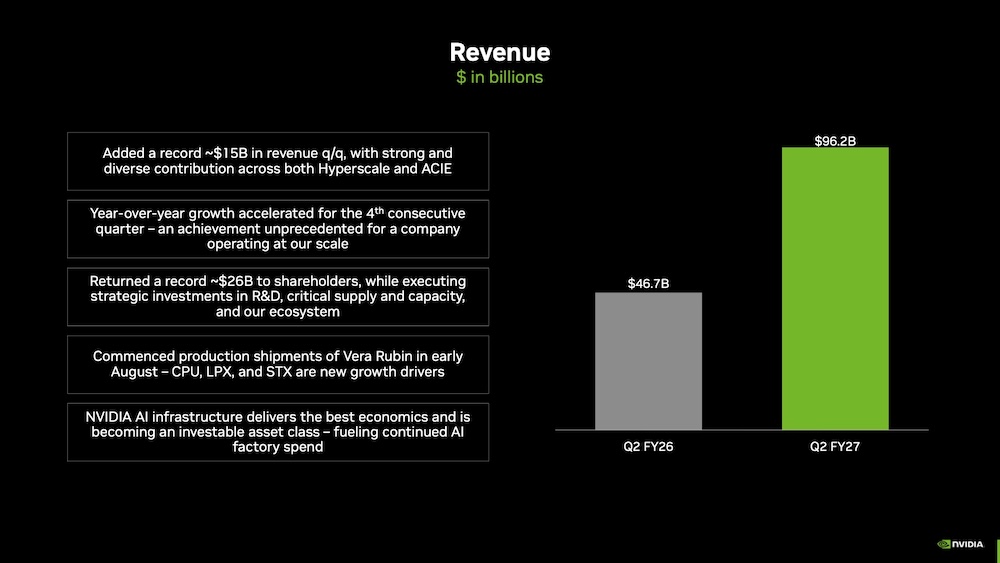
Generating $96.2 billion, up 18% QoQ and up 106% YoY
This is a Press Release edited by StorageNewsletter.com on August 27, 2026 at 2:01 pmSummary:
- Revenue of $96.2 billion, up 106% from a year ago
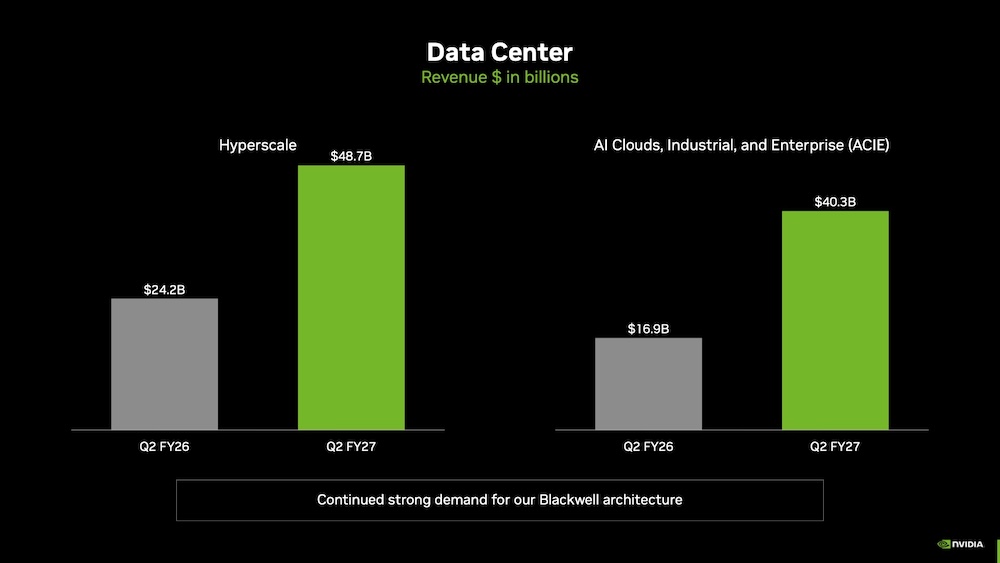
- Data Center revenue of $89.0 billion, up 117% from a year ago
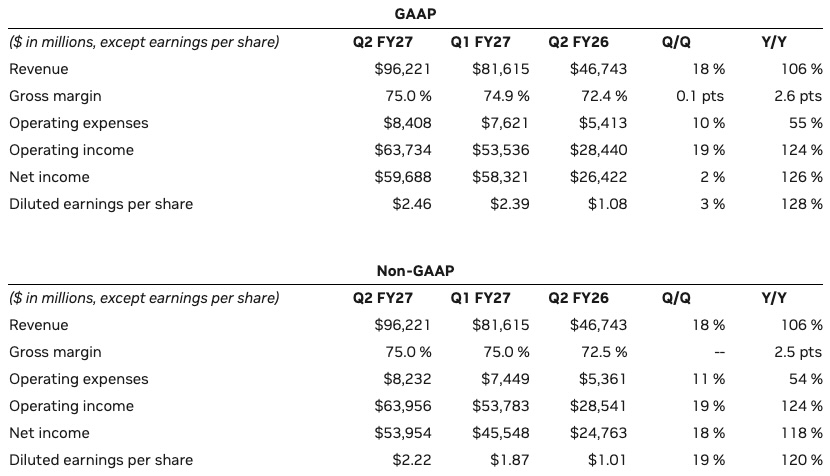
Nvidia Corp. reported record revenue for the second quarter ended July 26, 2026, of $96.2 billion, up 18% from the previous quarter and up 106% from a year ago. For the quarter, GAAP and non-GAAP gross margins were both 75.0%. GAAP and non-GAAP earnings per diluted share were $2.46 and $2.22, respectively.
“AI has reached its inflection point. It’s doing useful work. Its tokens are productive and profitable. Now, compute is revenue,” said Jensen Huang, founder and CEO, Nvidia. “And demand is accelerating. This time last year, one lab alone was driving the buildout; today, we have a golden age of new AI labs and startups, multiple frontier labs scaling in parallel, a thriving open-model ecosystem and physical AI coming online — with strong momentum across the US and around the world. The AI infrastructure buildout is at full steam. Vera Rubin, now in full production, was built to power exactly this moment.”
During the second quarter of fiscal 2027, Nvidia returned approximately $26.0 billion to shareholders in the form of shares repurchased and cash dividends. As of the end of the second quarter, the company had approximately $99.0 billion remaining under its share repurchase authorization.
Nvidia will pay its next quarterly cash dividend of $0.25 per share on October 1, 2026, to all shareholders of record on September 10, 2026.
Q2 Fiscal 2027 Summary
Click to enlarge
Click to enlarge
Outlook
Nvidia’s outlook for the third quarter of fiscal 2027 is as follows:
- Revenue is expected to be $108.0 billion, plus or minus 2%. Nvidia is not assuming any Data Center compute revenue from China in its outlook
- GAAP and non-GAAP gross margins are expected to be 74.0%, plus or minus 50 basis points
- GAAP and non-GAAP operating expenses are expected to be approximately $9.2 billion and $9.0 billion, respectively
For the full year fiscal 2027, Nvidia expects GAAP and non-GAAP tax rates to be between 16.0% and 18.0%, excluding any discrete items and material changes to Nvidia’s tax environment.
Highlights
Data Center
- Second-quarter revenue was $89.0 billion, up 18% from the previous quarter and up 117% from a year ago
- Announced the Nvidia Vera Rubin platform is ramping into full production with racks running at partners including CoreWeave, Google Cloud, Microsoft Azure, Oracle Cloud Infrastructure and Nebius
- Revealed that Nvidia Spectrum-6 switch systems — supporting both pluggable and co-packaged optics as part of the Nvidia Vera Rubin platform — are arriving across the world’s gigascale AI factories
- Unveiled Nvidia Vera, the first CPU built for AI agents, with broad adoption planned across the world’s leading technology providers
- Announced that Nvidia Groq 3 LPX, the interactive AI inference accelerator, is now in full production
- Introduced new security innovations for Nvidia Vera BlueField-4 STX, delivering agentic AI storage processing with in-silicon security for AI factories
- Launched the Nvidia DSX platform, providing infrastructure builders a complete playbook to design, build and operate AI factories at scale
- Announced strategic partnerships to establish independent compute financing platforms with Apollo, BlackRock, Blackstone, Brookfield, Goldman Sachs and KKR to mobilize over $500 billion of third-party capital for the buildout of AI infrastructure over time, subject to definitive agreements
- Announced that SpaceXAI will deploy Nvidia Vera CPUs to accelerate its next generation of agentic AI applications
- Secured land, power and shell capacity through a partnership with SB Energy at the PORTS-Pike Technology Campus in Ohio to host Nvidia compute
- Revealed that Nvidia Blackwell led across every category in the MLPerf Training 6.0 benchmarks and in AgentPerf, the industry’s first agentic AI infrastructure benchmark
- Announced new software, open source models and partnerships with the world’s leading software platform providers to build autonomous AI agents for industries and enterprises; expanded Nvidia Agent Toolkit with Nvidia PhysicsNeMo and new and updated Nvidia CUDA-X libraries
- Launched Nvidia BioNeMo Agent Toolkit, which provides domain-specific tools and skills for the agentic life sciences era
- Formed the Open Secure AI Alliance with industry leaders to advance AI safety and security
- Revealed that Nvidia GPUs with Confidential Computing are now used for confidential inference in Apple’s Private Cloud Compute
- Expanded Korea’s AI factory ecosystem through strategic partnerships with SK Telecom, NAVER and Brookfield to build sovereign AI infrastructure at gigawatt scale on the Nvidia DSX platform, as part of a broader Nvidia-powered national AI push across Korea’s industries and research institutions
- Announced a multiyear technology partnership with SK hynix to advance next-generation memory for the global AI factory buildout
- Partnered with the Japan government and industrial leaders to launch the world’s first national AI infrastructure; revealed that Japan’s leading enterprises, startups and research institutions are building industry-specialized AI models with Nvidia Nemotron open models
- Announced that the Nvidia Vera Rubin platform delivers world-class supercomputers for science; announced a record 35 new Nvidia AI HPC supercomputers in development across Europe
Edge Computing
- Second-quarter Edge Computing revenue was $7.2 billion, up 13% from the previous quarter and up 27% from a year ago
- Partnered with Microsoft to reinvent the Windows PC with Nvidia RTX Spark — a 1-petaflop superchip with the full CUDA and Nvidia RTX ecosystem
- Announced Nvidia DGX Station for Windows, the world’s most powerful deskside AI supercomputer for developing and running agents on Windows
- Launched a local AI initiative with optimizations for top open models — DeepSeek v4 Flash, Diffusion Gemma, Nemotron 3.5 Lightning and Qwen 3.8 — and agent harnesses Hermes Agent and OpenClaw across RTX and DGX platforms
- Expanded the Nvidia DRIVE Hyperion robotaxi-ready platform ecosystem, including strategic collaborations with Foxconn, VinFast, Uber and HUMAIN
- Introduced Nvidia Alpamayo 2 Super, the frontier open reasoning model for safe robotaxi and autonomous vehicle development, for commercial use
- Launched Nvidia Cosmos 3, the world’s first fully open frontier omnimodel for physical AI
- Announced the Nvidia Isaac GR00T Reference Humanoid Robot, the first open humanoid robot reference design built on Nvidia Jetson Thor and the Nvidia Isaac GR00T open development platform
- Announced Nvidia Halos for Robotics, the industry’s first full-stack safety system for physical AI, unifying AI compute and safety in a single comprehensive platform
- Released a major collection of open source agent tools and skills for physical AI, enabling developers to turn complex robotics, autonomous vehicle and vision AI workflows into agent-executable tasks
Comments
Honestly, the numbers are staggering. Nvidia reported 2Q27 revenue of $96.2B, up 106% YoY and 18% sequentially, with Data Center alone generating $89B, up 117% YoY. Gross margin held at 75%, operating income reached $63.7B, and net income $59.7B. For 1H27, cumulative revenue already stands at $177.8B. Q3 guidance of $108B signals no slowdown. This is very impressive.
Click to enlarge
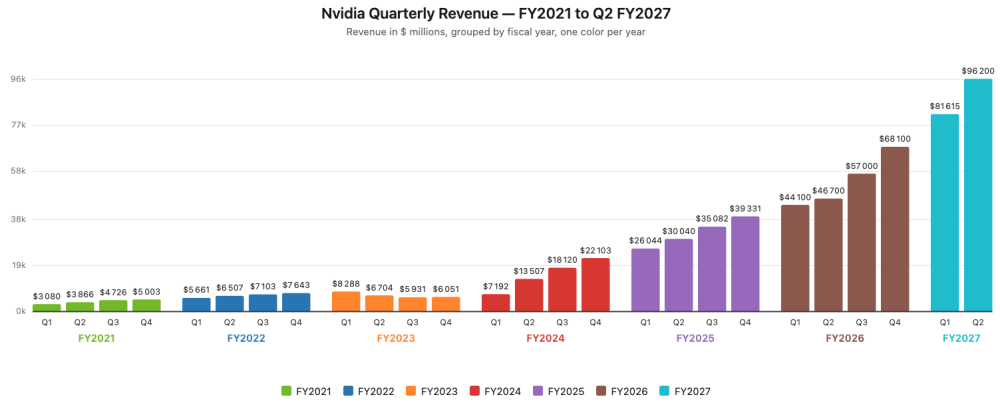
And the global revenue curve is clear about that, there is an acceleration of the revenue, some 6 months period or quarters being multiple of recent full years. To compare Intel and AMD have generated respectively $57B and $41B for the last 12 months. So Nvidia equals in 1 quarter what Intel and AMD have generated combined in 1 year.
Click to enlarge
As Jensen Huang, CEO, Nvidia, put it: "AI has reached its inflection point. Compute is revenue." This captures the strategic shift perfectly, Nvidia is no longer just a semiconductor company, it is the backbone of a global AI infrastructure buildout. And his recent blog about the asset notion or concept illustrates this.
Vera Rubin is now in full production, ramping at CoreWeave, Google Cloud, Microsoft Azure, Oracle Cloud Infrastructure, and Nebius. Spectrum-6 networking is deploying across gigascale AI factories worldwide. Nvidia also unveiled the Vera CPU, the first processor specifically designed for AI agents, alongside Groq 3 LPX for interactive inference, BlueField-4 STX for in-silicon security, and the DSX platform as a complete AI factory blueprint for infrastructure builders.
On the physical AI front, Cosmos 3 launched as the first fully open frontier omnimodel, alongside the Isaac GR00T open humanoid robot reference design and Halos for Robotics, the industry's first full-stack physical AI safety system.
The geopolitical dimension is notable: Nvidia explicitly excludes China Data Center compute revenue from its Q3 outlook, yet still guides $108B, underscoring how strong the rest-of-world demand is. Strategic sovereign AI partnerships span Japan, Korea, and Europe.
The broader perspective: Nvidia is no longer competing in the chip market, it is defining the architecture of the AI economy, from silicon to software to financing ($500B mobilized with Apollo, BlackRock, KKR, and others). The gap between Nvidia and any rival continues to widen.








 Subscribe to our free daily newsletter