


Exclusive Interview with Oded Nagel, CEO, CTERA
Sustaining rapid growth and expanding market presence
By Philippe Nicolas | October 29, 2026 at 2:01 pm Oded Nagel is CEO of CTERA Networks, since 2023. He joined the company in 2008 and occupied since then several positions: chief strategy officer, VP solutions and director, customer care. Previously he collaborated with Checkpoint, SofaWare Technologies and 013 Netvision. He holds a BA in Business and Economics.
StorageNewsletter: Oded, following our recent meeting during the 70th edition of The IT Press Tour in California, I would like to take this opportunity to ask you a few questions about CTERA, the business strategy, and solutions, particularly in today’s challenging market environment, which, despite its complexities, also presents significant opportunities for growth and innovation. CTERA is a private company with strong enterprise recognition and adoption. Could you share a few key figures that show the company’s growth?
Oded Nagel: We don’t publish financials, but a few numbers tell the story. We’ve grown at a CAGR of more than 25%, and CTERA now manages hundreds of petabytes of customer data. Internally, we’re at about 200 people. Over the past two years, marketing has more than doubled and sales is on track to do the same, while R&D has stayed roughly the same size because AI has made our engineers far more productive. That ratio reflects where we are. The platform is built, and we’re scaling how we take it to market.
The AI wave is reshaping the market quickly, and CTERA has had to adapt its strategy. How would you describe your new mission?
For 18 years, our job was to unify and protect file data across distributed environments. That foundation hasn’t changed, but the destination has. Our mission now is to make enterprise file data usable by AI, safely, and with a measurable return. Most organizations are buying GPUs, models, and copilots, yet few can prove value. We see three reasons: the data isn’t AI-ready, security hasn’t kept up, and not enough people know how to build agents. Our principle is simple: move the AI to the data, not the data to the AI.
Prices for memory and storage components are under strong pressure. Is that affecting your business, and if so, how are you responding?
It affects everyone in the market. We’re software-defined and price mainly on capacity, so we don’t carry hardware inventory risk, but our customers feel it directly. Our own research across 16PB of production data found that only 4.4% of capacity is actively used and 88% of files haven’t been touched in over a year. Paying flash prices for that data makes even less sense when component costs rise. We help customers respond in three ways: edge caching keeps only active data on local flash, archiving moves cold data to lower-cost object storage, and customers choose their own object storage, in the cloud or on premises, so they aren’t tied to one vendor’s hardware pricing.
What does that mean for your partners?
This is a major opportunity for partners to bring more value to their customers. With the CTERA platform, partners can go beyond storage and help customers get more out of their own data, so teams can find, use, and activate it more effectively and become more productive.
Partners can also help customers cut costs, which matters even more as component prices rise. CTERA analyzes data activity to separate the data people use from the data they don’t. Active data stays fast and accessible, and unused data is archived to lower-cost storage. Customers spend less on storage, and partners become trusted advisors, which creates more services and recurring revenue.
Your data platform is already very rich. What are the most important features and services you’ve added recently?
Five additions stand out. First, CTERA Fusion Direct unifies file and object in one namespace, so existing S3 buckets attach to the Global File System without migration, and AI clusters can read the same data over S3 and S3 over RDMA. Second, CTERA InsightAI gives administrators plain-language visibility into what they store, what’s growing, and what’s risky. Third, MCP connectivity links file data to Microsoft 365 Copilot, Claude, Gemini, and Cursor, while our n8n integration brings it into agentic workflows. Fourth, AI-assisted data archiving identifies cold data and moves it under policy. And most recently, Forward Deployed Engineering embeds our engineers in customer teams until an AI use case is in production and the customer can run it on their own.
Underpinning all of this is cyber protection, which matters even more as AI gains access to file data. CTERA Ransom Protect detects malicious behavior and blocks attacks at the edge, and we’re extending that protection from encryption to data exfiltration.
AI is changing what enterprises expect from file services. What does that mean for CTERA and for your customers’ needs? In other words, modern challenges call for modern solutions: where does CTERA fit?
File services used to be judged on access, performance, and protection. Those still matter, but there’s now a new consumer of file data: the AI agent. The common approach is to copy data into a separate AI pipeline, which adds cost and risk, creates another copy to govern, and strips away the context and permissions that make the data trustworthy. We take the opposite approach. We help customers bring AI to their data, not their data to AI. The same Global File System that serves users over SMB and NFS serves AI over S3 and MCP, with permissions enforced in place. The data stays where it is, governed as it always was, and customers use the models of their choice.
Could you give examples of the AI services you deliver on the CTERA platform, along with some customer references?
CTERA InsightAI analyzes metadata only, such as names, paths, sizes, and audit logs, so there are no file reads and no egress costs. A manufacturer with more than a petabyte across four regions and 33 CTERA Edge Filers uses it to understand what is growing, stale, valuable, or risky. CTERA Content Services goes deeper. It converts documents, scans, and audio into AI-readable text, then runs permission-aware search, RAG, classification, and extraction. A U.S. mortgage company uses it through MCP in Microsoft Copilot Studio to search loan files, tag personal information, and prepare training data for default-prediction models. A medical-legal firm uses it to turn scanned and handwritten records into case narratives for legal review.
You’ve also introduced a data archiving service. What does it mean for enterprises, and what impact does it have on their storage TCO?
Archiving has traditionally meant removing data from the working estate. Ours keeps it in the same namespace, under the same access model, and still reachable by AI. The cost reduction comes from two levers: the data moves to a lower-cost license tier and to a lower-cost storage class, in the cloud or on premises. AI identifies the candidates, and every move is logged with a reason, with retention controls for compliance. The TCO impact depends on how much cold data a customer has. Given that most estates are overwhelmingly inactive, the opportunity is significant, and we’d rather show customers their own numbers than quote a generic percentage.
Competition in this space is active. How do you differentiate from the usual players addressing the same needs?
You’ll find point products for each piece of this: file services, analytics, security, AI pipelines. What customers struggle with is stitching them together. We deliver the file system, the edge, protection, insights, and the RAG and embedding layer on one governed platform, plus the engineers to connect it to their workflows. Two principles matter. First, data stays in standard formats, with no proprietary encapsulation, so customers keep control and sovereignty. Second, on security, we play offense: CTERA Ransom Protect detects malicious behavior and blocks it at the edge rather than relying only on restore after the fact.
How do you assess the growing threats of ransomware and data theft, and what measures should organizations prioritize to strengthen their resilience
Backup is defense, and it’s still necessary. But restoring a billion encrypted files takes days or weeks, so we put the emphasis on stopping the attack early or altogether. CTERA Ransom Protect watches for malicious behavior and blocks it at the edge. In third-party lab testing by Synergy7, it detected all eight ransomware families tested, with a median time to block of 24.5 seconds, and kept every attack under 10% file encryption. The bigger shift now is exfiltration. If you can’t show what was stolen, you have to assume everything was, notify every customer, and absorb the fines. Knowing exactly what was touched is becoming as important as recovery. That’s why we brought Tal Sarfaty on as SVP of Cybersecurity, and it’s a major focus going into 2027.
And before we wrap up, what is your perspective on data sovereignty, and how do you see its importance evolving?
Sovereignty starts with control over where data lives and how it’s stored. CTERA runs fully on premises, in a private cloud, or in the customer’s own cloud tenancy, and data stays in standard S3 buckets with no proprietary encapsulation, so customers are never locked into us or a single provider. The same applies to AI. Customers bring their own model, including private LLMs running on their own infrastructure, so sensitive files never have to leave their environment to be useful. For many of our customers in government, healthcare, and financial services, that’s the only way AI gets approved at all.
As 2026 draws to a close, what have been the key milestones for CTERA this year, and what are your priorities for 2027?
2026 was our busiest year. We launched CTERA Fusion Direct in March, CTERA InsightAI in May, n8n integration in June, Microsoft 365 Copilot support in July, and AI-assisted archiving in September. We also published research on how little enterprise storage is actually used, introduced Forward Deployed Engineering in October, and brought in Tal Sarfaty as SVP of Cybersecurity. For 2027, our priority is helping customers close their AI skills gap and move AI projects from pilot to production, improving efficiency and productivity across the organization without compromising security or data sovereignty.
Comments
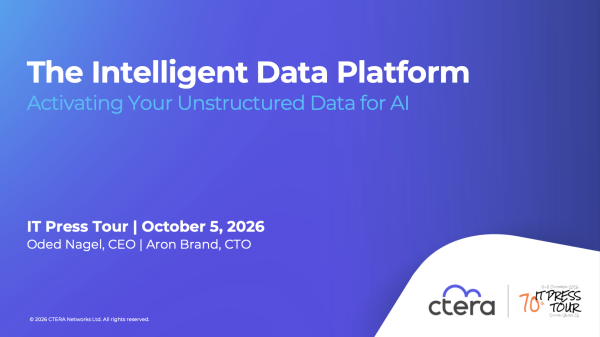
CTERA has undergone significant transformation over the past several years, introducing major innovations and expanding its solution portfolio to address rapidly evolving customer requirements. Our latest in-depth session with the company, held just a few weeks ago, clearly demonstrated the extent of this evolution and how closely CTERA's strategy and offerings align with current market demands. Click the image below to access the full presentation.




 Subscribe to our free daily newsletter