








Recap Huawei Connect 2026
Confirming the AI infrastructure strategy with several key new production iterations and innovations
By Philippe Nicolas | September 30, 2026 at 2:01 pmThe 2026 edition of Huawei Connect, held recently in Shanghai, China, was once again an impressive conference, showcasing the breadth of the portfolio Huawei has rapidly designed, developed and brought to market across multiple technology domains. The main theme this year was “Advancing the Agentic World”. More than 20,000 attendees from around the world joined the event, confirming the strength of the Huawei brand, its growing market penetration and the interest surrounding its technologies. Each edition also illustrates the speed of Huawei’s engineering teams and their ability to push the limits in performance, integration, scalability and resiliency.
Huawei used its annual flagship event to launch several products and introduce key innovations. We highlight five areas in particular: processors and accelerators, data interconnects, AI infrastructure, networking and cooling technologies.
The first keynote, presented by David Wang, deputy chairman of the board and rotating chairman, immediately set the tone with updates to the Ascend roadmap, Huawei’s AI accelerator family. The company has accelerated its schedule, with some products now expected significantly earlier than previously announced.
The Ascend 960DT is scheduled for Q1 2027, approximately two quarters earlier than initially planned, while the Ascend 960PR is expected in Q3 2027, also shortening the original delivery window. Specifications are ambitious, with at least 2 PFLOPS of FP8 performance and 4 PFLOPS at FP4, combined with up to 288GB of memory and 9.6TB/s of memory bandwidth.
Click to enlarge
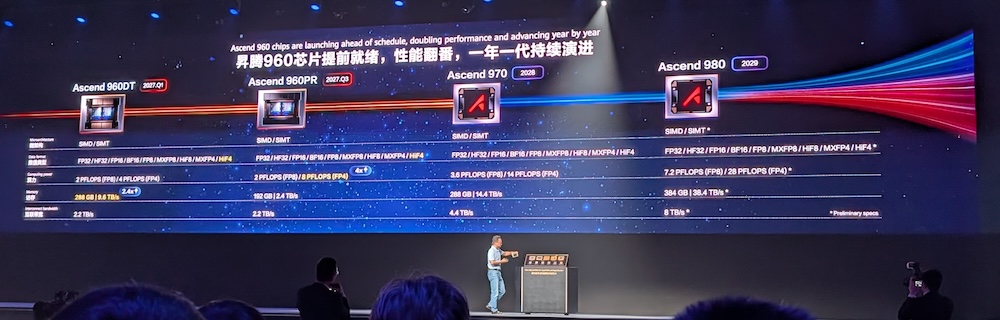
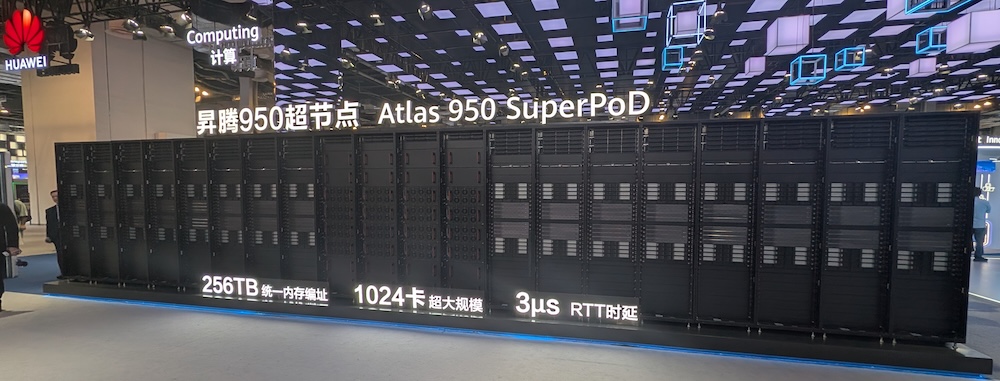
Nvidia continues to dominate this category, with its Rubin GPU offering 288GB of HBM4 and 19.2TB/s of memory bandwidth, exactly twice the figure announced for Ascend. Huawei’s strategy, however, is increasingly centered on pooling large numbers of compute resources to deliver aggregate performance at massive scale. This is the promise behind its SuperCluster and SuperPod architectures, combining Kunpeng CPUs, TaiShan systems and Ascend accelerators through the latest generation of UnifiedBus (UB).
Huawei’s networking team has also made significant progress with Hi-ONE, its new interconnect technology based on a Near-Packaged Optics (NPO) approach. The architecture can combine approximately 5,500 Hi-ONE modules to build very large clusters while reducing the number of network hops and lowering latency.
Closely related to this strategy is UnifiedBus, which Huawei presents as an advanced peer-to-peer interconnect architecture capable of linking different types of components, including CPUs, NPUs, DPUs, memory, storage devices, NICs and switches. The technology remains largely confined to the Huawei ecosystem today, but its architectural scope is broader in terms of device types than many alternatives currently available in the industry.
Click to enlarge
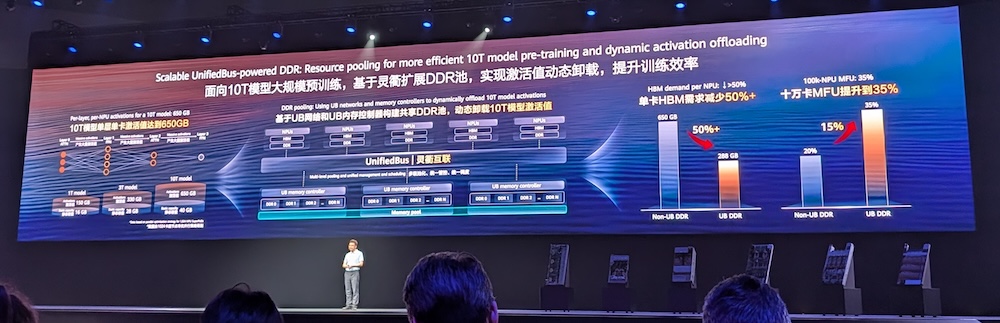
Facing UB are technologies such as Nvidia NVLink, UALink and even CXL, each addressing different parts of the interconnect challenge with its own strengths and limitations. There is clearly an intense technology race underway in this domain as AI infrastructure increasingly depends on the ability to efficiently connect compute, memory, networking and storage resources.
On the storage side, Huawei clearly emphasized AI infrastructure. While its traditional storage families continue to evolve, the most interesting development is Context Memory Storage, designed around KV cache workloads. Huawei currently offers the M800 and plans to introduce the M900 in early 2027.
The M900 will be available in two configurations: a 2U air-cooled appliance and a 1U liquid-cooled model. A cluster can scale to 64PB, while each appliance integrates 12 ASUs, or AI Storage Units, each providing 64TB.
Click to enlarge
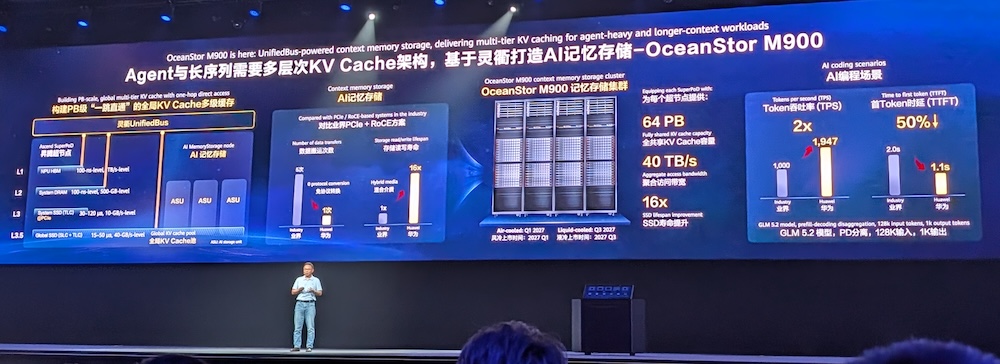
According to Huawei, the architecture eliminates protocol conversion and CPU forwarding, reducing access latency from milliseconds to approximately 60 microseconds. A single cluster can deliver up to 40TB/s of aggregate access bandwidth, which Huawei says is 1.5× higher than competing solutions.
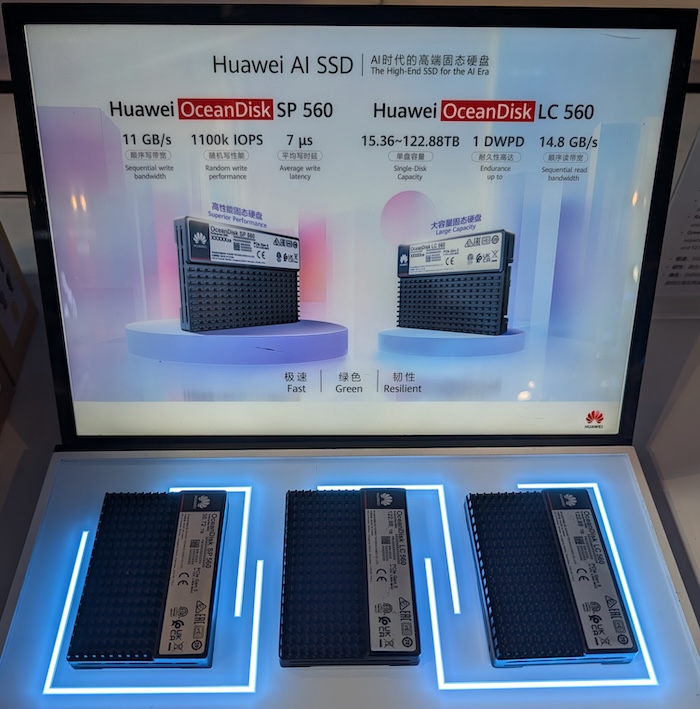
The current M800 is based on the OceanDisk 1800 architecture, a family that Huawei is now extending with the OceanDisk 1610. The company is also partnering with ThinkParQ around BeeGFS to address HPC and AI workloads. This initiative illustrates Huawei’s desire to expand its software partner ecosystem in high-performance storage, and we expect additional partnerships in this area.
Regarding its SSD strategy, Huawei confirmed multiple models covering different capacities and interfaces, with capacities currently reaching 122TB. Its magnetic disk initiative has been somewhat delayed but is still expected to materialize over the next few quarters.
On the cloud side, Huawei Cloud officially launched its latest AI Cluster Service (AICS) globally, positioning it as an infrastructure foundation for agentic AI and a way for enterprises to extend their internal environments with flexible external resources. Huawei also highlighted its Agentic Model-as-a-Service (MaaS) platform, designed to accelerate enterprise adoption of AI agents and models.
One impression remains constant from one Huawei Connect to another: the remarkable pace at which Huawei’s engineering teams introduce new technologies and products across an increasingly broad range of infrastructure layers.
The conference was also an opportunity to meet partners and end users from many regions, all interested in learning more about Huawei’s technology roadmap. Another interesting keynote came from Jim Zemlin, executive director of the Linux Foundation, who naturally emphasized the strategic importance of open source and illustrated its momentum with several concrete examples.
This software and open-source dimension is particularly important for Huawei. Expanding the ecosystem around its processors, clusters, UnifiedBus architecture and other infrastructure technologies will be critical to broader adoption. Hardware performance alone is not sufficient; software compatibility, developer support and a strong partner ecosystem will play an equally important role.
Huawei Connect 2026 ultimately demonstrated once again the extraordinary breadth of Huawei’s IT portfolio. From processors and AI accelerators to networking, interconnects, storage, cloud infrastructure and cooling, the company continues to expand across virtually every layer of the modern data center stack.
Click to enlarge







 Subscribe to our free daily newsletter