









IT Press Tour 69: DataCore
Unifying products management and adding AI in many places for better IT operations
By Philippe Nicolas | September 8, 2026 at 2:00 pmNew session during the 69th edition of The IT Press Tour held last week in Ljubljana, Slovenia, with DataCore, an established and recognize Software-Defined Storage player.

Said Boukhizou, recently promoted VP, Products, DataCore, reintroduced the company but insisted on 2 key directions for the company fueled by active acquisition strategy, unification of the product line and addition of key AI services. The presentation follows a four-act narrative: why freedom still matters, how acquisitions expanded DataCore’s capabilities, the move from integration to one platform, and agentic AI storage operations.
Click to enlarge
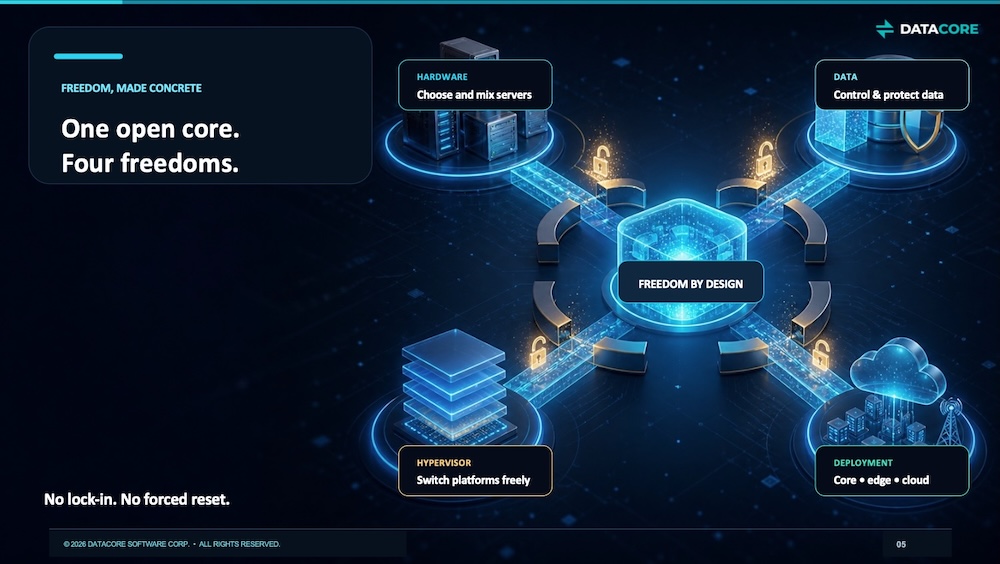
DataCore’s founding purpose is to give customers and partners freedom from infrastructure constraints, platform barriers, and data lock-in, letting them choose their technology stack on their own terms. This is made concrete through “four freedoms” built on one open core: hardware (choose and mix servers), data (control and protect it), hypervisor (switch platforms freely), and deployment (core, edge, cloud). In a market where server availability is under pressure, DataCore lets customers choose, mix, reuse, and refurbish x86 hardware from any vendor, turning hardware scarcity into an input rather than a dependency trap. Post-Broadcom/VMware uncertainty is addressed directly: customers can change hypervisors (ESXi, Hyper-V, Proxmox, XCP-ng, Xen) while keeping independent data services and continuity intact.
Click to enlarge
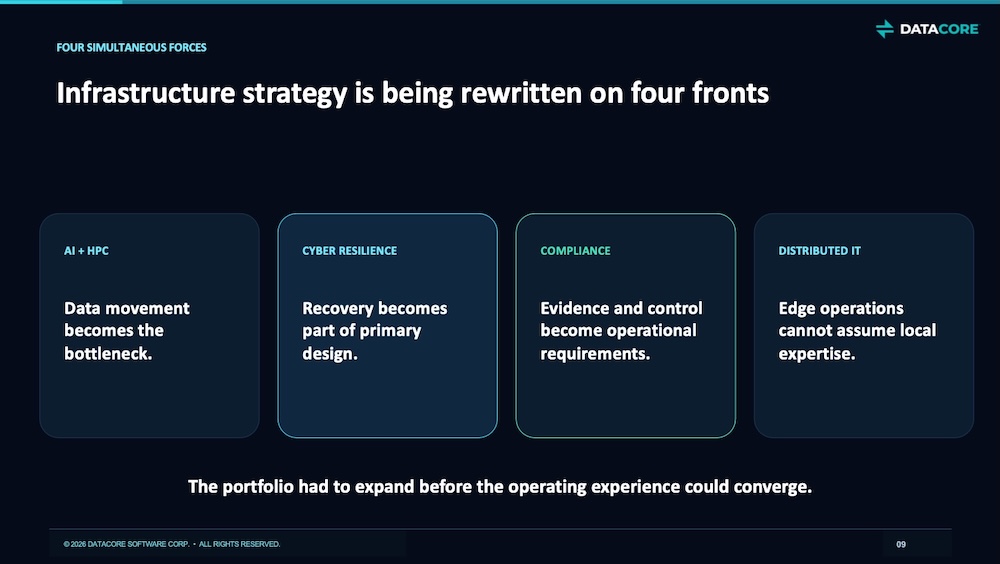
Data is no longer centralized and it is very disseminated, core, edge, cloud-native, and AI workloads each demand different performance, economics, and resilience models (“plurality”), making freedom more valuable but harder to operate. Four simultaneous forces are reshaping infrastructure strategy: AI/HPC (data movement bottlenecks), cyber resilience (recovery as a primary design principle), compliance (regulators like NIS2, DORA, and the Cyber Resilience Act now demand evidence, tested recoverability, trustworthy recovery points, audit trails, not just architecture diagrams), and distributed IT (edge sites lacking local expertise).
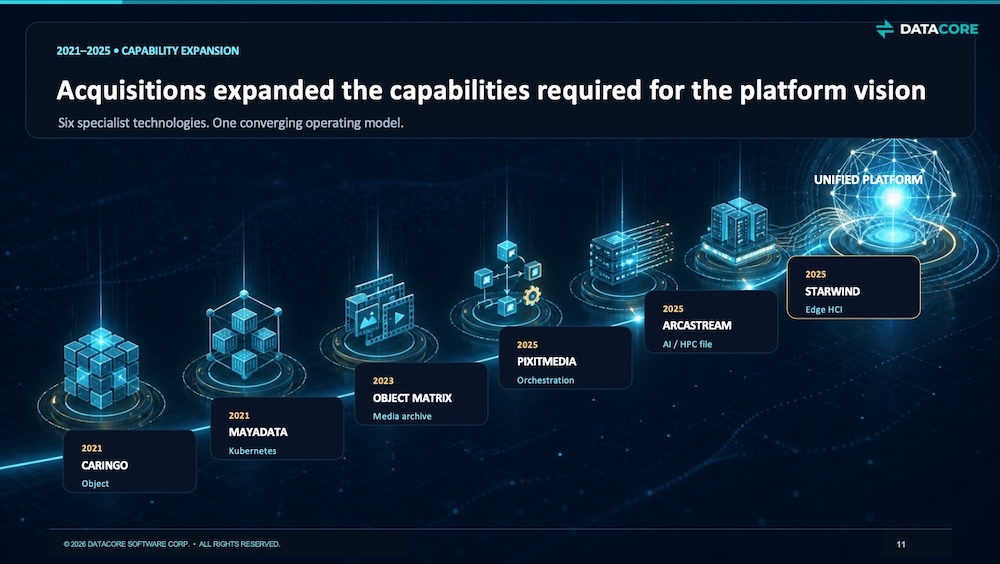
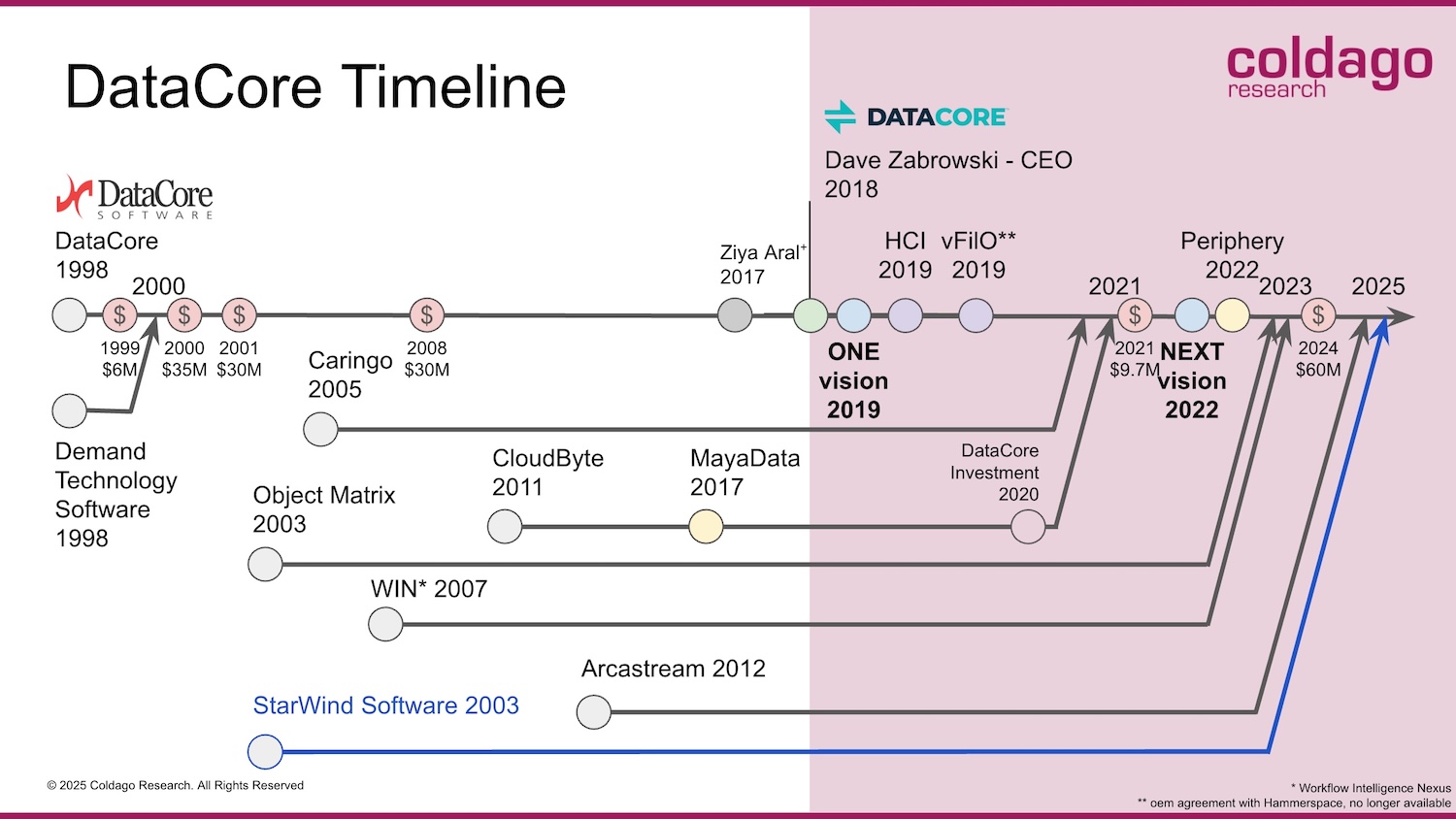
DataCore expanded capabilities through six acquisitions according to the image below: Caringo (object, 2021), MayaData (Kubernetes, 2021), Object Matrix (media archive, 2023), Pixitmedia (orchestration, 2025), Arcastream (AI/HPC file, 2025), and StarWind (edge HCI, 2025). The company stresses that “breadth ≠ unity”, acquiring specialist technologies is only phase one; real value comes from unifying engineering direction, go-to-market, technology (APIs, identity, telemetry), and operations (support, lifecycle). We don’t know why WIN, acquired in 2023 is not listed and we’re still surprised that PixitMedia and Arcastream are mentioned “twice”. Why DataCore continues to say that ArcaStream is a parallel file system like Swarm and SANsymphony as these two provide real object and block storage. ArcaStream relies on IBM GPFS/Spectrum Scale/Storage Scale as a foundation adding a management and orchestration layer on top. But s we wrote many years ago, DataCore needs a file storage solution, this is why they oemed in 2019 Hammerspace as vFilO for a limited period.
Click to enlarge
Clearly, the strategy evolved from acquisition to integration to one platform. The transformation arc is Acquire → Integrate → Unify → Autonomize, converging block, file, object, container, and HCI storage into one platform experience (shared identity, telemetry, policy, automation, support) without sacrificing infrastructure choice.
Click to enlarge
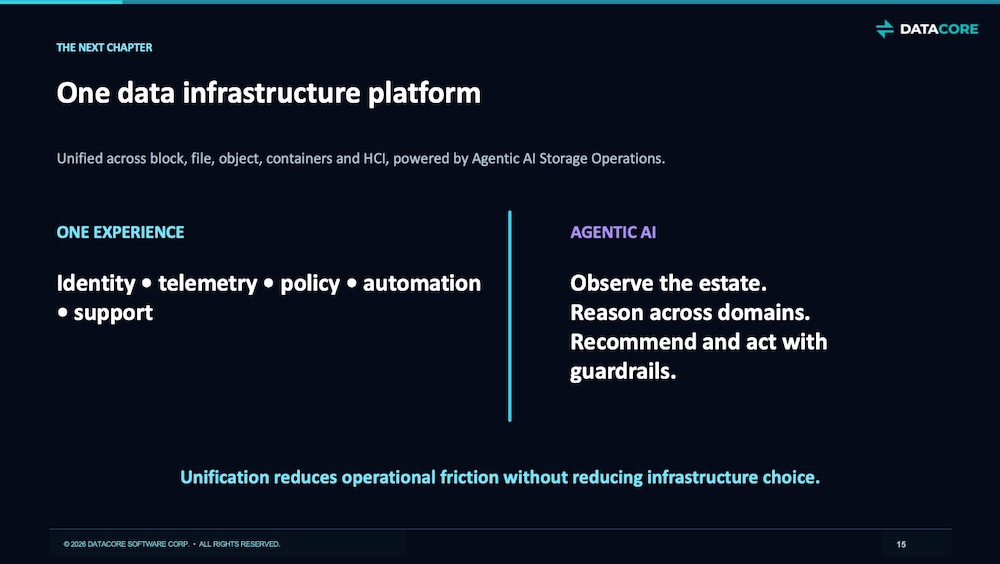
This unification of the product line is a fundamental strategy aspect but beyond that adding Agentic AI into IT operations is the next journey. DataCore is moving from dashboards that describe problems to systems that help resolve them, using an Observe → Reason → Recommend → Act loop, with human policy and approval remaining the control plane. Guardrails include policy, approvals, auditability, rollback, and explainability. Priority use cases: capacity prediction, performance bottleneck detection, cyber resilience verification, compliance monitoring, lifecycle management, and support diagnostics.
Click to enlarge
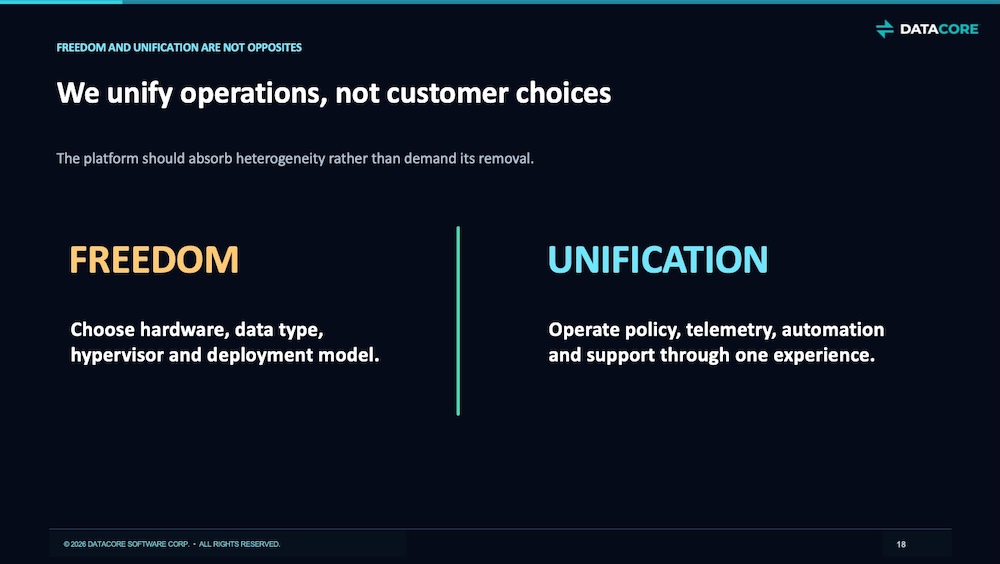
As it was well described by Said Boukhizou, the product portfolio offers different engines towards one direction: SANsymphony (block), StarWind (edge/ROBO/SMB HCI), Swarm (cyber-resilient S3/archive), Nexus (parallel file/orchestration), and Puls8 (Kubernetes storage). We expect some news with details during IBC 2026 and later during the DataCore Days, paramount for the company and the potential exit strategy, many observers, executives, employees, investors… expect.
Comments
We wish to add the last timeline built by Coldago Research about DataCore.
Click to enlarge







 Subscribe to our free daily newsletter