




Company Profile: Scale Computing
Entering a new era for a few months
By Philippe Nicolas | February 4, 2026 at 2:01 pmCompany name:
Scale Computing

HQ and offices:
Austin, Texas (HQ); Indianapolis, IN; San Francisco, CA and Netherlands (EMEA HQ)
Website:
scalecomputing.com
Date founded:
2002
Founders:
Brett Stewart and Dirk Heinen founded the company after selling Wayport, a leading ethernet solution provider to AT&T.
Leaders:
 William (Bill) Morrow, CEO
LinkedIn profile

Mark Cree, president and COO
LinkedIn profile
 Brett Stewart, CTO and co-founder

Richard Newman, CSO
LinkedIn profile
 Scott Loughmiller, CPO
LinkedIn profile
Click to enlarge
Financial funding:
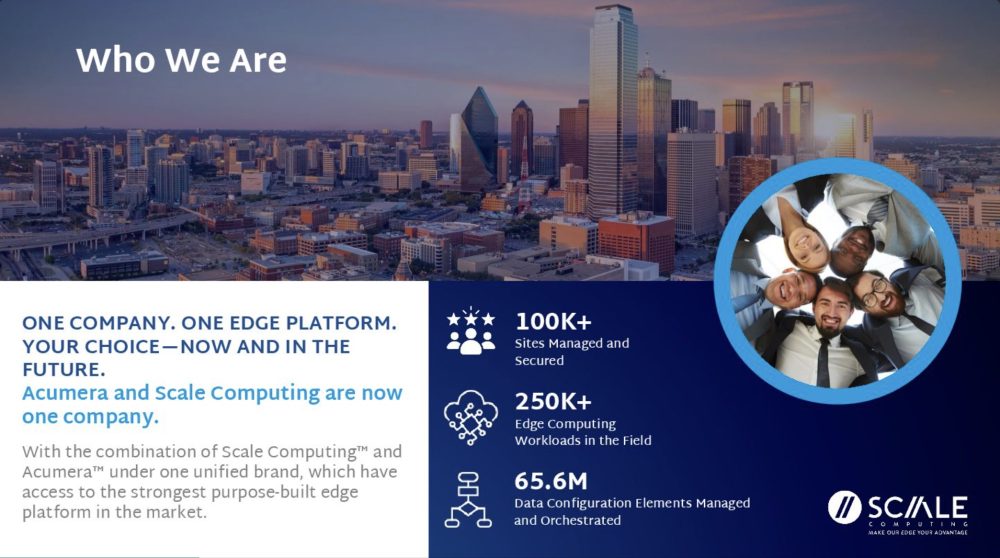
Privately held; revenue not publicly disclosed.
Employees numbers:
500
Supports a global organization spanning North America and EMEA, with dedicated regional sales, channel, marketing, and solutions architecture teams.
Revenue:
Not publicly disclosed
Click to enlarge
Technology:
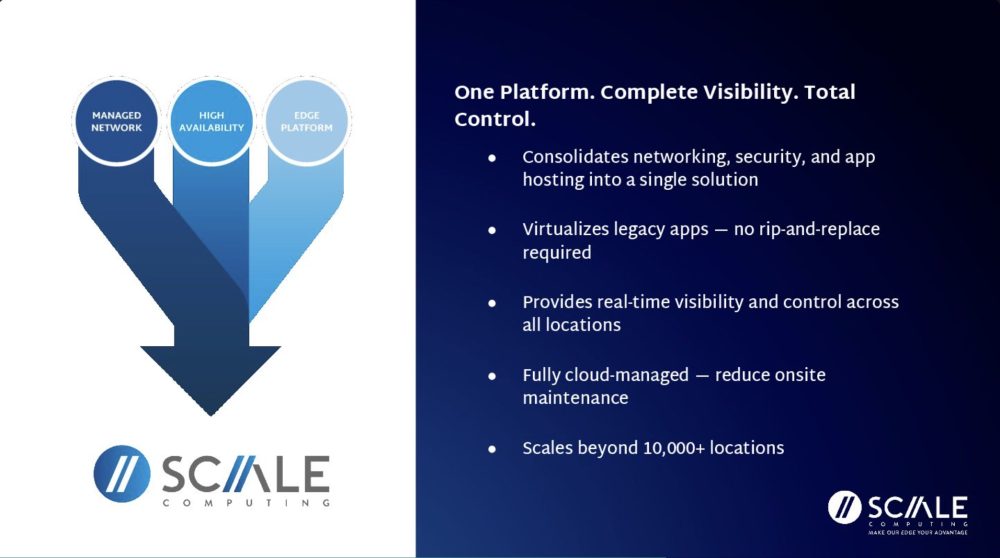
Scale Computing delivers edge-native, software-defined infrastructure that converges:
- Virtualization
- Storage
- Compute
- Edge orchestration
- Network services and security
Its architecture is designed for distributed, low-touch environments where applications must run close to where data is generated – the edge. The platform emphasizes:
- Self-healing automation
- Integrated virtualization
- AIOps-driven operations
- High availability in locations without local IT staff
- Centralized, cloud-based fleet management
Products:
Click to enlarge
- Scale Computing Platform – Edge computing solution delivering integrated compute, storage, and virtualization at the edge
- Scale Computing Fleet Manager – Cloud-based, single-pane-of-glass orchestration for large fleets of edge clusters, including Zero-Touch Provisioning (ZTP) and application lifecycle management
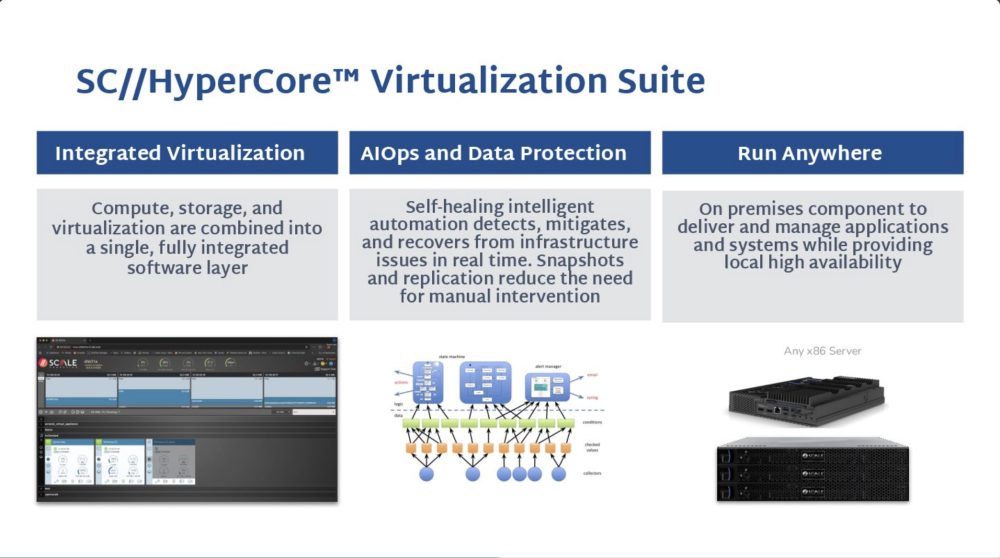
- Scale Computing HyperCore – Integrated virtualization suite combining compute, storage, and virtualization in a single software layer with self-healing automation and built-in data protection
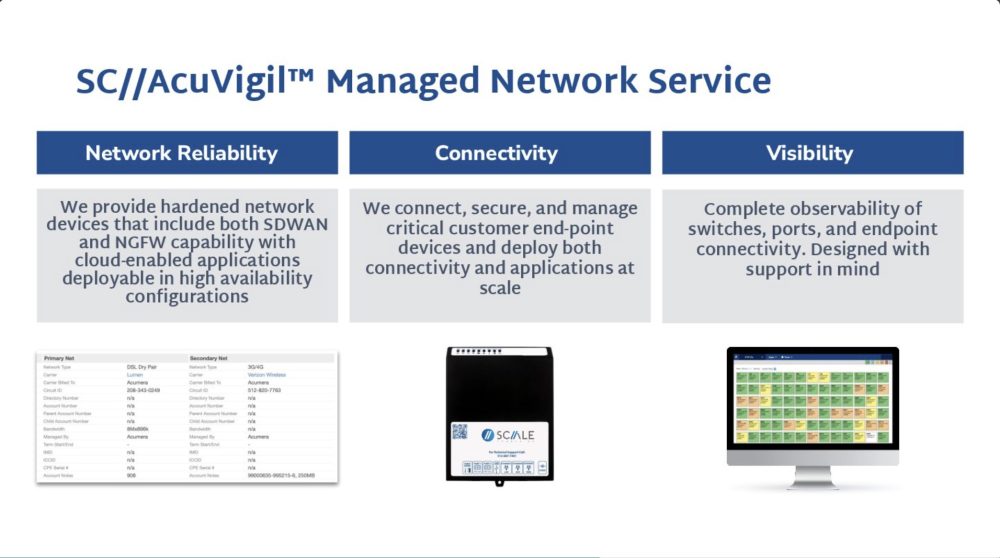
- Scale Computing AcuVigil – Managed network service delivering SD-WAN, NGFW capabilities, endpoint connectivity, and secure edge networking with full observability
- Scale Computing Reliant Platform – Edge Computing as a Service (ECaaS), providing managed, API-driven configuration, orchestration, monitoring, and in-location high availability
Click to enlarge
Release and Roadmap:
- Expansion of AI at the edge use cases
- Support for containerized and Kubernetes workloads alongside VMs
- Large-scale fleet operations (10,000+ sites)
- Further integration of networking, security, and application hosting into a unified edge platform
- Continued evolution of cloud-based fleet orchestration and remote lifecycle management capabilities
Pricing model and price:
Scale Computing’s pricing strategy is designed to be transparent, flexible, and scalable across a variety of deployment types and customer sizes. It combines software licensing, subscription terms, hardware configurations, and optional support services into bundled offerings that align with use-case needs rather than one-size-fits-all list prices.
Core Pricing Principles
- Tiered Licensing: The primary software platform (SC//Platform and HyperCore virtualization) is offered in multiple license tiers – from entry-level capabilities up to full feature sets including advanced tools like replication and AI workload support
- Usage-based Metrics: Standard and Professional software licenses are typically priced per core per year, with multi-year minimum terms (e.g., five-year commitments), enabling predictable annual costs
- Hardware & Software Bundling: For appliances and full node clusters, quotes include both the underlying hardware and the integrated SC// software. Customized pricing is available via an online pricing tool that delivers real-time, configuration-based quotes
- No Hidden Fees: Pricing is positioned as transparent and upfront – Scale emphasizes clarity and avoidance of surprise add-ons that can arise with legacy virtualization licensing
License Tiers (Examples)
According to public pricing guidance and industry summaries:
- Standard: A reliable, affordable base tier including essential HyperCore virtualization and distributed storage services. Entry pricing has been noted around $249 per core per year (with minimum term commitments)
- Professional: Adds advanced features such as replication, enhanced performance tools, and GPU virtualization support for scaling and AI workloads. Typical pricing runs higher, around $312 per core per year with similar multi-year term requirements
- Professional Essentials: A simplified, all-inclusive package (e.g., 3-node cluster with defined RAM per node) tailored for small/medium deployments – historically starting around $5,600 per year on a five-year term
Quote & Pricing Tools
- Instant Pricing Tool: Scale Computing provides a live configuration-based tool on its website that allows partners and customers to select specific appliances, software modules, support levels, and term lengths, returning an accurate, context-sensitive pricing quote quickly
Value Positioning
- Scale Computing frames its pricing as simplified TCO, moving away from complex legacy licensing fees (e.g., separate virtualization, storage, and backup licensing) and toward integrated infrastructure that is easier to budget and operate
GTM:
Historically 100% channel-driven, selling through:
- Regional and global partners
- MSPs
- VARs
- OEM relationships
Strong emphasis on vertical-specialized partners delivering services on top of the platform. The company is now evolving toward a hybrid model, adding more direct and enterprise sales engagement while maintaining a strong partner ecosystem.
Customers:
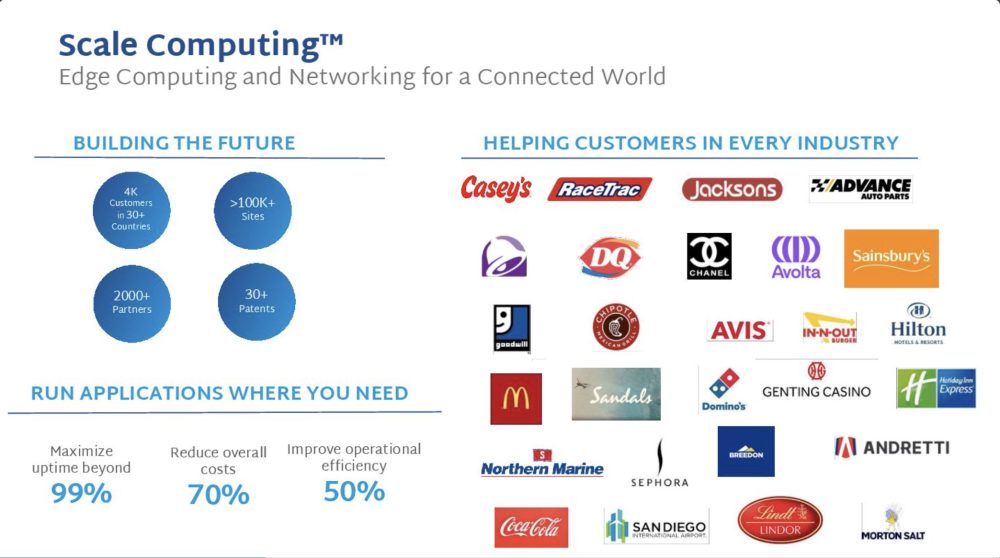
Mid-market and enterprise organizations operating highly distributed environments, including:
- Retail chains
- Quick-service restaurants (QSR)
- Convenience stores and gas stations
- Manufacturing
- Logistics
- Healthcare
- Education
- Public sector
Workloads/Use cases/Applications:
- Point-of-sale (POS) and retail systems
- AI-driven voice ordering (drive-thru)
- IoT data collection and analytics
- Local data processing and BI (e.g., PowerBI, Azure IoT integrations)
- Containerized analytics workloads (Kubernetes at the edge)
- Payment systems and PCI-sensitive workloads
- Legacy app virtualization (no rip-and-replace required)
- Store networking, security, and endpoint connectivity
Target market:
Scale Computing focuses on organizations with:
- Ten, to Hundreds, to tens of thousands of distributed sites
- Limited or no onsite IT staff
- Real-time operational requirements
- Compliance and security needs at the edge
- A mix of legacy and modern, containerized workloads
Competition:
- Broadcom / VMWare
- Nutanix
- StorMagic
- Proxmox
- Verizon Business
Comments
The recent 66th edition of The IT Press Tour, last week in California, has been the opportunity to get a fresh update on the company and products strategy.
Scale Computing has been a pioneer in software-defined infrastructure for more than two decades, delivering solutions that integrate multiple components and resources with a strong focus on edge computing. Its flagship solution, HyperCore, has built a substantial installed base and stands as a credible alternative to competing platforms.
The acquisition by Acumera came as a surprise to the market - and even internally - but it has unlocked meaningful synergies and opportunities by bringing together two converging portfolios. The transaction was accompanied by leadership changes, including the departure of Jeff Ready and the appointment of Mark Cree as President and COO of the new Scale Computing organization, while Scott Loughmiller continues in his role as CPO.
The newly formed Scale Computing now has a significant opportunity to prove that 1+1 can be greater than 2, driven by deeper integrations, expanded up-sell and cross-sell initiatives, and an IT environment increasingly shaped by consolidation and shifting workloads between on-premises and the cloud. Edge computing has shown sustained growth over many years, reflecting the increasingly distributed nature of modern enterprises in a geographically dispersed world.
Click to enlarge
Looking ahead, AI-driven integrations are expected to further enhance edge-focused product offerings, enabling more efficient control of thousands of distributed nodes while reducing and optimizing IT operations and management costs.







 Subscribe to our free daily newsletter