




CES 2026: Phison Showcases Gen5 Storage to Redefine User Experiences
With E37T cost-effective PCIe Gen5x4 NVMe 2.0 SSD controller designed to deliver performance with active power efficiency measurement of under 2.3W, E28 isPCIe Gen5x4 NVMe 2.0 SSD, and Pascari X201/D201 enterprise SSDss
This is a Press Release edited by StorageNewsletter.com on January 8, 2026 at 2:00 pmPhison Electronics Corp. announced the newest addition to its product portfolio, the E37T PCIe Gen5 controller, to be featured alongside its suite of client solutions at CES 2026.

Built with best-in-class efficiency, the E37T utilizes 3D NAND to deliver competitive price-to-performance value for modern consumer workloads across notebooks and mobile devices.
To meet the demand for cost-efficient solutions, the E37T brings core architecture refinements over previous generations to support the latest 3D NAND with up to 4,800MT/s speeds, providing a 38% performance gain for maximum value. (1) The new controller features DRAM-less design and 4-channels making the E37T the single-sided design for notebooks, handhelds and compact systems that require M.2 2280, 2242 or 2230 form factor storage without sacrificing performance.
“As consumer applications demand greater storage capacity and sustained performance in small spaces, the E37T is designed to deliver power-efficient operation while pushing the Gen5 performance ceiling,” said Michael Wu, president and GM, Phison US. “With the next wave of platforms introducing PCIe Gen5 in smaller form factors, the E37T expands our portfolio with a versatile, high-value storage solution that brings faster, more responsive user experiences to a broad range of devices and use cases.”
Announcement follows the successful launch of the company’s E28 PCIe Gen5 controller, delivering exceptional performance for demanding gaming and workstation workloads. The E28 has received industry recognition for its top speeds and now comes in a larger 8TB (2) capacity.
Phison will showcase its latest consumer and enterprise portfolio solutions at the company’s Bellagio Suite during CES from January 6-8, 2026, including:
E28 Flagship PCIe Gen5 SSD: Performance Without Compromise
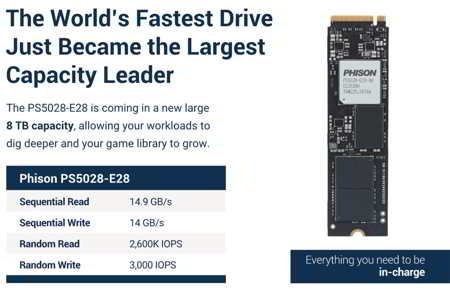 The Phison E28 is a PCIe Gen5x4 NVMe 2.0 SSD engineered for hardware enthusiasts and professional environments where maximum performance, efficiency and reliability are critical. Built on TSMC’s advanced 6nm process, it delivers up to 14.9GB/s sequential reads, and 14GB/s sequential writes for exceptional load times in gaming, content creation, and workstation workloads. (3) The E28 significantly improves power efficiency and thermals, delivering sustained high performance for high-end laptops. With support for the latest 3D TLC NAND, an 8-channel design with DRAM cache and NVMe 2.0, the E28 sets a new standard for uncompromising Gen5 SSD performance.
E37T PCIe Gen5 SSD: Cost-Efficient Performance for the Mainstream
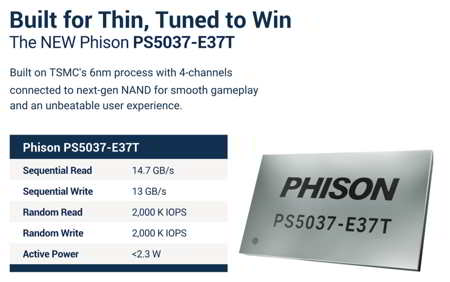
The firm’s E37T is a cost-effective PCIe Gen5x4 NVMe 2.0 SSD controller designed to deliver leading performance with an active power efficiency measurement of under 2.3W. Optimized for OEMs, system builders and mobile platforms, E37T achieves up to 14.7GB/s sequential reads and 13.0GB/s sequential writes, with up to 2,000K 4KB random IOs. (3) Its DRAM-less, 4-channel design keeps power consumption and thermals low, making it a choice for next-gen laptops and mobile gaming using compact form factors.
Pascari X201 and D201 Gen5 Enterprise SSDs: Optimized Performance from Extreme Speed to Hyperscale Efficiency
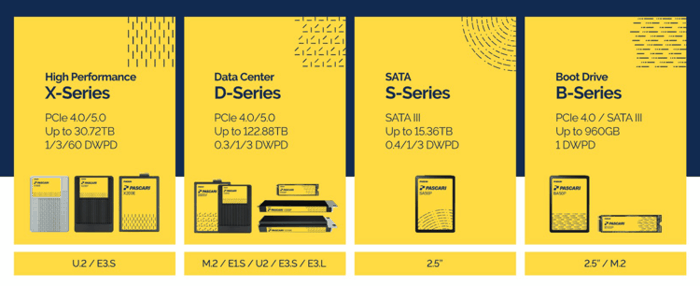
The firm’s Pascari X201 and D201 enterprise SSDs span data center needs from extreme performance to high-density efficiency. The Pascari X201 targets the most demanding workloads including AI training, analytics, high-frequency trading and HPC to deliver ultra-low latency, exceptional throughput and power-efficient reliability. The Pascari D201 is optimized for hyperscale and cloud environments, pairing PCIe Gen5 performance with enterprise-grade reliability for efficient operation across object storage, database clusters, content delivery and data center consolidation.







 Subscribe to our free daily newsletter