


Coldago Map 2026 for Object Storage
The edition covers 14 vendors, a lineup that reflects recent changes in the market, with new dynamics and new use cases
This is a Press Release edited by StorageNewsletter.com on November 26, 2026 at 2:02 pmColdago Research, an independent market research and analysis firm, recently released the 8th edition of its Object Storage Map.
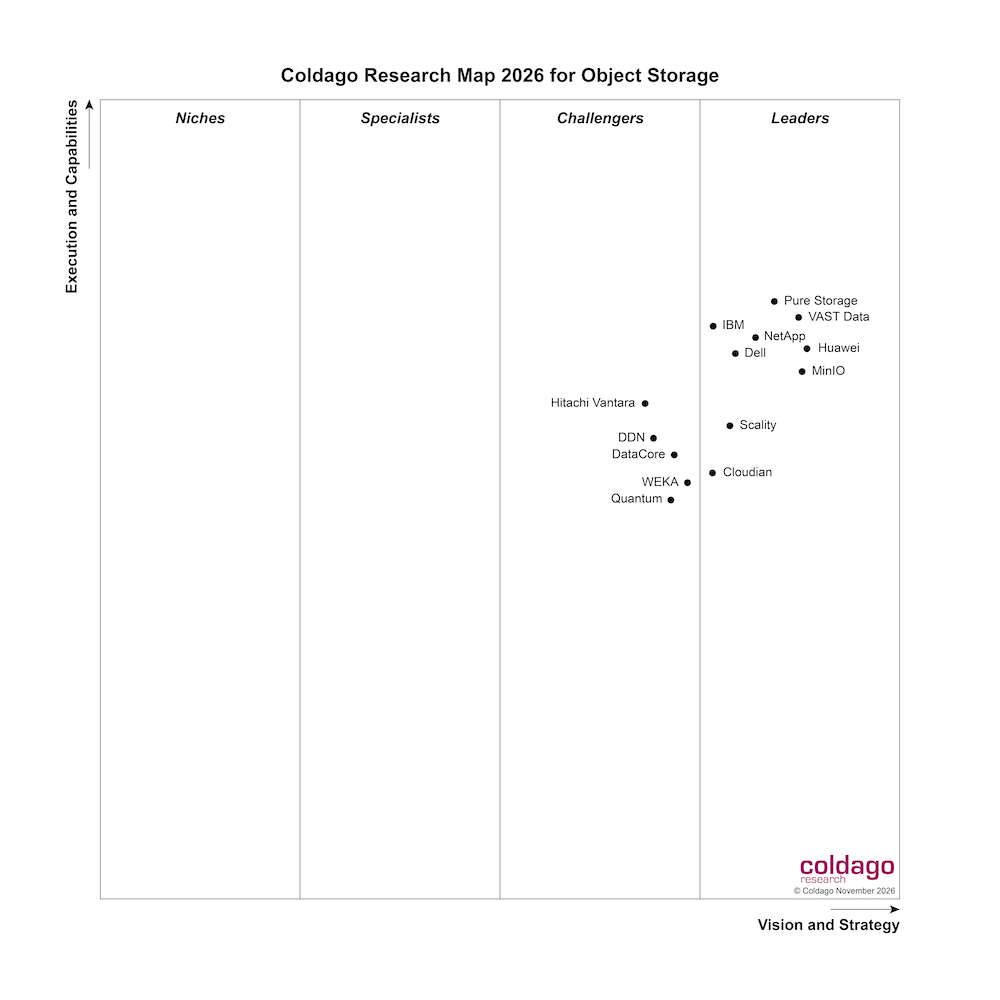
The 2026 edition reflects how the market has shifted, including new use cases. It evaluates 14 vendors, sees DDN return to the list, and names 9 leaders: Cloudian, Dell, Huawei, IBM, MinIO, NetApp, Pure Storage, Scality and VAST Data.

Over each 12-month cycle, Coldago builds every Map on a broad base of information: direct exchanges with vendors, end users and partners if needed, plus close analysis of product announcements, customer case studies and strategic alliances. The Map is not a forecast. It shows where vendors stand in the market today, like a mirror, based on their track record and weighted toward the most recent 12 months. Where relevant, vendors also complete a dedicated evaluation matrix. It covers the product portfolio and the features tied to the Map’s scope, as well as business operations, user profiles and installed base. The Coldago team then segments, groups and normalizes this input so that vendors can be compared and ranked on a consistent basis.
Coldago ranks companies, not individual products, and looks at every offering a vendor has that fits a given Map. A vendor isn’t reduced to one flagship product. The assessment covers its full presence in the storage segment under review. A vendor with only one relevant solution is assessed on that product, and one with several is assessed on the whole relevant portfolio, so the Map reflects each company’s real market footprint. To be included in the matrix, a product, or an extension to an existing one, must have been generally available for at least six months and be actively marketed as an official GA release. There is no minimum company age, but each product must have production deployments, which shows a basic level of market adoption. Coldago also applies its own selection criteria and excludes SMB-oriented and entry-level offerings from the analysis.
Click to enlarge
The evaluation matrix lets analysts look at vendors across several dimensions, grouped under company profile, business and strategy, and products and technologies.
- Company profile. Analysts examine the executive team, the founders and their backgrounds, the company’s track record with its main wins and setbacks, its age, geographic reach, headcount and financial position. On funding, this includes venture capital backing (total raised, number of rounds, type of investors), IPO status, market visibility and possible exit paths…
- Business and strategy. The review covers the business model, go-to-market approach, alliances, partnerships and OEM agreements, pricing, revenue figures, financial ratios, deal activity and operational efficiency. It also looks at the use cases addressed, target verticals, solution strategy, customer references, the size of the installed base, customer retention and repeat purchases, competitive wins, product removals by customers, and general business conduct…
- Products and technologies. This part centers on product–market fit, current releases, how the product has evolved and where it is headed, release frequency, intellectual property and patents, development agility, and internal design and architecture. Analysts also weigh the adoption of new technologies and industry standards, involvement in standards bodies, feature richness, access methods, data protection, services, cloud integration and performance. Public participation in official benchmarks and published results are taken into account too. The use of open-source components and third-party integrations is reviewed with a focus on who really owns the technology, and Coldago gives more credit to solutions designed and built in-house than to those assembled mostly from external parts. Customer-facing incidents such as data corruption, loss of data integrity or regressions can also lower a vendor’s ranking, beyond its data protection features alone…
After the data is collected, normalized and weighted, Coldago runs it through a set of proprietary formulas that produce comparative indexes. These algorithms are the analytical core of the study: they turn raw data into the Coldago Index and then into the Coldago Map, i.e the image above.
Once again, Coldago ranks companies on the market presence and performance they have actually shown over the past 12 months, not on future expectations, potential or hypothetical scenarios.




 Subscribe to our free daily newsletter