



Seagate: Fiscal 1Q27 Financial Results
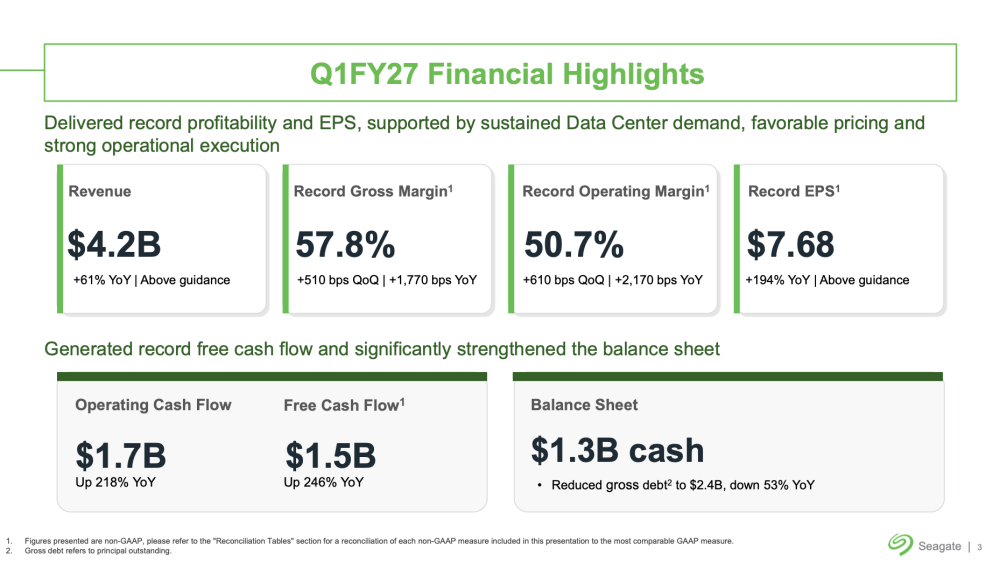
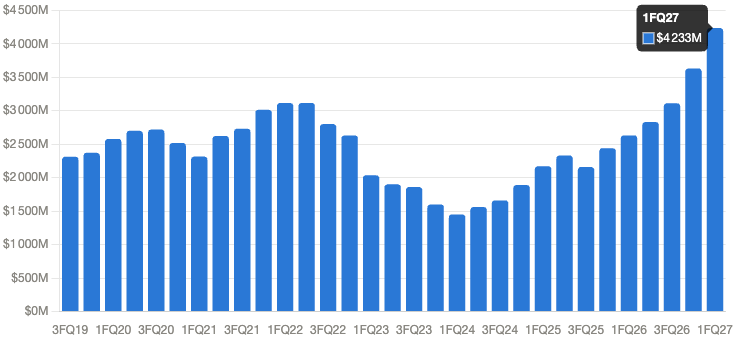
Generating $4.2 billion, up 16% QoQ and up 61% YoY
This is a Press Release edited by StorageNewsletter.com on October 28, 2026 at 2:01 pmSummary:
- Revenue of $4.2 billion
- GAAP gross margin of 57.3%; non-GAAP gross margin of 57.8%
- GAAP diluted earnings per share (EPS) of $7.59; non-GAAP diluted EPS of $7.68
- Cash flow from operations of $1.7 billion and free cash flow of $1.5 billion
- Retired $1.2 billion of debt and returned $568 million to shareholders through dividends and share repurchases
- Increased quarterly cash dividend by approximately 3% to $0.76 per share
Seagate Technology Holdings plc, an innovator of mass-capacity data storage, reported financial results for its fiscal first quarter ended October 2, 2026. “Seagate delivered another quarter of record profitability and our highest ever free cash flow in the September quarter, demonstrating the earnings power of our business amid a strengthening demand environment,” said Dave Mosley, chair and CEO, Seagate.
“Data creation, retention and reuse continue to compound storage demand with long term customer demand visibility reinforcing our view of a multi-year growth phase. Our HAMR-based technology roadmap enables us to address growing exabyte demand through areal density gains while maintaining supply discipline. Combined with our value-based pricing strategy and strengthened balance sheet, we believe Seagate can deliver profitable growth, strong cash generation and increased shareholder returns over the long term,” concluded Mosley.
Quarterly Financial Results
Click to enlarge
For a detailed reconciliation of GAAP to non-GAAP results, see accompanying financial tablesonline.
Click to enlarge
During the fiscal first quarter, the company generated $1.7 billion in cash flow from operations and $1.5 billion in free cash flow. Seagate’s balance sheet strengthened as the company retired approximately $1.2 billion in principal debt in the fiscal first quarter, lowering gross debt to $2.4 billion. Additionally, the company returned $568 million to shareholders through dividends and share repurchases. As of the end of the quarter, cash and cash equivalents totaled $1.3 billion, and there were 230 million ordinary shares issued and outstanding.
Subsequent to the end of the fiscal first quarter, the company retired an additional $750 million of principal debt, bringing gross debt to $1.6 billion.
Quarterly Cash Dividend
The board of directors of the company declared a quarterly cash dividend of $0.76 per share, which will be payable on January 7, 2027 to shareholders of record as of the close of business on December 23, 2026. The payment of any future quarterly dividends will be at the discretion of the board and will be dependent upon Seagate’s financial position, results of operations, available cash, cash flow, capital requirements and other factors deemed relevant by the board.
Business Outlook
The business outlook for the fiscal second quarter of 2027 is based on our current assumptions and expectations; actual results may differ materially as a result of, among other things, the important factors discussed in the Cautionary Note Regarding Forward-Looking Statements section of this release.
The company is providing the following guidance for its fiscal second quarter 2027:
- Revenue of $4.8 billion, plus or minus $100 million
- Non-GAAP diluted EPS of $9.20, plus or minus $0.20
Guidance regarding non-GAAP diluted EPS excludes known pre-tax charges related to estimated share-based compensation expenses of $0.30 per share.
We have not reconciled our non-GAAP diluted EPS guidance for fiscal second quarter 2027 to the most directly comparable GAAP measure, other than estimated share-based compensation expenses, because material items that may impact these measures are out of our control and/or cannot be reasonably predicted, including, but not limited to, net (gain) loss from debt transactions, strategic investment losses (gains) or impairment charges, income tax adjustments on these measures, and other charges or benefits that may arise. The amounts of these measures are not currently available but may be material to future results. A reconciliation of our historical non-GAAP financial measures to their nearest GAAP equivalent is contained in this release.
Comments
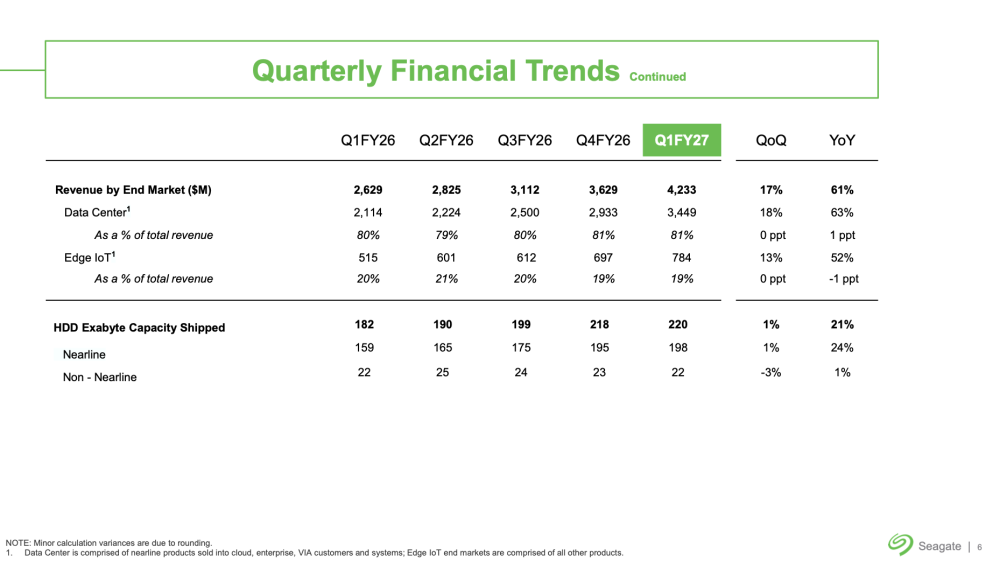
Seagate reported strong results for its first fiscal quarter of 2027 confirming the remarkable momentum of the HDD industry. Revenue reached $4.23B, up 61% YoY and 17% sequentially, compared with $3.63B in the preceding quarter. The company significantly exceeded its original revenue guidance of $4.1B, illustrating the strength of demand for mass-capacity storage. The penury of component and AI pressure have made positive impacts on several players such Seagate.
Data center revenue reached $3.4B, representing approximately 81% of total sales, with 63% annual growth. Seagate shipped a record 198 exabytes of nearline capacity, while total shipments reached 220 exabytes.
The company's Mozaic HAMR technology is becoming a decisive competitive advantage. Mozaic 4, supporting capacities up to 44TB, is ramping at major hyperscalers, with further qualifications underway. Seagate expects HAMR products to represent approximately half of its nearline exabyte shipment run rate by the end of calendar 2026.
Click to enlarge
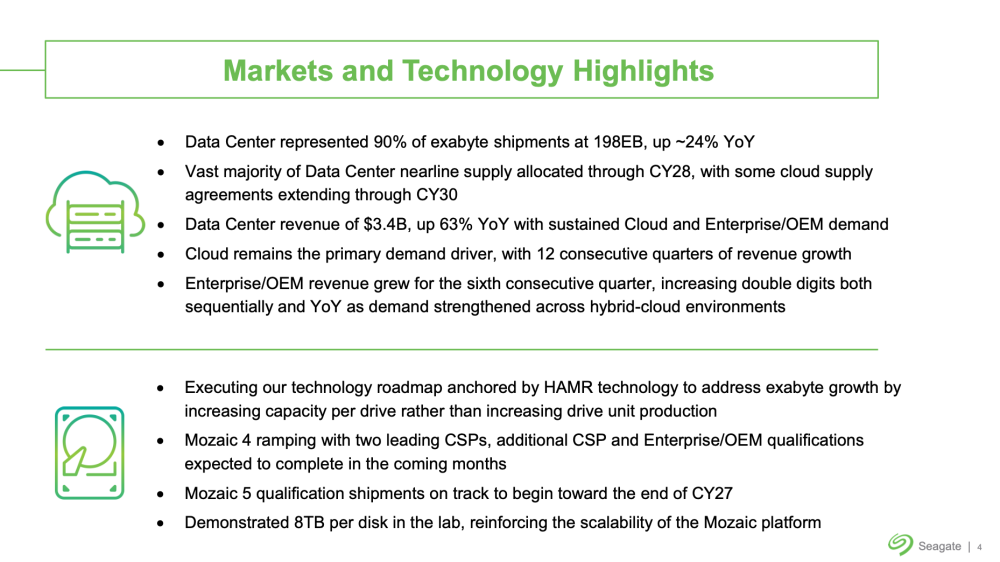
For 2Q27, Seagate forecasts revenue of $4.8B, plus or minus $100M, and non-GAAP EPS of $9.20. Management expects operating margins to approach the mid-50% range. The vast majority of nearline capacity supply is already allocated through calendar 2028, with certain cloud agreements extending to 2030, providing unusual long-term visibility.
Seagate's performance reflects a profound transformation of the storage market. AI infrastructure requires not only GPUs, HBM and high-performance SSDs, but also enormous volumes of economical, persistent storage for datasets, generated content and long-term retention.
Equally important, the HDD market has become concentrated around three suppliers: Seagate, Western Digital and Toshiba. Disciplined production, increasing areal density and value-based pricing are changing industry economics. Revenue can now grow substantially faster than shipped capacity, translating directly into exceptional margins.
HAMR is central to this strategy, allowing Seagate to increase capacity per drive without proportionally expanding manufacturing output. This strengthens its competitive position while improving hyperscalers' storage economics.
However, the extraordinary profitability also raises questions about sustainability. Dependence on a limited number of hyperscalers, manufacturing complexity, rising component costs and potential changes in AI capital expenditure remain significant risks.
The critical question is whether Seagate has entered a sustainable, multi-year profitability cycle or is benefiting from an unusually favorable supply-demand imbalance. Current customer commitments, technology differentiation and accelerating cash generation strongly support the structural-growth argument, although maintaining these exceptional margins will require continued discipline.
Below we add a quarterly revenue trajectory since 3Q19 illustrating a strong growth since 1Q24 except 3Q25.




 Subscribe to our free daily newsletter