









OCP Global Summit 2026: IDC Raises 2029 Forecast for OCP-Recognized Infrastructure Spending by 2.7x to $800 Billion
Annual study commissioned by the Open Compute Project Foundation projects spending will reach $892 billion in 2030 as AI investment and adoption expand
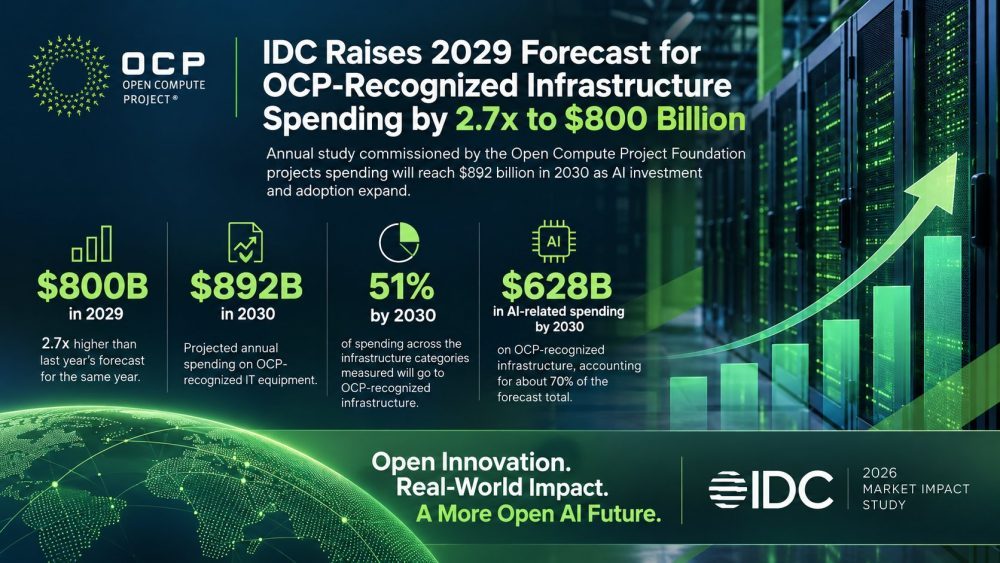
This is a Press Release edited by StorageNewsletter.com on October 15, 2026 at 2:01 pmThe Open Compute Project (OCP) Foundation announced a sharp increase in IDCs forecast for worldwide spending on OCP-recognized IT equipment. The 2026 IDC Market Impact Study projects annual spending of approximately $800 billion in 2029, up from the $295 billion forecast for the same year in last year’s study—an increase of approximately 2.7x. The new forecast reaches $892 billion in 2030, when OCP-recognized IT equipment is projected to account for approximately 51% of all spending across the infrastructure categories covered by the study.
Commissioned annually by the OCP Foundation, the study assesses the market impact of OCP-recognized equipment. This year’s findings reflect both the rapid expansion of AI infrastructure investment and broader adoption of OCP designs.
“AI is changing what the industry needs from its infrastructure, and these findings show the growing role of open designs in meeting that demand,” said Cliff Grossner, Ph.D., Chief Innovation Officer, OCP Foundation. “Our Community is bringing companies together to solve challenges that span the entire data center, from silicon and servers to cooling, power and the grid. That collaboration helps organizations put new technology to work at scale.”
AI Investment Drives Growth
IDC projects spending on OCP-recognized IT equipment will grow from approximately $154 billion in 2025 to $892 billion in 2030, representing a compound annual growth rate of approximately 42%.
Servers represent the largest spending category, with GPU-accelerated systems driving much of the growth. IDC also forecasts continued growth in switching equipment, rack infrastructure, power and cooling as organizations build the systems needed to support increasingly demanding workloads.
Key findings include:
- $800 billion in projected annual spending in 2029, approximately 2.7 times the prior forecast for that year
- $892 billion in projected annual spending in 2030, including approximately $814 billion in servers
- Approximately 51% of spending across the infrastructure categories measured going to OCP-recognized infrastructure by 2030
- Approximately $628 billion in AI-related spending on OCP-recognized infrastructure in 2030, accounting for about 70% of the forecast total
Click to enlarge
IDC also points to the growing ecosystem of solution providers and the availability of openly shared designs as factors supporting adoption. Use of OCP-recognized IT equipment extends beyond the Foundation’s formal membership to organizations that access and implement those designs worldwide.
Advancing Open Infrastructure from Chip to Grid
The findings reinforce OCP’s expanded Open Data Center Ecosystem Vision, which addresses the interconnected demands of AI infrastructure from chip to grid.
Over the past year, the OCP Community has advanced higher-power rack designs, liquid cooling, Ethernet-based AI networking and open chiplet specifications. Its facilities work includes DC power distribution, energy storage, and coordination between data centers and the utility grid.
The Foundation’s Open Data Center for AI Strategic Initiative brings these efforts together across facility power, cooling and management. The OCP Energy Project extends collaboration into energy generation and storage, while the AI Computing Continuum project supports deployment beyond hyperscale data centers into enterprise, regional and edge environments.
As AI infrastructure evolves, OCP will focus on supporting diverse AI silicon, coordinating design across the data center, and developing open building blocks that organizations can deploy across a wider range of environments.
Comments
The 2026 OCP Global Summit, held this week in San Jose, California, confirms the extraordinary momentum behind AI infrastructure and open hardware standards.
These figures illustrate a fundamental transformation of the data center industry, with AI accelerating investments across computing, networking, storage, power distribution and cooling. No surpise here as we live this for a few years now with some phenomenal moves, investments, acquisitions and this famous "virtuous" circle among players.
The announcements made during the San Jose conference reinforce this trajectory. Nvidia introduced open designs around its Vera Rubin architecture, extending collaboration with Cisco, Google, Meta and Microsoft. AMD unveiled its Helion open rack-scale architecture for agentic AI workloads. Meta presented its IcePack liquid-cooled networking rack, IceCube 102.4Tbps switching platform, MetaRoCE transport protocol and Open Switch Platform Architecture initiative. Broadcom emphasized advanced Ethernet networking and optical connectivity, while Supermicro expanded its OCP-based rack-scale portfolio.
Beyond processors and accelerators, the industry is increasingly addressing megawatt-scale racks, 800V DC power distribution, liquid cooling, photonics and composable infrastructure. Storage is also evolving around AI-optimized SSDs, KV-cache management, NVMe and data-centric computing.
It confirms that a shift is happening as OCP is progressively moving beyond its hyperscaler origins to become a reference architecture for the broader AI infrastructure ecosystem, including neoclouds, enterprises and sovereign AI initiatives.
However, the spectacular IDC revision deserves some caution. These figures represent projected spending on OCP-recognized equipment, of course not OCP revenue or necessarily incremental market creation. They also depend heavily on sustained hyperscaler capital expenditure and AI monetization. And here there is a risk here beyond the fact this IDC report is commissioned.
The real test will be whether this unprecedented investment translates into sustainable economics beyond the current AI infrastructure expansion.







 Subscribe to our free daily newsletter