








IT Press Tour 70: VergeIO
An "infrastructure operating system" to replace VMware
By Philippe Nicolas | October 15, 2026 at 2:00 pmSecond participation this year for VergeIO joining The IT Press Tour with very active recent months both at the corporate and product levels. First, we had the privilege to meet Parag Patel, the new CEO, who joined the company recently and took over on September 8, 2026. Yan Ness moved to the board. Patel joined VMware in 2004, when it had about 500 employees. In his last five years there he ran worldwide vSAN sales and grew it to around 25,000 customers. He later worked at C3 AI and Forcepoint. New board members joined the company recently, former VMware CTO Kit Colbert arrived in June and former VMware ecosystem leader Zia Yusuf in July. Both also invested. The firm also recruited very recently Rémi Bargoing as VP EMEA Sales after 13 years at DataCore, most recently as VP of sales. His job is to build local sales teams and a partner network in each country. SVP Sales Chris Lehman said EMEA growth is “accelerating dramatically”.
Patel shared his view on the market: Broadcom will concentrate on its top 10,000 VMware customers and Nutanix is chasing the same accounts. That leaves about 300,000 VMware customers without a natural successor, many of them facing renewals of two- and three-year deals signed in 2023 and 2024. “We thought the market was finished, and now it’s opened up all over again,” he said.
Click to enlarge
One platform instead of five products
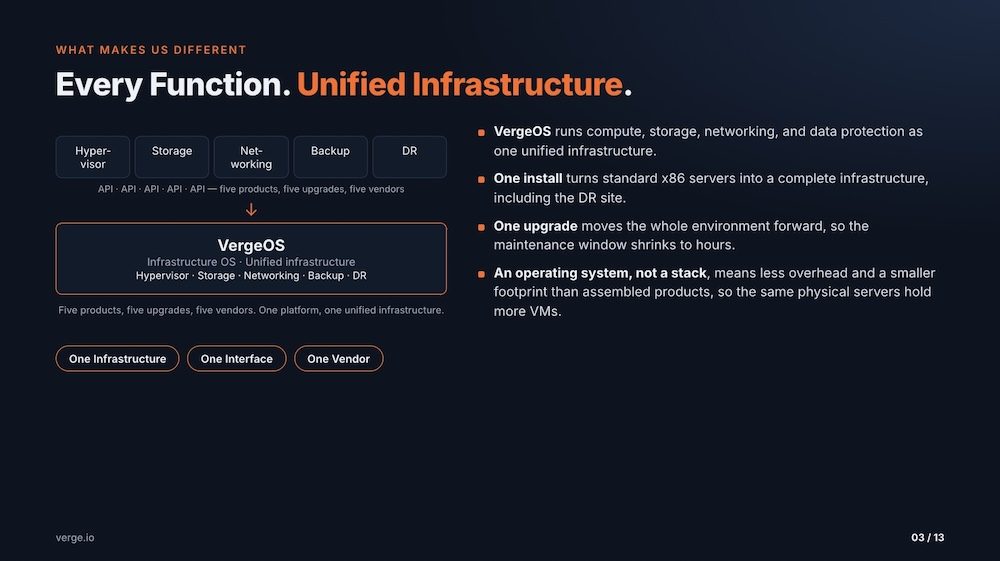
VergeOS runs the hypervisor, storage, networking, backup and disaster recovery as a single operating system on standard x86 servers, not as a stack of separate products. VergeIO argues this gives:
- one install, including the DR site
- one upgrade, so maintenance windows shrink to hours
- lower overhead, which Crump said fits 25–30% more VMs on each server
- a small codebase, under 400,000 lines in total
VergeOS is licensed per physical server, regardless of sockets, cores or capacity. VergeIO claims about 45% savings against VMware, and George Crump, CMO, said Topgolf’s own savings were closer to 96%, which went from six Dell VxRail servers per venue to three standard Dell servers across 110 venues. Pretty impressive.
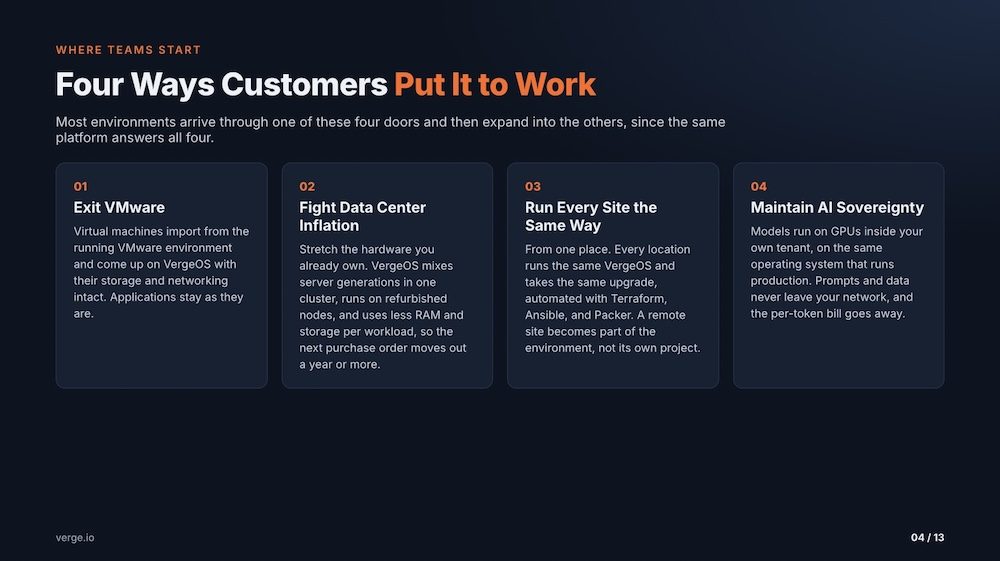
This unification invites users to consider 4 use cases for adoption and start
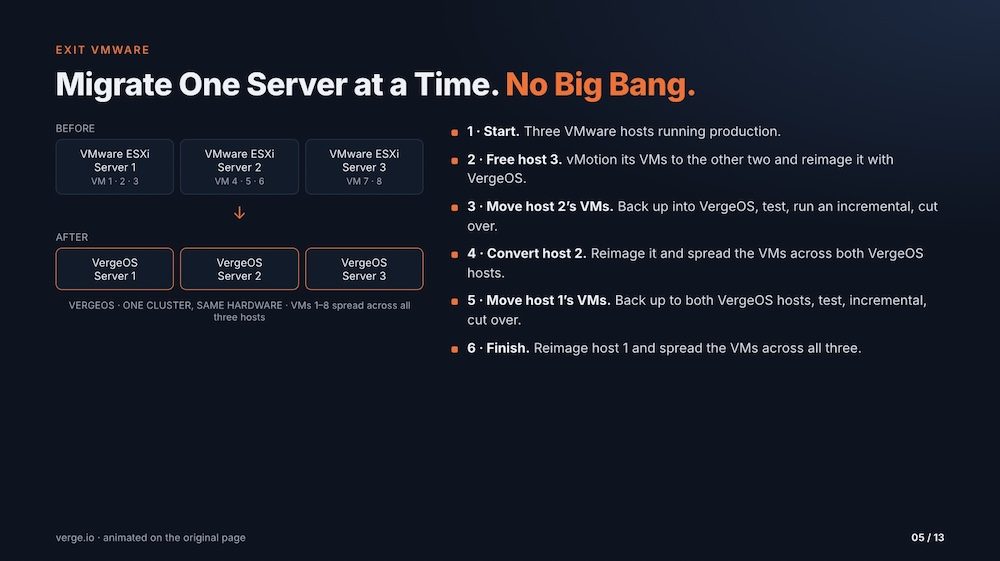
- Exit VMware: VMs are imported with their storage and network settings intact, and the migration can proceed one server at a time. A host is emptied with vMotion, reimaged with VergeOS, and its VMs are backed up into VergeOS and cut over after an incremental pass. The cycle repeats until the cluster is converted on the same hardware. A recorded demo showed a differential backup from vSphere, an import that kept the MAC address, and a boot on VergeOS with a snapshot as a safety net
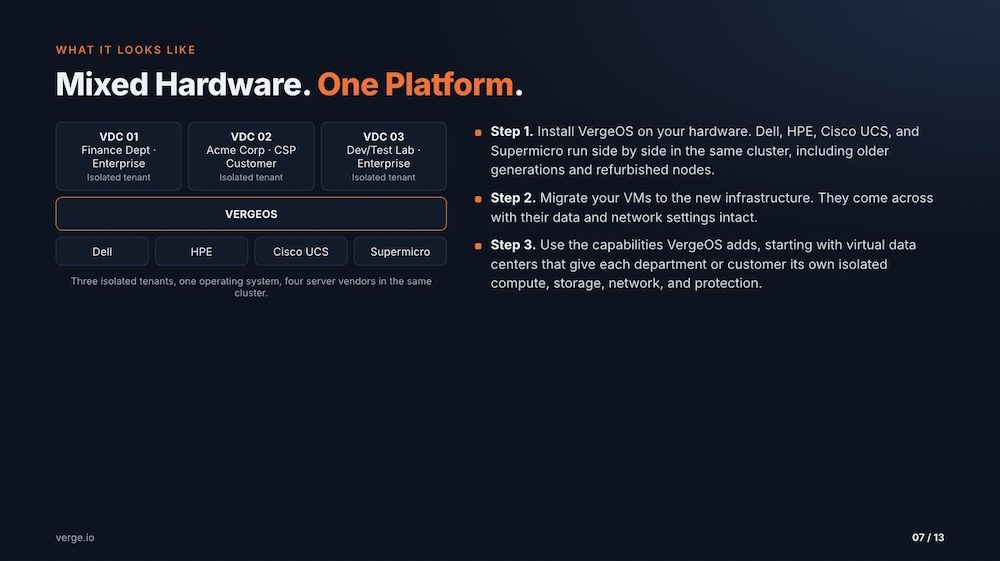
- Fight data center inflation: VergeOS can mix Dell, HPE, Cisco UCS and Supermicro servers of different generations, including refurbished nodes, in one cluster. Each department or customer can get an isolated virtual data center. Storage tiering is set per virtual disk and changed live. In the demo, a running SQL Server’s 200 GB data disk moved from NVMe to HDD without interruption, and the VM’s media cost fell 49%, from $263 to $133. That calculation uses September 2026 street prices of $706/TB for a 15.36TB NVMe drive and $56/TB for a 24TB HDD. VergeIO noted that the NVMe drive costs about three times what it did a year earlier
- Run every site the same way: Remote sites run the same VergeOS, take the same upgrade, and are automated with Terraform, Ansible and Packer
- Keep AI sovereign: Models run on GPUs passed through to the customer’s own tenant, so prompts and data never leave the network and there is no per-token bill. One demo showed a local AI agent, running on two passed-through GPUs and driving the Verge CLI, create 20 Ubuntu VMs and then delete them. In another, a business user asked a local model to analyze six webinar attendance files without the files leaving the platform. VergeIO’s message: “Your Data. Your Models. Your GPUs. Your Rules”
Click to enlarge
The team has introduced recent new product features with the Veeam integration among others. VergeOS is now a supported platform in Veeam Backup & Replication 13.1, through the Universal Hypervisor API plug-in, replacing the old oVirt KVM path. It supports CBT incremental backup, backup scans, cross-platform restore, file-level and application-item recovery (SQL, Exchange, AD, Oracle, SharePoint), and export to VHD, VHDX or VMDK. Replication, CDP and Instant Recovery to VergeOS are not yet supported. Also a new significant release has been introduced, VergeOS 26.2, which speeds up VMware migration by 120% (2.2x the transfer speed) by adding asynchronous I/O to NBD transfers, supports Windows Failover Clustering shared disks on VergeFS, so SQL Server clusters no longer need a dedicated SAN and allows single-server remote sites, such as retail outlets, that need only two network connections and no core network.
Click to enlarge
As the market is very active in this VMware ecosystem, VergeIO appears to be a serious alternative with a mature product, very comprehensive and at a very compelling price. The opportunity is real. A study commissioned by Rimini Street found that nine in ten VMware users are considering alternatives. Competition is heavy, though: Nutanix (FY2026 revenue of $2.85B and 32,360 customers), Proxmox, OpenShift Virtualization, Hyper-V/Azure Local, HPE Morpheus and Scale Computing are all pursuing the same customers. Veeam support removes a major objection from enterprise buyers. VergeIO’s main differentiators are its single-OS simplicity, server-based pricing, and the ability to keep using existing hardware while flash prices rise. These recent recruitments with strong VMware background and investments illustrate this ambition wishing to rapidly take significant market share in the area.
Click to enlarge
We’ll monitor the next few months in this active domain and try to collect key success factors and stories from VergeIO.







 Subscribe to our free daily newsletter