








IT Press Tour 70: DDN
Make AI Profitable
By Philippe Nicolas | October 14, 2026 at 2:00 pmDDN joined The IT Press Tour for the 10th times and we had the opportunity to meet several recent members of the executive team. Among them, Kevin Delane who joined the company early this year as president and CRO and replaced Paul Bloch who moved to the chairman seat. The angle chosen by DDN was on the economics of AI, not raw performance. As its tagline puts it, “We don’t make GPUs faster. We make them work, profitably”. As Gartner says last August:
- AI-optimized IaaS spending reaches $42B in 2026, nearly double 2025’s $21.5B
- Inference ($23.3B) overtakes training ($19B) for the first time
- Inference is 55% of that spend in 2026 and is expected to reach 59% in 2027
The team refreshed the audience with some business metrics as DDN delivered impressive results. We realized that this acceleration invited the top management to reorganize its layers with several key recruitments to scale the business. Among them, Omer Asad, CPO, Kevin Delane, president and CRO as mentioned above, Guido Torrini, CFO, Lauren Bloch, chief people officer, Michelle Rosen, CLO, Rick Scurfield, chief growth officer, Andrew Kahl, CCO, and Adam Berlew, CMO.
Click to enlarge
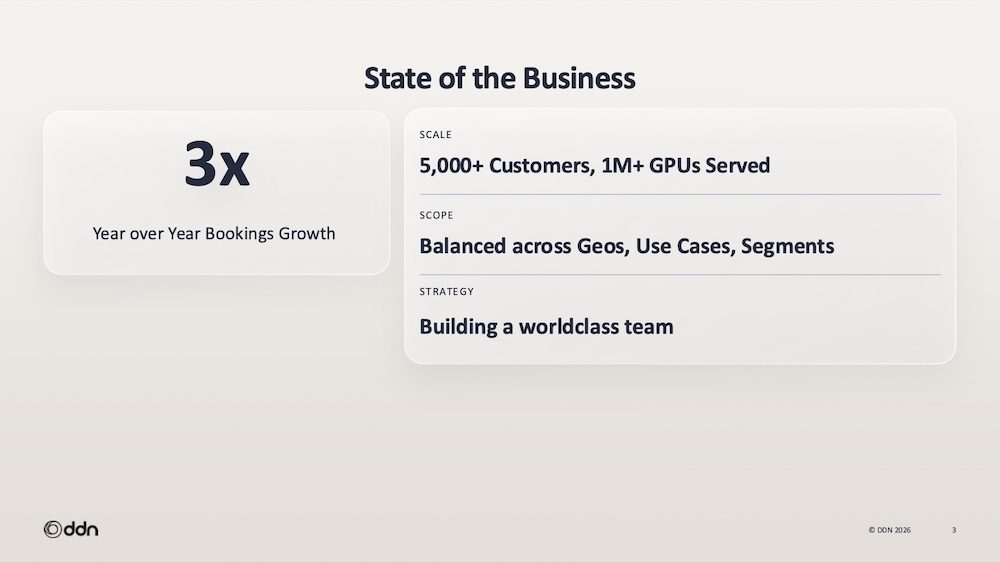
The installed base dramatically accelerated. Customers span Nvidia cloud partners and AI clouds, AI-native and sovereign AI players, energy, government and aerospace, healthcare, higher education, financial services and enterprise AI. DDN also highlights new customers for its Managed Lustre service in the last three months.
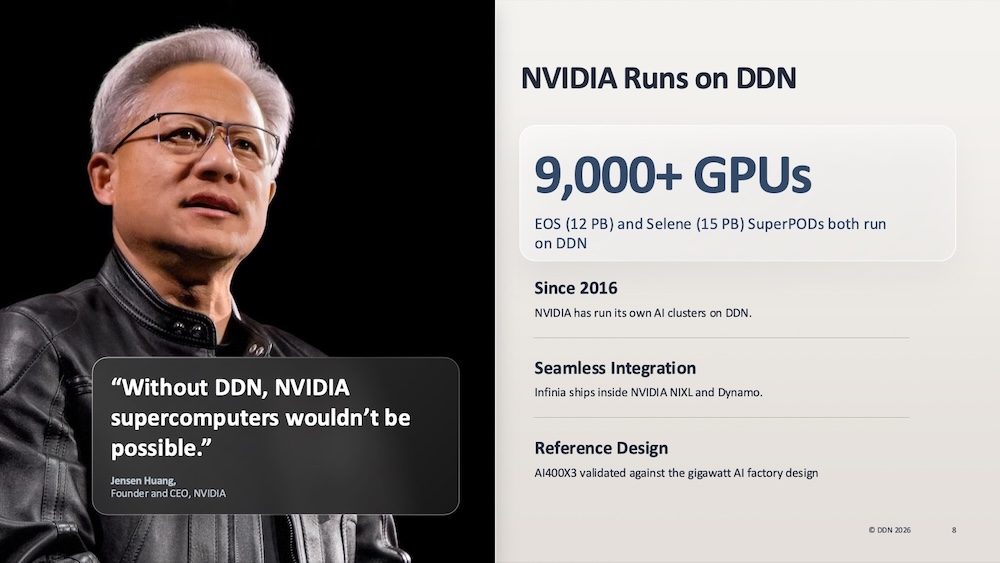
The relationship with Nvidia remains central. Nvidia has run its own clusters on DDN since 2016, including Selene with 15PB, Eos with 12PB and Cambridge-1, across more than 9,000 GPUs. Infinia ships inside Nvidia NIXL and Dynamo. The AI400X3 is validated against Nvidia’s gigawatt AI factory reference design, and EXAScaler is validated for DGX SuperPOD, BlueField-4, 800 Gb/s networking and the upcoming Rubin platform. Jensen Huang is quoted: “Without DDN, Nvidia supercomputers wouldn’t be possible”.
Click to enlarge
Participating to tons of AI oriented projects, DDN reached a point described as “data platforms that cost GPU revenue”. The firm lists eight ways storage erodes GPU economics.
In training:
- GPUs wait on data while drawing full power
- Checkpoints stall thousands of GPUs
- On shared clusters, one heavy job slows every other job
- Each expansion costs as much as the capacity it adds
In inference:
- Prefill waits on context coming from file and object layers
- Agentic loops recompute the same context every turn
- Systems that were fast in a proof of concept slow down at hundreds of nodes
- Tenants cannot be kept apart
Click to enlarge
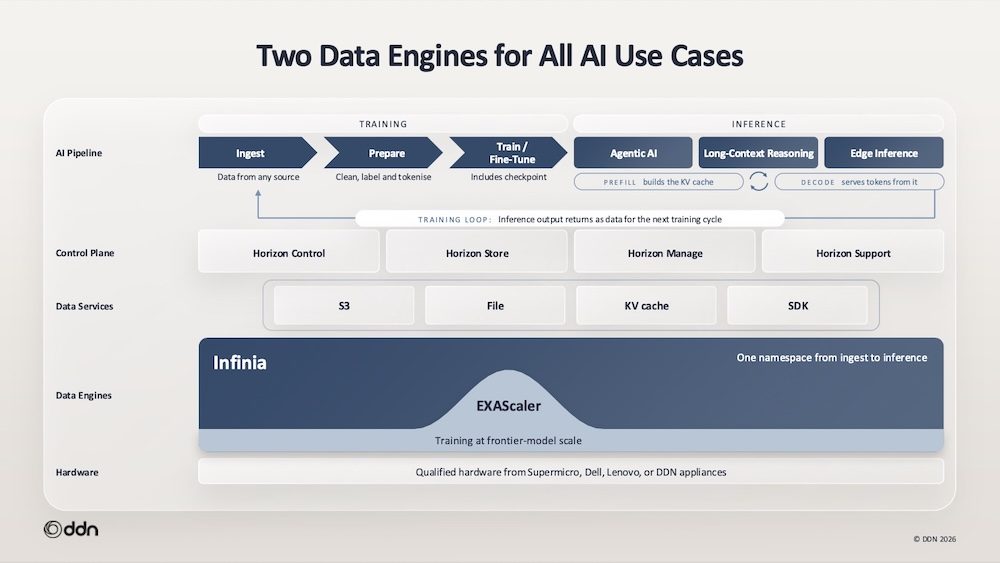
DDN’s answer is two data engines under one namespace, covering ingest, preparation, training, fine-tuning, agentic AI, long-context reasoning and edge inference. A Horizon control plane (Control, Store, Manage, Support) sits on top, with S3, file, KV cache and SDK services. The engines run on DDN appliances or as software on qualified Supermicro, Dell and Lenovo hardware.
The company relies on EXAScaler, a proven well deployed highly scalable file storage solution, as the training engine and Infinia, a modern object storage software, for the inference part.
EXAScaler is DDN’s Lustre-based parallel file system. Every compute node reads from and writes to every storage server in parallel, with no gateway in between. DDN supports each training problem with a reference case:
- Utilization: Up to 99% GPU utilization and 96% network use in the DGX B200 SuperPOD reference design, with 190 GB/s per 2U appliance
- Checkpointing: On Google Cloud Managed Lustre, which is EXAScaler sold as a first-party Google service, checkpointing is 15x faster, model training 1.5x faster, and training costs 42% lower
- Multi-tenancy: India’s sovereign Shakti Cloud runs 8,000 B200 GPUs at 99% utilization across tenants, using QoS policies and per-tenant I/O views while keeping data in the country
- Footprint: Eos’s 576 DGX systems need fewer than three racks of DDN storage, about 100 kW for 18.4 exaflops. Each building block delivers 190GB/s and 8M IOPS in 2U at 2.5 kW, and Hot Pools keep cold data on low-cost disk within the same namespace
Infinia uses a distributed-hash and key-value store design in a multi-tenant philosophy key for neoclouds and sovereign clouds. Each client computes where every piece of its data lives and fetches all of it in parallel, without a directory, index tier or gateway. Adding nodes adds bandwidth while overhead stays flat. One production cluster runs on more than 300 nodes. A single NIXL plugin covers Dynamo, vLLM, SGLang and LMCache, and moves KV cache over RDMA between GPU memory and Infinia’s single namespace for KV cache, objects and files.
Click to enlarge
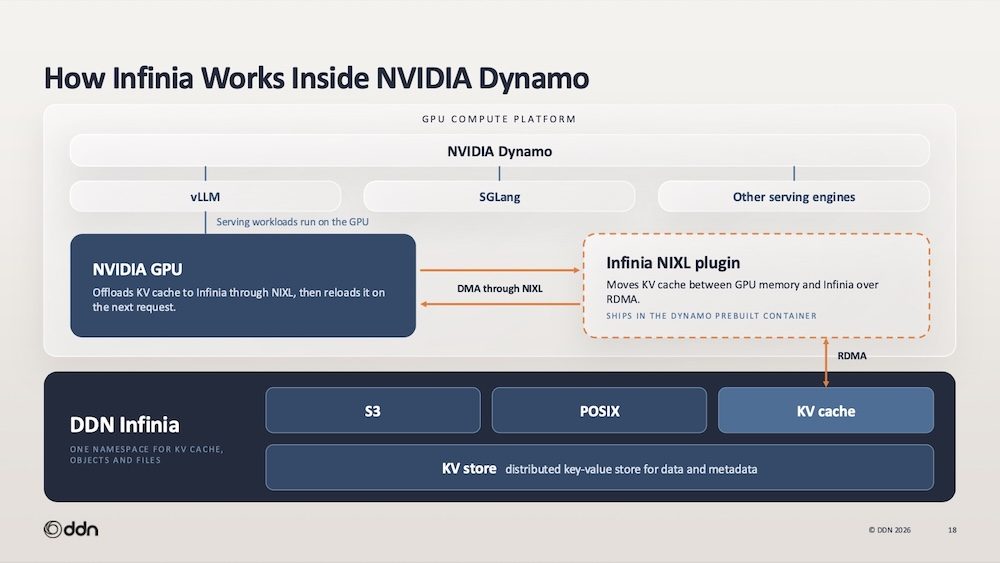
DDN’s inference figures from deployed configurations liek the one used by Nebul:
- Time to first token is 4.2x faster at 100K-token context with Dynamo
- Wasted GPU time. For a 4,096-GPU B200 chat fleet, DDN puts the cost of recomputing context at $186K of lost revenue every day
- Scale. Audited object performance on Oracle Cloud Infrastructure reached 225K GET and 194K LIST requests per second
- Tenant isolation. One API call sets a tenant’s keys, quota and access, and weighted fair share in the data path keeps each tenant to its assigned share
The largest reference is a frontier AI lab running 700PB on Infinia. The deployment spans four data halls of 240 nodes each, is more than 90% full, holds over 10 billion objects in a single hall, and has buckets averaging 50 PB. On Infinia 2.5 it peaks at 6.4TB/s of GET throughput and handles 5M small-object GETs and 3M PUTs per second.
This DDN approach confirms what we see on the market, modern challenges require modern solutions and Infinia illustrates this perfectly.







 Subscribe to our free daily newsletter