







IT Press Tour 70: Phison Electronics
From NAND controllers to AI infrastructure
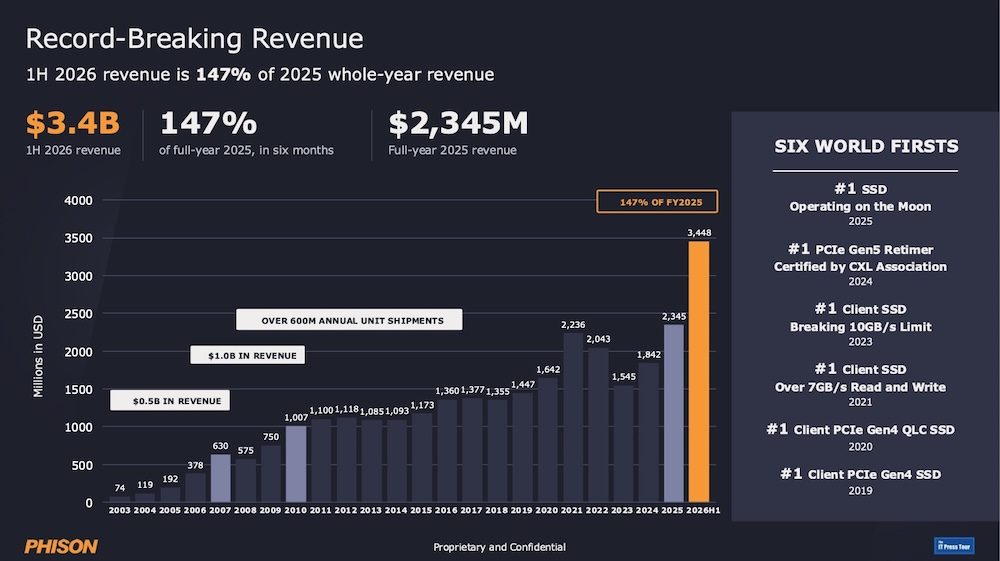
By Philippe Nicolas | October 13, 2026 at 2:01 pmFor the 3rd times, Phison joined The IT Press Tour and we had the chance to learn recent developments around AI and new directions. Michael Wu, president of Phison USA, opened the session with the company profile and we saw an amazing revenue trajectory in the current business climate and AI pressure in all domains especially DRAM, HBM and NAND.
- Size: 25+ years in business, more than 5,000 employees (75% in R&D), and R&D spending above 80% of operating expenses
- Market position: a 20%+ share of the global client SSD controller market
- Business lines: client, embedded, enterprise, automotive, gaming, design services, and power and signal ICs
Revenue was $2.345B in 2025. First-half 2026 revenue reached about $3.4B, or 147% of the whole of 2025 in six months. AI ecosystem products are driving the growth: enterprise SSDs, aiDAPTIV, AI PCs, AI networking, AI servers and boot drives. That group made up 38% of revenue in 2Q26, up 78% quarter over quarter, and AI module revenue has grown three- to fourfold since early 2025. Phison also lists six “world firsts”, including the first SSD operating on the Moon and the first PCIe Gen5 retimer certified by the CXL Consortium.
Click to enlarge
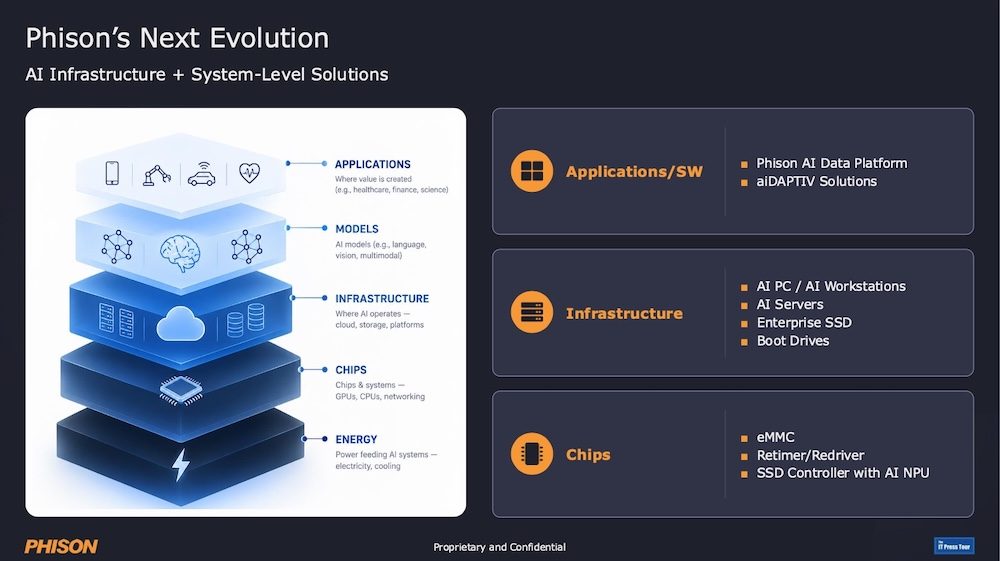
Wu argued that NAND demand used to be predictable: smartphone and PC shipments multiplied by average capacity. Now it is driven by AI tokens, as “AI factories” turn electricity into tokens that need flash at every stage. Phison describes its own path as a repeatable pattern of growth: from consumer, to embedded and design-in, to enterprise, and now to AI systems. That last stage spans chips (an SSD controller with an AI NPU, retimers and redrivers), infrastructure (enterprise SSDs, boot drives, eMMC, AI servers and workstations), and software (aiDAPTIV and the Phison AI Data Platform).
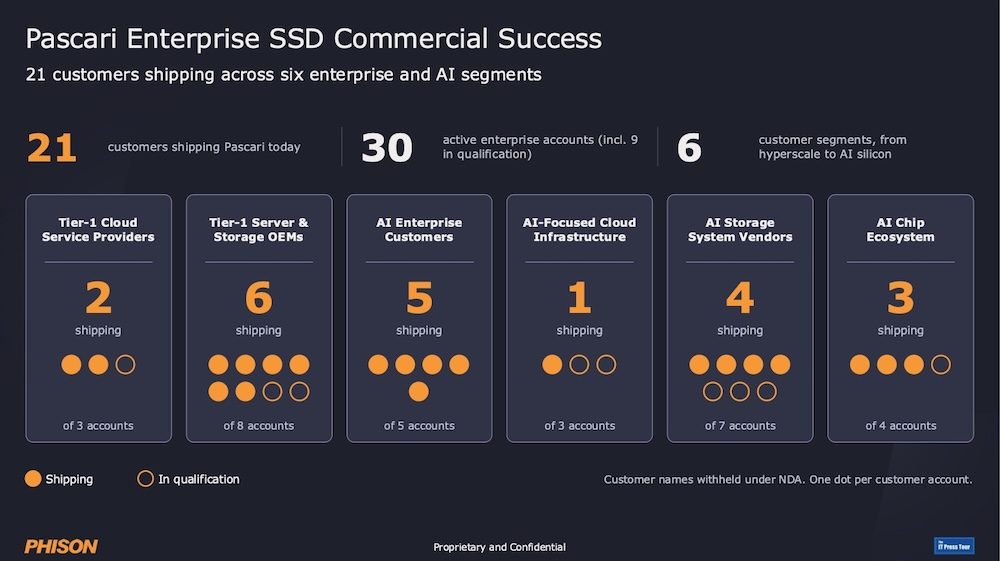
The Pascari enterprise brand now ships to 21 customers out of 30 active accounts, with 9 still in qualification. They span six segments: tier-1 cloud providers, server and storage OEMs, AI enterprises, AI-focused clouds, AI storage vendors and AI chip companies. Names are withheld under NDA. Phison also stresses its role behind other brands, as a controller and design partner to Kioxia, Micron, Samsung, SK hynix, SanDisk and Solidigm.
Click to enlarge
Phison launched aiDAPTIV several months ago as it extends AI memory with flash with a compelling TCO. Rick Allen, senior product marketing lead, presented aiDAPTIV as Phison’s answer to the “memory wall”. He cited Gartner figures: in 2026, cloud spending on AI inference ($23.3B) overtakes training ($19B) for the first time, agentic AI uses 5 to 30 times more tokens than a chatbot, and AI PCs will make up 55% of PCs shipped. Larger mixture-of-experts (MoE) models, longer contexts and agents all push memory needs beyond what HBM and DRAM can supply affordably.
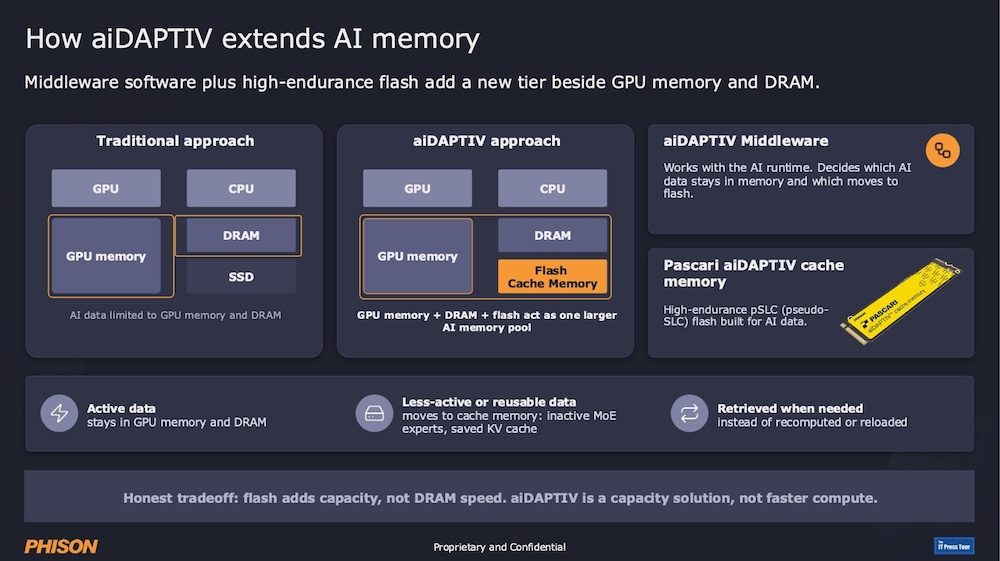
aiDAPTIV is middleware plus high-endurance pSLC flash. It adds a cache tier next to GPU memory and DRAM, and integrates at the runtime level (llama.cpp, OpenVINO, vLLM, PyTorch) without changes to applications. Phison is upfront about the limits: “flash adds capacity, not DRAM speed”. aiDAPTIV has three main uses:
- Dynamic MoE offload. Inactive experts stay in the flash cache. In one test, a Gemma 4 26B-A4B workload needed 23.5GB and dropped to 15.9GB of DRAM, so it ran on a 16GB laptop
- KV cache reuse. Context is read back from flash instead of being recomputed. In Intel AI Playground, RAG time to first token fell from 55 seconds to 1.4 seconds (39× faster) on a 32GB Panther Lake PC. Other tests showed 20× to 85× gains
- Fine-tuning of larger models without adding GPUs
Click to enlarge
Intel and Phison announced their collaboration at Computex 2026 last June. aiDAPTIV is already available in Intel AI Playground, a llama.cpp integration is in progress, and OpenVINO support is planned. As of September 2026, Phison counted 8 PC OEMs engaged, 7 programs in or ready for mass production, and 6 silicon platforms. Software partners include LLMWare, AnythingLLM, TurinTech, Ollama and LM Studio.
OEMs can choose between two M.2 options: a hybrid TLC SSD with a pSLC cache partition (for example, 1TB with 85 GB of cache) or a dedicated 1–4TB cache drive. Phison presents aiDAPTIV as a cheaper alternative to moving from 32GB to 64GB of DRAM. It is also aimed at Nvidia Jetson edge systems such as robots, and at GenBI reference servers built on Supermicro with RTX PRO 6000 Blackwell GPUs. Some figures on these slides, including memory budgets, price comparisons and the Jetson examples, are marked “pending validation.”
Click to enlarge
The strategy with its own SSD line named Pascari has paid off and delivered one isntance for every stage of AI. Phison positions Pascari as the brand under which its long-standing behind-the-scenes engineering finally reaches enterprises directly. Pascari launched in 2024, the year after aiDAPTIV debuted. Its pitch rests on three things: vertical integration (controller, firmware, hardware, validation), workload customization through IMAGIN+ design services, and engineering proven in space. The deck cites Futurum data: 79% of AI infrastructure operators run training-heavy workloads, and data growth is the top infrastructure challenge.
The portfolio maps onto the AI data lifecycle:
- X-Series (performance): up to 14.8GB/s, 3.3M IOPS, and 60 DWPD on the X202Z for checkpointing. The X200P ranked No. 3 globally in the IO500 with Megware
- D-Series (density): up to 245.76TB on the D206V
- S-Series: SATA, up to 15.36TB
- B-Series: Gen5 M.2 boot drives
- aiDAPTIV: for KV cache and context
- Space: for lunar and onboard storage
Four drives launched at Computex 2026: the D206V, the liquid-cooling-ready E1.S D250P, the B200P and the X202Z. Phison says its validation involves more than 6,000 test hours, 2,000+ samples and 20+ test chambers.
The section ends with a new market: orbital data centers. Phison argues that land-based AI data centers are running into limits on power, water, carbon and land. In orbit, a sun-synchronous path gives continuous solar power and cooling works without water. Launch costs have fallen sharply, with 167 missions by a single provider in 2025.
A ten-year cost model published by Starcloud, which Phison labels illustrative and not its own, puts a terrestrial deployment at $167M against $8.2M in space. Phison points to compute constellations being designed, an Nvidia H100 that reached orbit in November 2025, and commercial cloud services expected in 2027. It presents all of these as customers for mission-specific storage, not competitors.
We expect some news around SuperComputing 2026, mid November in Chicago, IL, USA.







 Subscribe to our free daily newsletter