








Micron Technology: Fiscal 4Q26 and FY26 Financial Results
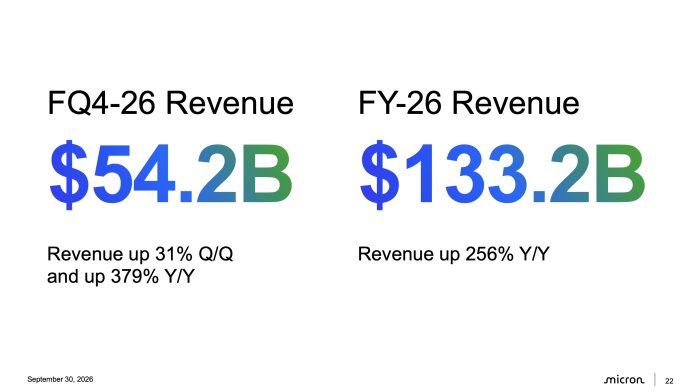
Generating $133.19 billion, up 256.3% YoY
This is a Press Release edited by StorageNewsletter.com on October 2, 2026 at 2:01 pmFiscal Q4 2026 Highlights:
- Revenue of $54.23 billion versus $41.46 billion for the prior quarter and $11.32 billion for the same period last year
- GAAP net income of $37.70 billion, or $32.87 per diluted share
- Non-GAAP net income of $38.40 billion, or $33.42 per diluted share
- Operating cash flow of $43.97 billion versus $25.39 billion for the prior quarter and $5.73 billion for the same period last year
Fiscal 2026 Highlights:
- Revenue of $133.19 billion versus $37.38 billion for the prior year
- GAAP net income of $84.97 billion, or $74.33 per diluted share
- Non-GAAP net income of $86.76 billion, or $75.52 per diluted share
- Operating cash flow of $89.68 billion versus $17.53 billion for the prior year
Micron Technology, Inc. announced results for its fourth quarter and full year of fiscal 2026, which ended September 3, 2026. “Micron delivered record fiscal 2026 results, and we expect an even stronger fiscal 2027,” said Sanjay Mehrotra, chairman and CEO, Micron Technology. “AI is becoming Super Intelligence (SI), and memory enhances this intelligence and the competitiveness of our customers’ platforms. We are increasing our investments in technology, products and manufacturing to help drive SI forward with our customers, and our Strategic Customer Agreements provide added confidence in the durability of Micron’s financial performance.”
Click to enlarge
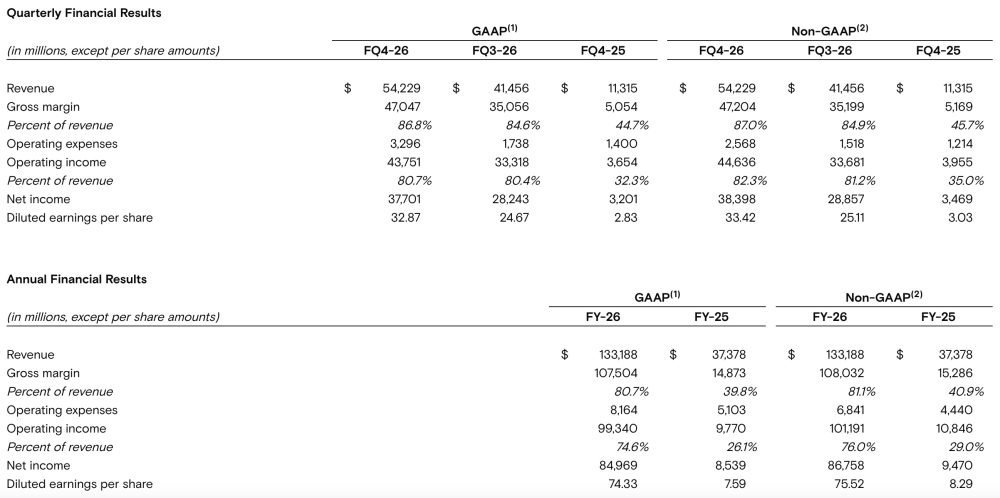
Investments in capital expenditures, net(2) were $10.77 billion for the fourth quarter of 2026 and $27.37 billion for the full year of 2026. Adjusted free cash flow(2) was $33.20 billion for the fourth quarter of 2026 and $62.31 billion for the full year of 2026. Micron ended the year with cash, marketable investments, and restricted cash of $73.48 billion. On September 30, 2026, Micron’s Board of Directors declared a quarterly dividend of $0.15 per share, payable in cash on October 29, 2026, to shareholders of record as of the close of business on October 14, 2026.
Click to enlarge
Business Outlook
The following table presents Micron’s guidance for the first quarter of 2027:
Click to enlarge

Product Highlights
- We began sampling the industry’s first 512GB ultra dense high-capacity DDR5 RDIMM modules capable of speeds up to 9,200 MT/s
- We have completed multiple customer qualifications of our 1-gamma based, 8,800 MT/s high-speed server RDIMM modules
- Our industry leading server LPDDR SOCAMM portfolio revenue more than doubled sequentially in the fourth quarter of 2026
- Our 7600 PCIe Gen 5 and 9650 PCIe Gen 6 SSD high-performance products are now shipping to market-leading customers for KV-cache applications
- Our 6600 ION SSD achieved a strong volume ramp in the fourth quarter of 2026
- We are now shipping 6-channel 1-gamma LPDDR5X for flagship mobile devices
- We have secured design wins with every Tier 1 OEM customer for AI workstation product
- Our 4600 SSD secured additional qualifications with leading PC OEMs
- We began sampling 1-gamma based LPDDR6 products to multiple physical AI markets
(1) GAAP represents US Generally Accepted Accounting Principles
(2) Non-GAAP represents GAAP excluding the impact of certain activities, which management excludes in analyzing our operating results and understanding trends in our earnings; adjusted free cash flow; investments in capital expenditures, net; and business outlook. Further information regarding Micron’s use of non-GAAP measures and reconciliations between GAAP and non-GAAP measures are included within this press release
Comments
How to describe these results? They are simply spectacular.
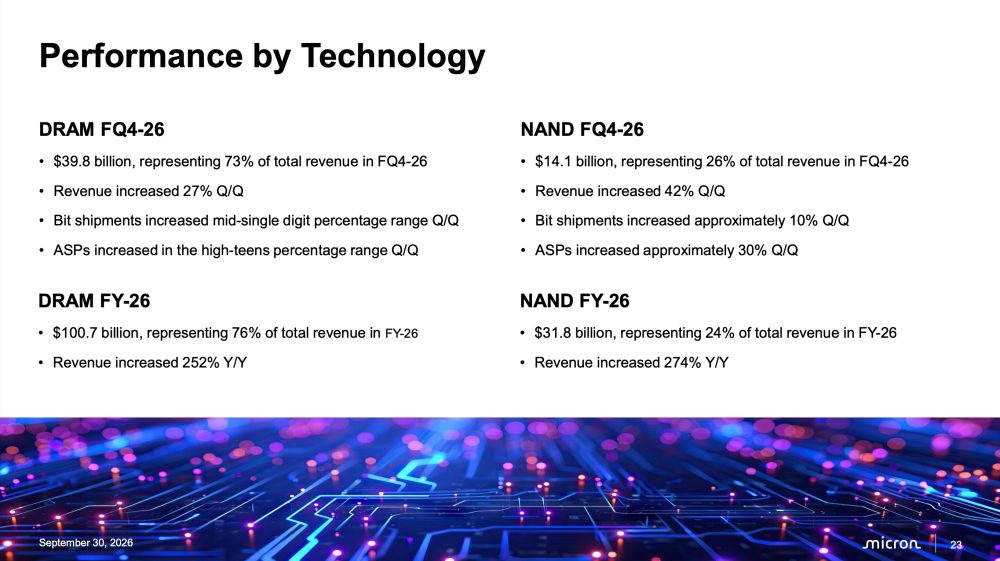
Micron generated $133.19B in FY26, compared with $37.38B in FY25, representing extraordinary growth of 256%. DRAM alone crossed the symbolic $100B threshold, reaching $100.7B, while NAND revenue jumped 274% to $31.8B.
Pricing was clearly one of the main engines behind this performance. DRAM average selling prices increased in the high teens quarter over quarter, while bit shipments grew only in the mid-single digits. The trend was even more pronounced for NAND, where prices climbed approximately 30% on roughly 10% higher bit shipments. The rest of the memory industry is following the same trajectory, with DRAM contract prices projected to rise another 10–15% and NAND prices 15–20% in 4Q26.
Click to enlarge
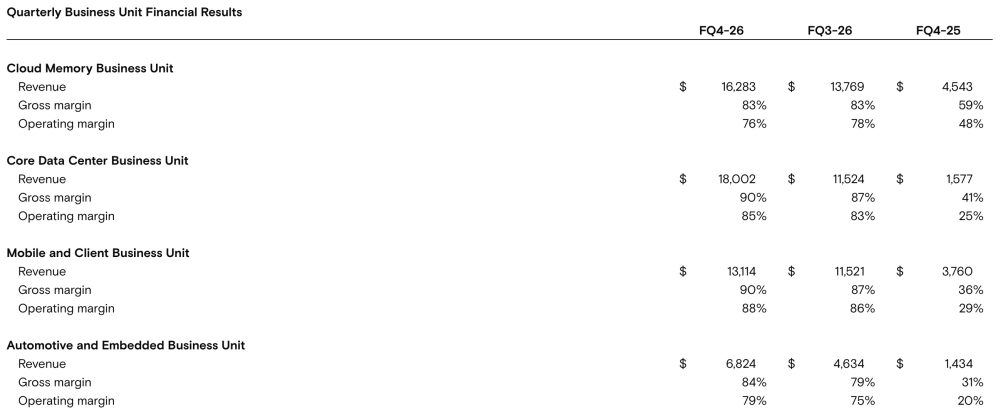
The second major contributor is, unsurprisingly, the AI infrastructure boom. Micron's Core Data Center business unit grew an astonishing 1,042% YoY. Data center SSD revenue approached $10B, more than 10× the level recorded a year earlier and representing more than two-thirds of NAND revenue. Micron points to KV-cache offload and HDD replacement as major drivers. Most of its 2027 HBM supply is already contracted at significantly higher prices. The company is also developing NVHBM, described as the first custom HBM4E, with Nvidia. On the technology side, 1-gamma DRAM and G9 NAND are leading production, while the next generations are expected to reach volume production during the second half of 2027.
Another structural change is the growing importance of long-term contracts, a trend we also see among other strategic suppliers benefiting from the AI tsunami. Micron has signed 26 Strategic Customer Agreements representing more than 35% of revenue through 2030 and backed by $32B in customer commitments, mostly in the form of cash deposits. Most agreements include floor and ceiling price bands. This is gradually transforming memory from a predominantly spot-driven commodity business into a more contracted model. It reduces downside exposure during weak markets, although it can also limit upside during periods of extreme pricing strength.
Supply is another critical dimension. Micron expects industry bit growth in the low-20% range for DRAM and mid-20% range for NAND during 2027–2028, while supply is expected to remain constrained. The company currently sees no clear line of sight to a supply-demand balance. Capex will increase, but additional capacity takes time to materialize: Idaho ID1 is expected in mid-2027, ID2 in late 2028, the Singapore NAND expansion in the second half of 2028, and New York around 2030.
Competition is experiencing a similarly rapid expansion. In DRAM, Samsung leads with a 38% share, followed by SK hynix at 25%, Micron at 24% and CXMT at 10%. HBM remains dominated by SK hynix with 50% and Samsung with 33%, while Micron holds approximately 18%. CXMT's IPO raised $8.6B and its manufacturing capacity is approaching Micron's, although its HBM yields remain around 25%. In NAND, YMTC has climbed to third place in bit shipments, ahead of Kioxia and Micron. Sandisk's FY26 revenue increased 175%, while Solidigm's QLC portfolio continues to reinforce SK Group's position in enterprise SSDs.
Putting everything into perspective, Micron is essentially betting that the combination of AI demand, constrained supply and long-term contracts will make this memory cycle structurally different, and potentially longer, than previous ones. One important variable remains China. The continued capacity expansion of CXMT and YMTC could put pressure on conventional DRAM and NAND pricing well before the new fabs planned in the US, Japan and Singapore begin contributing meaningful volumes from 2028 onward.
And perhaps the most striking number comes after FY26 itself: Micron expects approximately $61.5B of revenue in 1Q27 alone. That represents roughly 46% of its entire FY26 revenue in just one quarter, illustrating the extraordinary acceleration currently taking place across the memory industry.
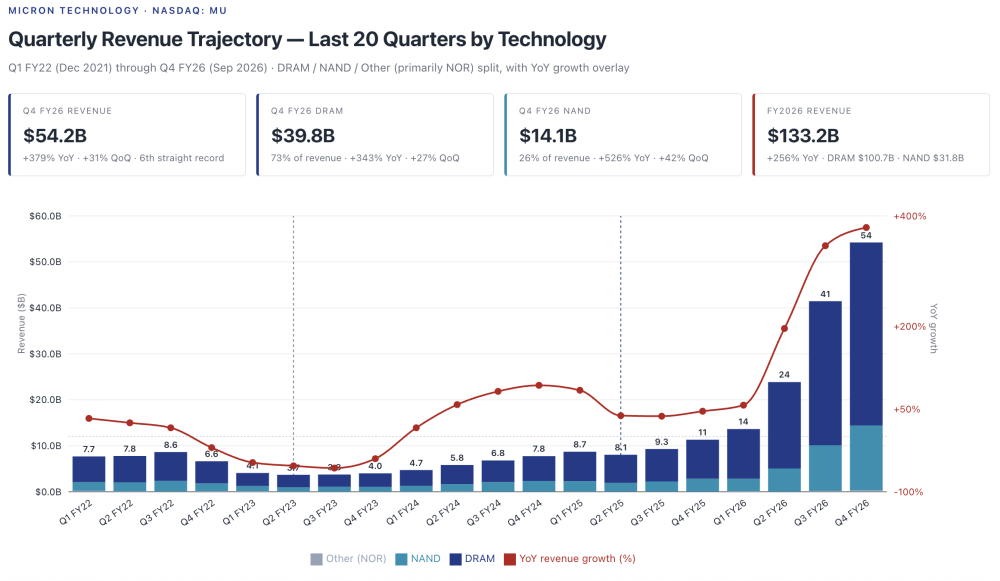
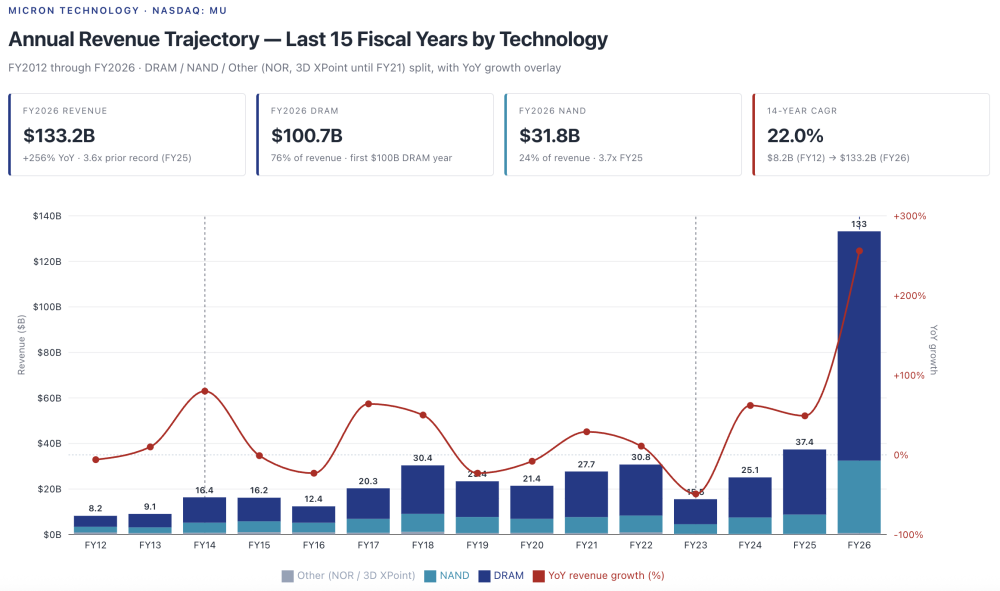
These 2 graphs below aggregate quarterly revenue for last 20 quarters and provide a consolidated view per year.
Click to enlarge
Click to enlarge







 Subscribe to our free daily newsletter