







Recap NetApp Insight 2026
Key news, strategic for the future of NetApp
By Philippe Nicolas | October 6, 2026 at 2:01 pmNetApp’s annual conference took place last week in Las Vegas, with the company making several significant announcements. As usual, the flagship event attracted end users and partners from around the world, with more than 4,000 attendees. The event gave CEO George Kurian the opportunity to introduce the NetApp Data Platform, the result of several years of development shaped by the rapid rise of AI, unprecedented business opportunities, evolving market requirements and, more recently, acquisitions.
Click to enlarge
This year has been particularly active on the M&A front, with three transactions: DataPelago, JetStream Software and Peak. DataPelago appears to have been acquired for less than $200 million, while the other two transactions were much smaller and look like real bargains for NetApp. Before these deals, NetApp’s most recent acquisition was Instaclustr in 2022. This renewed activity also illustrates the impact of the company’s refreshed management team, with several new executives joining over the past few quarters.
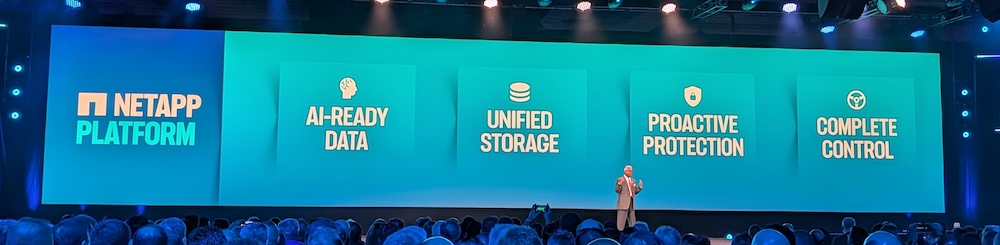
The new positioning is centered on data, the critical resource of today’s AI-driven world. The second key word is “platform”, illustrating NetApp’s move toward a broader enterprise approach. Beyond individual functions, tools, products and solutions, the platform model aims to capture, process, protect and serve data from a common horizontal infrastructure delivering multiple services.
For NetApp, this model is built around four key attributes: AI-ready data, unified storage, proactive protection and complete control.
AI-ready data
AI at NetApp now means AIDE, or AI Data Engine, designed to provide the full pipeline of data-centric services initially introduced last year with AFX. Delivered entirely in software, AIDE supports file and object storage and leverages a unified catalog spanning memory, context, advanced data orchestration and access.
The metadata layer has been significantly expanded with an MCP server, knowledge graph and decision fabric. DataPelago clearly brings additional value here with its zero-copy activation technology, designed to significantly reduce overall processing times by eliminating unnecessary data movement.
Unified storage
The second dimension is unified storage, a long-standing NetApp mantra. The company has promoted this approach for decades, initially combining file and block storage before progressively adding object and other services.
This unified model now extends beyond on-premises environments to span data centers and clouds. NetApp has also expanded its cloud reach to Oracle Cloud Infrastructure, adding OCI to its established presence on AWS, Microsoft Azure and Google Cloud.
Protection and control
Protection combines NetApp’s internal capabilities with external services and partnerships, including a new iteration of its relationship with Commvault.
The “complete control” pillar introduces new interfaces, easier service integration and, increasingly, agents designed to enable autonomous unified operations. A single console acts as the central control plane across the infrastructure.
Keystone is positioned as another key component, spanning local environments and multiple clouds while also serving as NetApp’s vehicle for sovereignty. But sovereignty means different things to different organizations, and the concept is particularly challenging for an American company addressing European requirements. Ultimately, sovereignty goes well beyond data center location, energy sources or simple data residency. It also involves technology ownership, operational control, jurisdiction, supply chains and dependency on external providers.
Click to enlarge
Peak and the Novus initiative
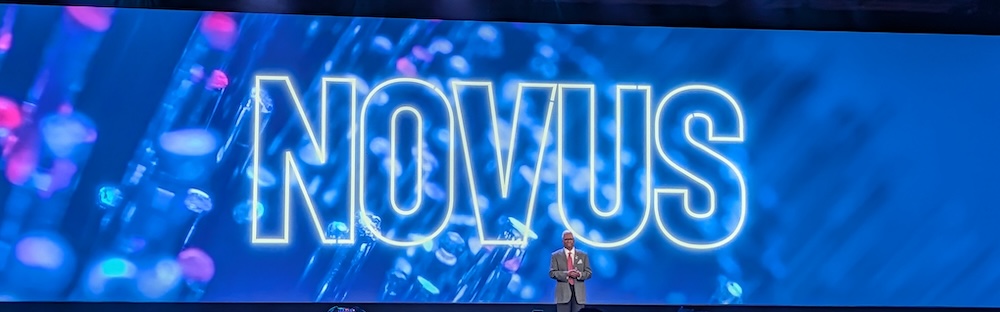
As already covered several times, NetApp has chosen to significantly extend its parallel file storage capabilities through the acquisition of Peak. The resulting initiative is known as Novus.
It remains somewhat surprising to see an NFS champion such as NetApp, with decades of internal expertise and a proven engineering track record, acknowledge that an external move was necessary. We have mentioned several times that NetApp was essentially naked in high-performance file storage for HPC and AI, relying for years on third-party parallel file systems such as Lustre, ThinkParQ BeeGFS and IBM Storage Scale, coupled with their E-Series array line.
pNFS has appeared in NetApp product data sheets for years, and when AFX was announced at Insight 2025, we anticipated another step in this direction. That milestone has now materialized through the Peak acquisition, which immediately brings several advantages.
The transaction should not represent a major financial commitment for NetApp. Peak raised relatively little capital and remained remarkably frugal, suggesting that its valuation was also reasonable. For NetApp, this looks like a very good operation. It also removes one potentially attractive option from competitors, even though Lattice remains available in the open-source domain.
This naturally raises another question: who could become the next acquisition target in this segment? Hammerspace comes immediately to mind. Beyond the various commercial, proprietary and open-source approaches, Dell and Pure Storage have also embraced pNFS, confirming the growing importance of open standards in high-performance file storage. We expect some news from Dell on Lightning file System but nothing has been really shared on this.
Performance and architecture
Performance is obviously a central element of NetApp’s decision. The company promotes aggregated throughput of up to 100TB/s across thousands of clients and tens of racks. It was also stated that the solution has reached 94GB/s per node, currently limited by hardware resources, suggesting that even higher performance is possible.
Click to enlarge
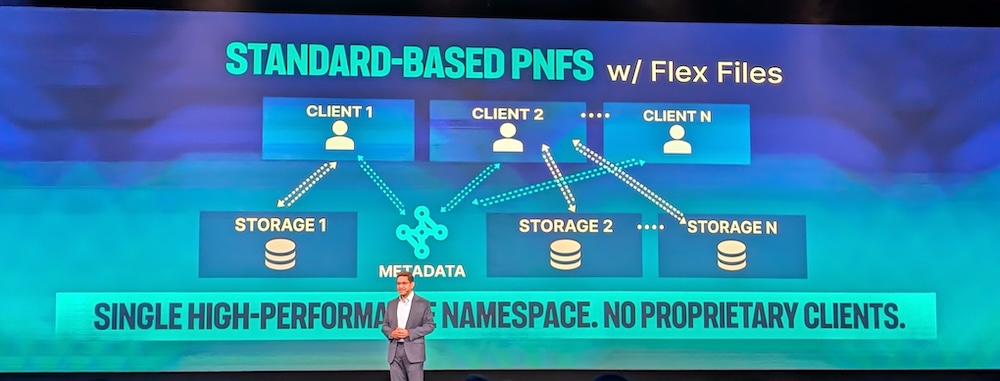
NetApp’s move confirms once again that asymmetric parallel file systems are an appropriate architecture at scale, separating metadata and data servers. Clients, metadata servers and data servers can scale independently. Multiple namespaces can be configured, with each appearing globally across clients, the consumers, and servers, the producers.
Beyond file striping at the client level, we also expect erasure coding to eventually operate at the client level.
Another important attribute for NetApp is the use of open standards, and this was clearly a key factor behind Novus because the architecture is based on pNFS. There is no need to install proprietary agents or drivers on clients. At a scale involving thousands of clients connected to the same file service, deploying and maintaining client-side software can quickly become an operational nightmare and introduce potential service disruption. This is precisely where the beauty of an open standard becomes obvious.
Another strength of Novus is its ability to address a broad range of workloads, supporting small and large files, random and sequential I/O, and write-intensive workloads in addition to very high read performance.
NetApp’s new file-storage dimension
One of the strongest messages at Insight was therefore the new dimension NetApp can achieve with Peak and its highly scalable file-storage technology. The company clearly recognizes that it needs new software-stack components to deliver AI infrastructure at scale, especially as intense market pressure around AI continues to shrink time-to-market expectations.
It also confirms that modern challenges require modern solutions. Although pNFS was first introduced with NFSv4.1 more than 15 years ago, the discussion today is about modern implementations and architectures, particularly flexible file layouts and their ability to exploit highly distributed storage infrastructures.
Click to enlarge
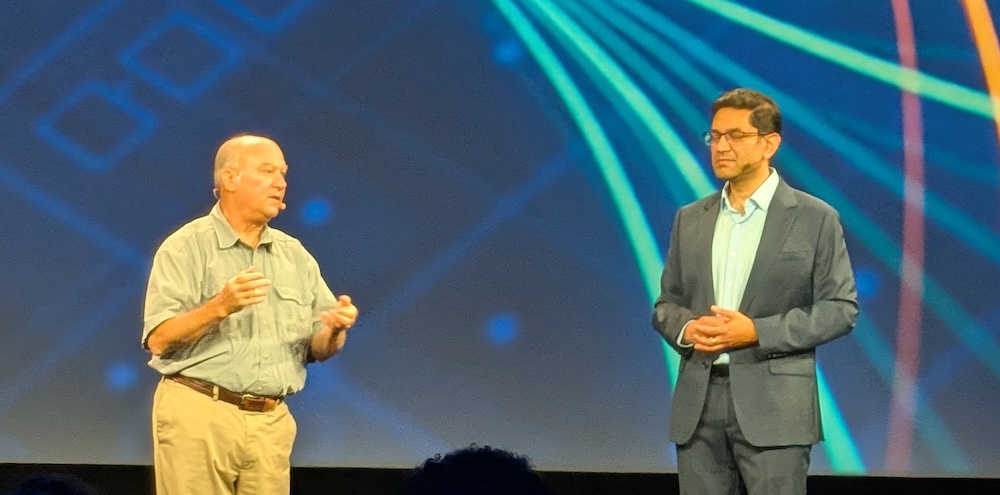
NetApp Insight and its various announcements also reinforce what Coldago Research introduced several years ago with its U3 storage model: Universal, Unified and Ubiquitous.
Each of these dimensions is increasingly aligned with the evolution of modern data storage architectures and broader market changes. AI is accelerating that transformation, forcing storage vendors to rethink not only performance and capacity, but also data mobility, metadata intelligence, protection, orchestration, openness and access across increasingly distributed environments.
NetApp’s latest strategy is therefore much broader than another storage refresh. The company is attempting to position data, rather than individual storage systems, at the center of its architecture, and to build the platform required to make that data immediately usable by the rapidly expanding AI ecosystem.








 Subscribe to our free daily newsletter