



IT Press Tour 69: ExpectedIT
Promoting a new way to compose resources to build logical large computer
This is a Press Release edited by StorageNewsletter.com on September 8, 2026 at 2:00 pmWe had the opportunity to meet ExpectedIT during the recent 69th edition of The IT Press Tour held last week in Ljubljana, Slovenia. Klas Moreau, CEO, ExpectedIT, introduced the company promoting a modern way to aggregate IT resources to address new high demanding AI and generic workloads.
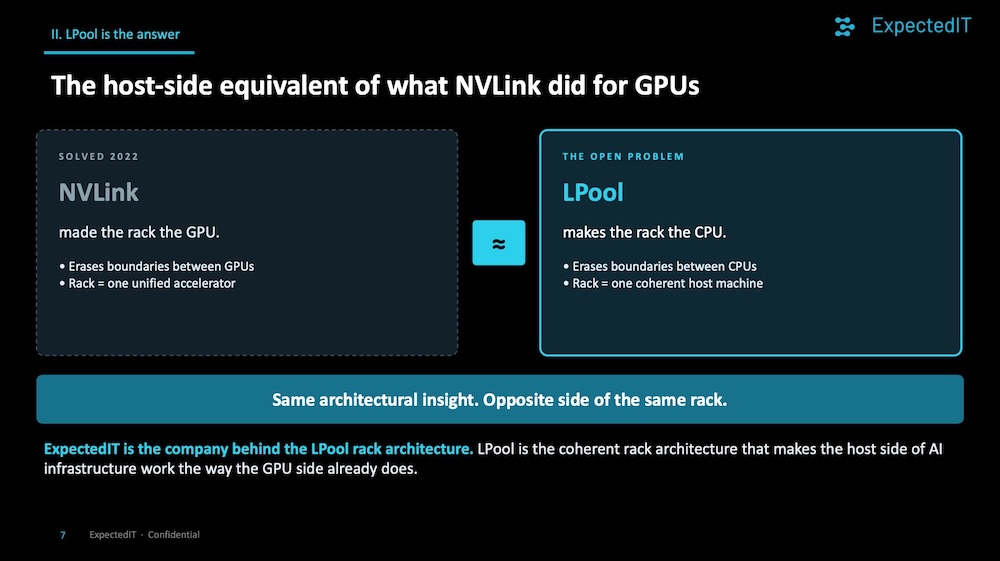
ExpectedIT is a German deep-tech startup developing LPool, a chip architecture designed to pool CPU, memory, storage, and network resources across an entire server rack. The company frames this as the host-side equivalent of what NVLink did for GPUs in 2022: NVLink erased boundaries between GPUs to make a rack function as one unified accelerator, while LPool erases boundaries between CPUs to make a rack function as one coherent host machine.
Click to enlarge
The team has seriously evolved recently with Klas Moreau, CEO, who joined a few months ago, Dr. Burkhard Steinmacher-Burow, CPO and co-founder, Àrni Ingimundarson, CTO and co-founder, both with a solid IBM experience with supercomputer and Power CPU design, and lastly Albert Weber, CFO. We also noticed the creation of a new advisory board chaired by Klaus Entenmann and includes Vinton G. Cerf, Peter Vinnemeier, Brian Fyda, Raj Singh, and an confidential US hyperscaler executive. The engineering team stands at 16, expected to double post-Series A.
Click to enlarge
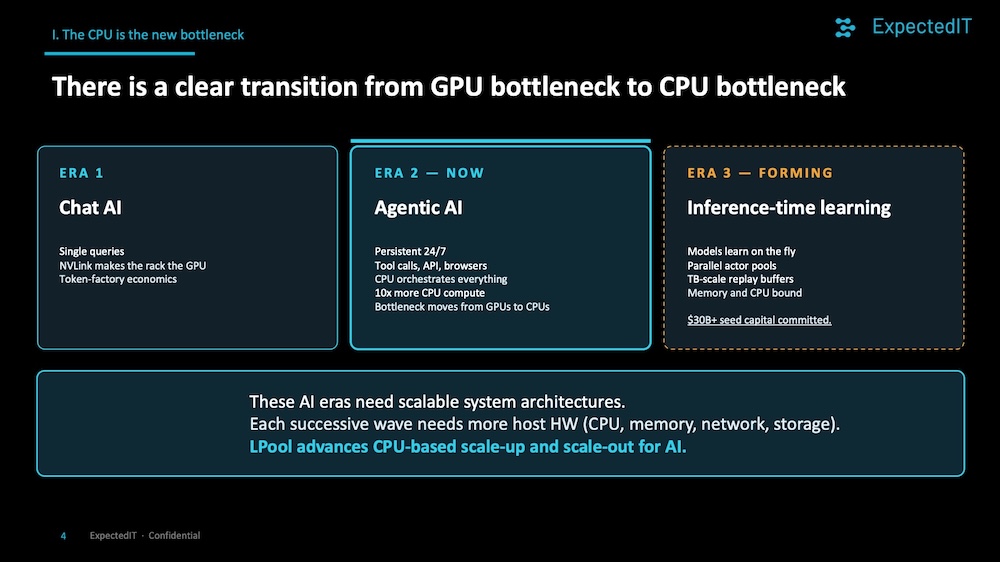
The team elaborated a strategy based on the AI tsunami that triggered so many technology initiatives in the industry. As AI workloads evolve from single-query chat (Era 1) to persistent, tool-calling agentic AI (Era 2, “now”) and eventually inference-time learning (Era 3, forming, with $30B+ seed capital already committed industry-wide), the system bottleneck is shifting from GPUs to CPUs. The presentation cites four independent sources: AMD/Lisa Su ($120B server CPU TAM by 2030), Nvidia/Jensen Huang (10x more compute needed for agentic vs. generative AI), UBS Research ($170B TAM, 70–80% of compute burden shifting to CPU), and Morgan Stanley (50–90% of agentic workload latency is CPU-side, $32–60B incremental CPU TAM from agentic AI alone).
Click to enlarge
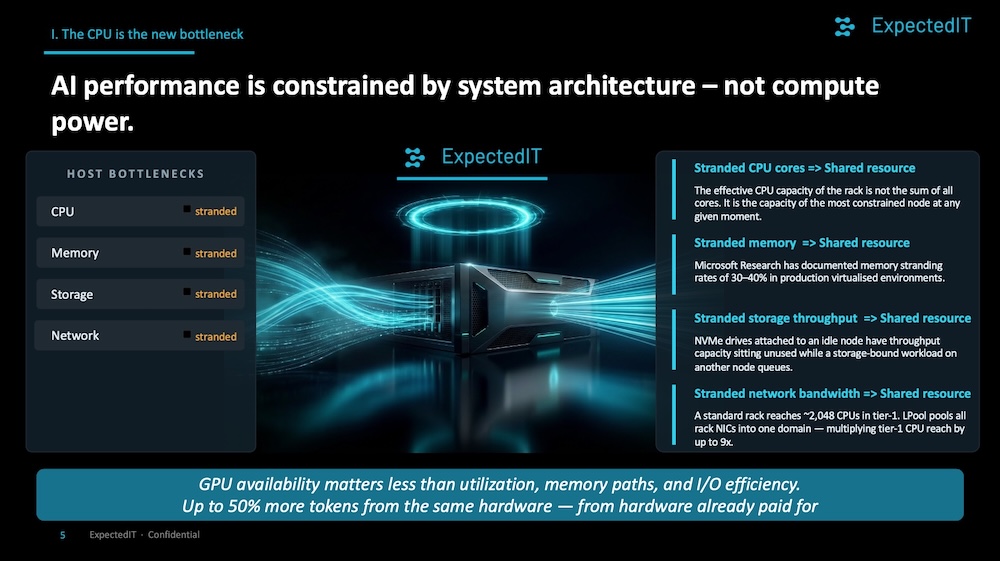
On the technology side, ExpectedIT designs and develops LPool to address “stranded” resources, CPU cores, memory (Microsoft Research cites 30–40% stranding in virtualized environments), storage throughput, and network bandwidth, that sit idle on one node while another node queues. Where AMD tops out at 2 sockets and Intel at 8 (a “hard ceiling”), LPool’s roadmap reaches 10 sockets (Gen 1, 2027 tapeout), 48 sockets (Gen 2, PCIe Gen 6), and 96 sockets (Gen 3, PCIe Gen 7), vendor-neutral across Intel, AMD, and ARM. Use cases include unifying small distributed KV-cache head nodes into one large, fast shared head node (up to 7x throughput) and general-purpose 32-CPU scale-up servers.
Klas Moreau spent time to size the market and the associated opportunity: TAM of $150B (server CPU market by 2030), SAM of $30B (LPool-compatible CPUs and chips), SOM of $200M + $200M via IP licensing/royalties plus fabless chip manufacturing. Target buyers include hyperscalers, GPU server OEMs (Nvidia, Dell, HPE, Supermicro, Bull), AI cloud providers (CoreWeave, Lambda, Crusoe, Together AI), and CPU vendors (Intel, AMD, ARM, Qualcomm, SiPearl), the latter serving as the initial “beachhead”.
In terms of business model and go-to-market, ExpectedIT identifies 3 layers with real ambitions confirmed by early talks with CPUs vendors, IP licensing (~€200M revenue by 2032, high margin), fabless chip manufacturing from Series B (~€400M combined by 2032), and a longer-term platform-standard layer (certification, per-rack software, exit optionality). Forecast revenue grows from €5M (2028) to €398M (2032); EBIT from €3M to €301M at ~75% gross margin.
As a new player, the traction trajectory is paramount with a memory directory chip logic complete (passed TSMC N6 backend), a working FPGA-based cross-CPU PCIe sharing demo, Intel UPI licensing endorsement, and core-thesis validation from Microsoft and Meta engineers (“something truly new,” per a Microsoft VP). Signed LOIs with FractalBrain (frontier AI developer), Core42/G42 (sovereign AI cloud), and 1984 ehf (Icelandic hosting); SiPearl LOI pending. EIC Accelerator status (top 4% of 1,000+ EU applicants) brings a €2.5M grant plus €10M equity co-investment. Current seed funding of €6.5M provides runway to September 2027.
The company expected to raise soon a new round, it explained why Klas Moreau joined the company, around €25M Series A, including up to €10M EIC equity, opening October 2026 and targeting close by end of March 2027. And to conclude, the tapeout will be ready in 2027, first CPU vendor license in 2027, production deployment in 2028. We’ll monitor closely this European story as LPool brings on the table a very interesting value proposition.







 Subscribe to our free daily newsletter