









The Forrester Wave: Object Storage Solutions, Q2 2026
Pretty strange report as some key players are missing
By Philippe Nicolas | August 21, 2026 at 2:01 pmForrester Research recently published a new report dedicated to object storage, “The Forrester Wave: Object Storage Solutions, Q2 2026,” and our first reaction is one of genuine surprise.
It is always puzzling to see a market report that omits several of the category’s established pioneers and reference vendors, and this is exactly what we find here. Cloudian is absent, as is DataCore, whose Swarm technology traces its roots back to Caringo. IBM is also missing, despite its Cloud Object Storage offering being based on Cleversafe technology acquired more than a decade ago. MinIO, one of the most prominent open-source names in object storage, is not included either. We could also mention Ceph, available through multiple distributions and implementations, as well as Quantum with ObjectScale, another solution with a long history in the market. But of course we find DDN, Dell, Everpure, Hitachi Vantara, Huawei, NetApp, Scality or Vast Data and they must be in this report.
At the same time, the report includes vendors that are not pure object-storage specialists but instead provide an object interface as part of broader, unified or multiprotocol storage platforms. This makes the selection even more difficult to understand. Why in that case for example Qumulo is not included? What initially feels surprising gradually turns into disappointment, especially considering the maturity of the object-storage segment and the historical importance of several omitted players.
We also noticed only two mentions of IBM and Oracle in the report in the other notable vendors part. And Oracle raises another question: why do we need Oracle in this particular context?
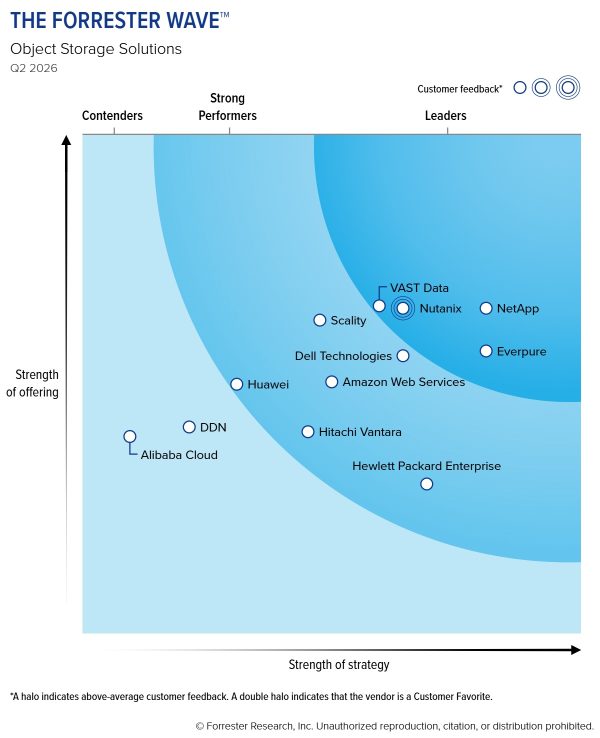
When a report is dedicated to products and solutions, especially in a domain like object storage, the comparison dimension is essential. From that perspective, mixing cloud services with on-premises products appears somewhat unusual. Same remark when you mix unified product with other dedicated object storage ones.
We can understand that some vendors may have declined to participate, which would naturally reduce the final list of evaluated companies.
This led us to wonder why some vendors were effectively “removed” from the landscape. Looking at Forrester’s inclusion criteria, the revenue requirement in particular caught our attention. We have to admit that determining object-storage-specific revenue for companies selling broader storage platforms is a difficult exercise. For several vendors included in the report, attributing a precise portion of revenue to object storage seems extremely challenging, if not impossible, especially when object capabilities are embedded within unified or multiprotocol storage products. As a result, some vendors may appear to be rather generous in what they classify as object storage revenue.
The famous “flat namespace” criteria, a key attribute of object storage, may also be difficult to validate consistently across all these products. The issue becomes even more complex as object storage continues to evolve. Many vendors now simply add an object interface, most commonly S3, on top of an existing storage architecture. But does providing an S3 interface automatically make a product an object storage solution? At the same time, many end users probably do not care about that distinction as long as they get the S3 compatibility they need, but technically the underlying architecture and foundation can be very different. Is it a question for purists? We’ll let readers make their own judgment, but once again, this list brings together solutions that are fundamentally very different in nature.
We also noticed that, for some companies, only a limited portion of their portfolio appears to have been evaluated. It is unclear whether this reflects a choice made by the analysts or by the vendors themselves.
We know perfectly well that building this type of survey, analysis and market report is not an easy exercise. Nevertheless, this particular iteration does not, in our view, fully reflect the actual forces shaping the object storage market today. We therefore expect the next edition to capture a broader set of vendors, architectures and market developments as it needs to relax some criteria probably…








 Subscribe to our free daily newsletter