



Seagate Technology: Fiscal 4Q26 and FY26 Financial Results
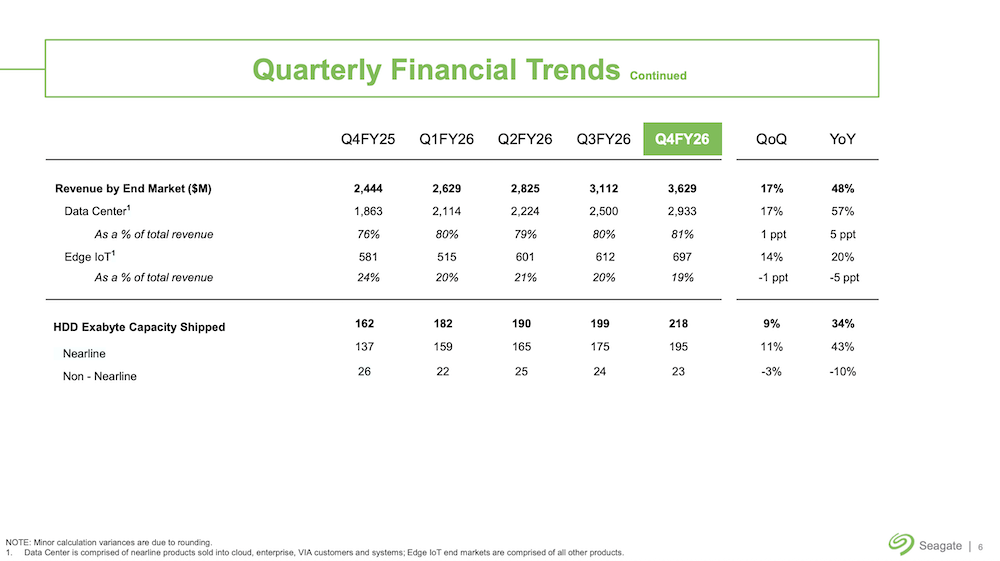
Generating $12.2 billion, up 34% YoY
This is a Press Release edited by StorageNewsletter.com on July 31, 2026 at 2:02 pmFiscal Q4 2026 Highlights
- Revenue of $3.6 billion
- GAAP gross margin of 52.3%; non-GAAP gross margin of 52.7%
- GAAP diluted earnings per share (EPS) of $5.58; non-GAAP diluted EPS of $5.71
- Cash flow from operations of $1.3 billion and free cash flow of $1.1 billion
- Retired $302 million in debt and returned $283 million to shareholders through dividends and share repurchases
Fiscal Year 2026 Highlights
- Revenue of $12.2 billion
- GAAP gross margin of 45.6%; non-GAAP gross margin of 46.1%
- GAAP diluted EPS of $13.90; non-GAAP diluted EPS of $15.58
- Cash flow from operations of $3.7 billion and free cash flow of $3.1 billion
- Retired $1.4 billion in debt and returned $810 million to shareholders through dividends and share repurchases
Seagate Technology Holdings plc, an innovator of mass-capacity data storage, reported financial results for its fiscal fourth quarter and fiscal year ended July 3, 2026. “Seagate’s strong fourth quarter exceeded our expectations for revenue and non-GAAP EPS, capping a fiscal 2026 in which we grew annual revenue 34%, delivered record profitability, and generated a record $3.1 billion in free cash flow. Our performance is being driven by robust cloud data center demand and disciplined execution, and we see the momentum continuing in 2027,” said Dave Mosley, chair and CEO, Seagate.
“As AI accelerates data generation and its value, we see durable long-term demand for mass capacity storage. Seagate is well positioned to address strengthening exabyte demand through our Mozaic platform and differentiated HAMR technology roadmap, enabling customers to scale efficiently while supporting our ability to drive profitable growth and value creation,” Mosley concluded.
Click to enlarge
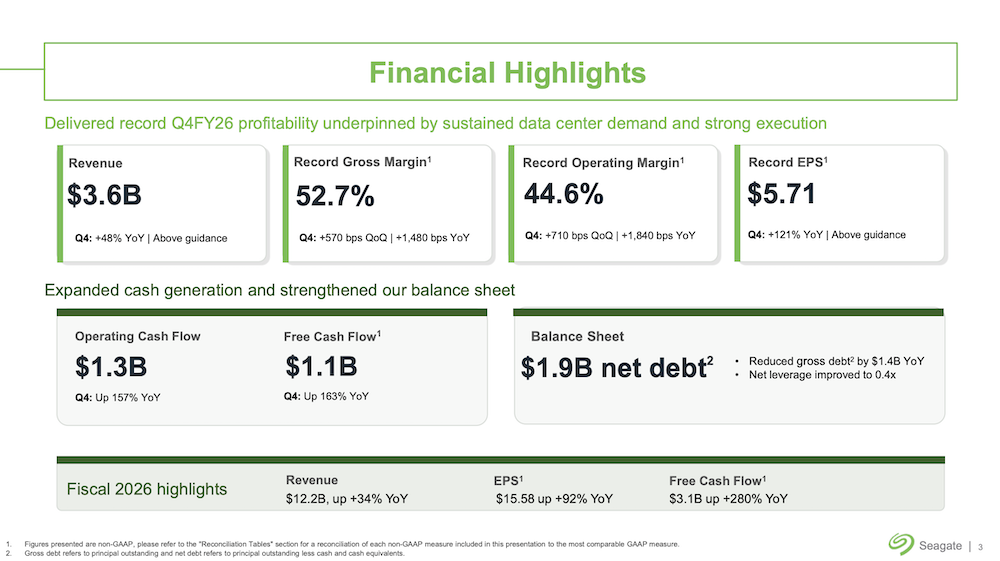
During the fiscal fourth quarter, the Company generated $1.3 billion in cash flow from operations and $1.1 billion in free cash flow. For fiscal year 2026, the Company generated $3.7 billion in cash flow from operations, $3.1 billion in free cash flow and returned $810 million of capital to shareholders through dividends and share repurchases. Additionally, the Company strengthened its balance sheet position, reducing its overall debt by $302 million during the fiscal fourth quarter and $1.4 billion during fiscal year 2026, exiting the fiscal year with total debt of $3.6 billion. As of the end of the fiscal year, cash and cash equivalents totaled $1.7 billion, and there were 227 million ordinary shares issued and outstanding.
Click to enlarge
Click to enlarge
Business Outlook
The business outlook for the fiscal first quarter 2027 is based on our current assumptions and expectations; actual results may differ materially as a result of, among other things, the important factors discussed in the Cautionary Note Regarding Forward-Looking Statements section of this release.
The Company is providing the following guidance for its fiscal first quarter 2027:
- Revenue of $4.1 billion, plus or minus $100 million
- Non-GAAP diluted EPS of $7.30, plus or minus $0.20
Our fiscal first quarter guidance includes:
- The estimated net dilutive impact from the Exchangeable Senior Notes due 2028; and
- Minimal expected impact from global tariff policies and/or the current conflict in the Middle East as of the date of this release
Guidance regarding non-GAAP diluted EPS excludes known pre-tax charges related to estimated share-based compensation expenses of $0.26 per share.
We have not reconciled our non-GAAP diluted EPS guidance for fiscal first quarter 2027 to the most directly comparable GAAP measure, other than estimated share-based compensation expenses, because material items that may impact these measures are out of our control and/or cannot be reasonably predicted, including, but not limited to, net (gain) loss from debt transactions, strategic investment losses (gains) or impairment charges, income tax adjustments on these measures, and other charges or benefits that may arise. The amounts of these measures are not currently available but may be material to future results. A reconciliation of our historical non-GAAP financial measures to their nearest GAAP equivalent is contained in this release.
Comments
When looking at Seagate's trajectory, and the same observation applies to Western Digital and Toshiba in the HDD market, AI has become the dominant force shaping both revenue growth and technology development. The reason is straightforward: AI has an insatiable demand for data storage, and there are no signs that this appetite will diminish anytime soon. For hard disk drive vendors, this represents a remarkable turnaround, especially considering the revenue declines experienced in 2022 and 2023.
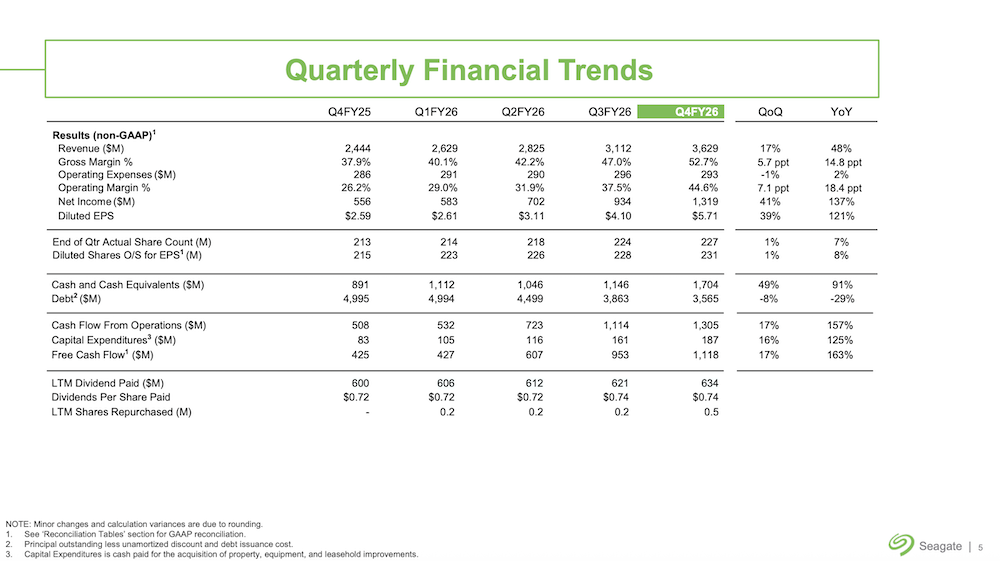
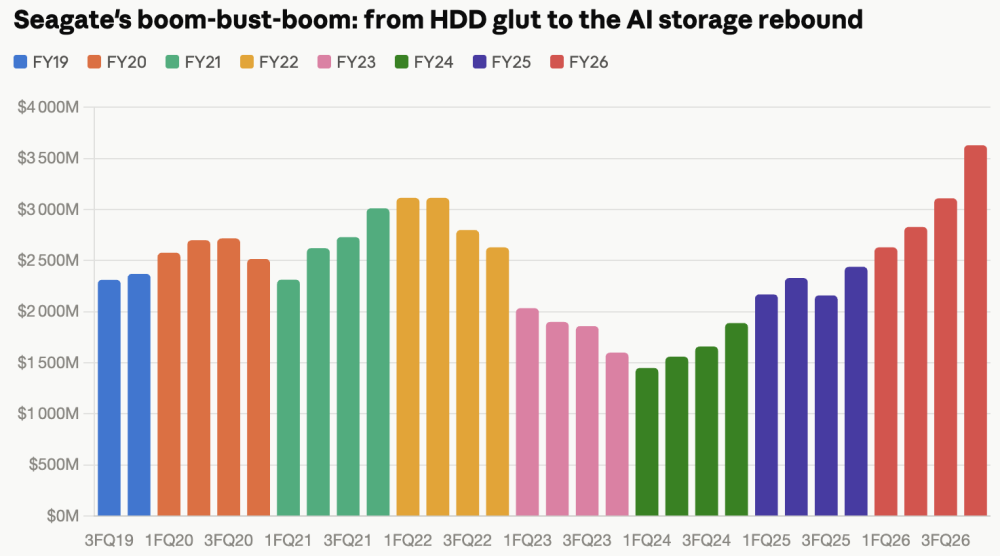
Fiscal 2026 was an exceptional year for Seagate, with revenue reaching $12.2 billion, up 34% YoY. The chart at the bottom perfectly illustrates this momentum. Every quarter established a new sequential record, and the growth curve since Q1 FY2024 has been particularly impressive. Q4 FY2026 alone generated $3.6 billion in revenue, representing a 48% YoY increase.
Click to enlarge
The AI era has also demonstrated that the future is not exclusively about flash storage. The sheer scale of AI data, combined with soaring NAND pricing, has renewed interest in storage tiering, albeit in a modern form, and in architectures that intelligently combine multiple memory and storage technologies, including HBM, DRAM, SSDs, HDDs, and even tape for selected use cases. Virtually every infrastructure vendor now promotes a strategy around KV cache management, context preservation, and multi-tier data placement to optimize AI workloads.
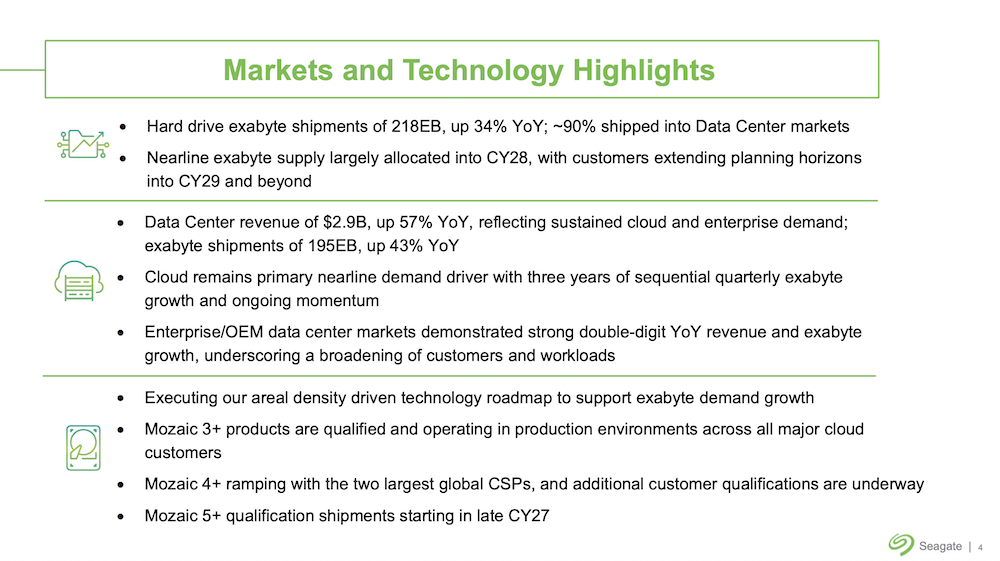
On the HDD technology front, Seagate continues to advance its HAMR roadmap through the Mozaic platform. The company is currently ramping shipments of Mozaic 4+ drives to major cloud service providers, while Mozaic 5+ is undergoing customer qualification with production targeted for late 2027. This roadmap is strategically important because hyperscalers, the largest customer segment for Seagate and its competitors, place enormous emphasis on storage density per drive to maximize data center efficiency. As a result, cost per terabyte remains the primary purchasing metric for these large-scale operators.
Like the SSD and memory industries, HDD vendors now report that a significant portion of their production capacity for calendar year 2028 has already been committed, confirming that hyperscalers and other large customers are securing multi-year supply agreements to guarantee future capacity.
Click to enlarge







 Subscribe to our free daily newsletter