









“Open Weights and American AI Leadership” – A Letter by Jensen Huang, CEO and cofounder, Nvidia
By Philippe Nicolas | July 28, 2026 at 2:21 pmMany of us read the letter titled “Open Weights and American AI Leadership” written by Jensen Huang, CEO and cofounder, Nvidia, and published July 24, 2026. It is obviously an interesting paper and we wish to share our opinion below the letter.
Click to enlarge
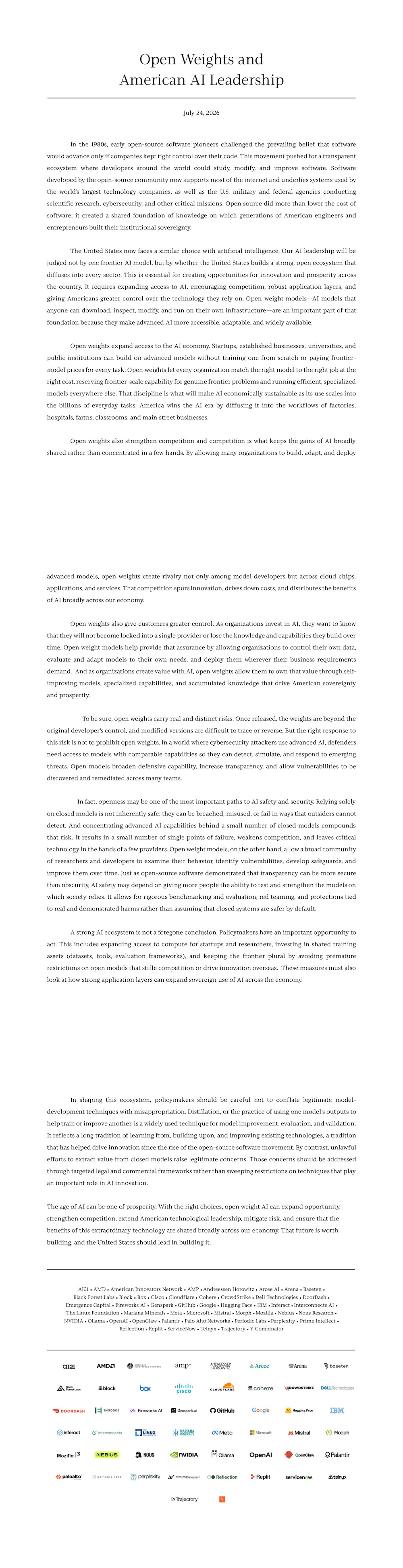
This document is a remarkable endorsement of the United States’ approach to AI and a strong advocacy for open source. It presents compelling arguments centered on cost efficiency, knowledge sharing, economic growth, and innovation. The case is persuasive in many respects. At the same time, however, it reflects a distinctly US-centric perspective. Most major open source projects are governed by US-based foundations or organizations and are driven by large communities in which American companies play a dominant role under well-defined licensing models. Nevertheless, the code remains open, accessible, auditable, modifiable, and deployable by individuals and organizations worldwide.
This open source wave has fueled many of the most important IT innovations of the past decades. Linux is undoubtedly the most visible example, powering billions of devices and systems every day while serving as the foundation of much of the Internet. Open source has unquestionably accelerated technological progress and benefited humanity on an unprecedented scale.
Reading this letter, one clearly senses a strategic effort to defend and promote US leadership while implicitly positioning it against the only other major force in this domain: China. But where does that leave Europe, India, Japan, and many other regions? It recalls an article we published in July 2025 entitled “Who Leads American IT Companies?”, which explored the concentration of technological leadership in the United States. Under this vision, many countries appear relegated to the role of consumers, purchasing US hardware running open AI models “from” the United States, as Jensen Huang has repeatedly emphasized.
The document can also be interpreted as an invitation to other countries to embrace this model, contribute to open source projects, develop AI models, and participate in their adoption. At the same time, it serves as a test of whether other nations are willing to accept this framework and “play by the rules” established by the dominant ecosystem.
History has repeatedly shown that intense competition drives innovation, and AI is no exception. The fierce rivalry currently unfolding is accelerating technological progress at an extraordinary pace.
One of the greatest strengths of open models is the level of control they give users, reducing vendor lock-in while promoting transparency and interoperability. Yet the composition of the communities behind these projects deserves attention. Linux, Apache, and many other flagship initiatives emphasize corporate contributors rather than national representation, and American companies remain overwhelmingly visible, even though their workforces are increasingly international.
The European debate around digital sovereignty illustrates another paradox. Too often, sovereignty is reduced to hosting data in domestic data centers powered by local energy sources while relying almost entirely on imported hardware and largely US-driven open source software. Europe lacks globally significant manufacturers across critical infrastructure segments, including servers, motherboards, processors, storage systems, storage media, networking equipment, and connectivity technologies. At the software level, open source has become both a strength and, in some respects, an acknowledgment that Europe has produced relatively few world-class platform companies comparable to its American counterparts. This reflects decades of limited industrial vision and fragmented technology policies rather than a lack of talent.
Given the risks associated with AI, Jensen Huang argues that open models developed within the US ecosystem offer stronger security, greater transparency, and faster responses to emerging threats. Another claimed advantage is preventing excessive concentration of power in the hands of only a few vendors. Legal and regulatory considerations also play an increasingly important role, although every participant should be subject to the same principles. Recent international events, including the FIFA Soccer World Cup, have illustrated how different teams, countries or federations often apply and interpret common rules in very different ways.
Ultimately, this document once again reflects a predominantly US-centric vision of the future of AI. While it promotes openness and collaboration, it presents only one of the competing models currently shaping the global AI landscape. The world is becoming increasingly divided around alternative technological ecosystems, and although only one is explicitly highlighted here, another rapidly growing parallel ecosystem is clearly emerging in the background.








 Subscribe to our free daily newsletter