









Exclusive Interview with Kumar Goswami, CEO and Cofounder, Komprise
Continuing to promote its advanced unstructured data management platform for modern ages leveraging AI
By Philippe Nicolas | July 22, 2026 at 2:01 pm Kumar Goswami is cofounder and CEO of Komprise, a company launched in 2014 and based in Campbell, CA. Before he was cofounder and CEO of Kaviza, a VDI specialist sold to Citrix in 2008. He also spent time at HP Laboratory, Kovair, OnLive Technologies, Tandem, Raytheon and GE Research. In parallel he’s an advisor to startups via multiple accelerators entities. He received his PhD in Computer Science from University of Illinois Urbana-Champaign in 1993.
StorageNewsletter: Kumar, can you give us a snapshot of the company today, headcount, VC funding raised, installed base, and your revenue range? Are you profitable?
Kumar Goswami: Thank you for the opportunity! We’re doing very well. Komprise is an unstructured data management solution that addresses two major problems in the enterprise: reducing outsized storage spending as data continues to grow rapidly and generating new value from dark data in the era of AI. Komprise has been growing at a rapid pace in the last few years. We are growing at more than 2x the typical B2B tech company and expect to financially break even by early 2027. We have hundreds of large enterprise customers, some of which are storing more than 50PB of data. Today we are approaching 200 employees.
How do you view the data management market right now? What impact is the current volatility in memory and flash pricing having on adoption of your solution and on end-user attitudes?
The current market and economic climate is adding strong tailwinds to our flight path. First, the global memory shortage and associated Flash crisis is killing our customers on costs — if they can even acquire the capacity that they need. Since Komprise has a proven solution to free up primary Flash capacity with our intelligent tiering, we’re seeing a lot of traction right now with companies that are in a pinch. They can use Komprise to free up 60, 70 or even 80% of primary storage by identifying and moving cold data to object storage in the cloud or elsewhere. This delays that expensive storage refresh while the global supply chain has time to correct.
Another sharp reality is that enterprise AI pilots are stalling. A large percentage are not making it into production where you have lots of files. You need a data management platform that addresses the front-end need to get data filtered and ready before you embed, chunk, or vectorize it. Otherwise you could be needlessly chunking millions to billions of files and feeding AI, resulting in high storage and AI token costs and poor AI accuracy. Komprise has built a platform that can handle this AI data preprocessing at scale, from any storage to any AI or lakehouse, and we’re really excited about the potential. In fact, one of our prestigious healthcare customers used Komprise to beat their clinical AI timelines by 300% and deliver ROI with 97% lower cost.
Komprise has rolled out several product iterations, or modules I should say, to the Intelligent Data Management platform. Could you walk us through the latest key features we should know about?
We continue to strengthen our core use cases while expanding into emerging AI and analytics use cases. I’ll cover AI in the next answer. Central to our customer value story is the Global Metadatabase. Think of this as a database with tabular information on all unstructured data across silos, geos and file and object stores. It powers enterprise search and it’s allowing our customers to generate intelligence that matters in the moment. For example, a highly distributed construction company, when hit with an earthquake, was able to find their critical documents that they needed in minutes instead of weeks. In the past, they had to contact each office and ask someone to do a manual search of the file systems. The customer told us how our enterprise search made an enormous difference in how they were able to address this calamity and prepare for it properly and faster than their competition. Yet our Global Metadatabase goes beyond search and analysis. Users can enrich their data so that it is highly useful for AI with industry context and a governance layer.
On the AI front, have you added any AI-oriented capabilities?
In the last two years we’ve heavily focused on new capabilities to support governed AI data workflows across any industry use case and any choice of AI or analytics platform. We have released three core AI data management capabilities:
- First, we released a built-in scanner to look inside the documents that we analyze for PII, PHI and IP. We tag all the data that’s sensitive in our Global Metadatabase and then Komprise enables action such as confining the data so that it isn’t fed to AI or move such sensitive data to secure storage. The same can be done for duplicate, orphaned and zombie data (data without any owners)
- Second, we have released Komprise AI Preparation and Process Automation (KAPPA) data services, which allows enterprises to write small Phython scriplets – which we call Kaplets – to extract whatever information you deem important from a file. We then run that Kaplet across millions to billions of files simultaneously and with maximal resource optimization per our latest patent. Let’s say a clinical research department has an AI project on chest X-rays. You can run a Kaplet to extract DICOM file headers, tag them per the body part and then feed only the chest X-rays to AI. This reduces the amount of data being sent, reduces AI token costs, and increases AI accuracy
- Third, we have released Transparent File Tables (TFT). Think of it as a living, actionable tabular catalog describing all your unstructured data across your enterprise. With TFT, you can send the entire Global Metadatabase or a subset to any lakehouse (e.g. Databricks, Snowflake) that supports the Apache Iceberg format. This is the untapped holy grail for data engineers: they can visualize the 80% of enterprise data that has been dark until now, using tools of their choice and without moving any data until it is required
Given how dynamic the market is, with both established players and new entrants, how do you differentiate Komprise? Why do end-users choose and stick with you?
First, Komprise gives not only global visibility across all storage from the data center to the cloud, but then, it gives you a way to optimally tier your data so that you do not get locked into any storage platform. That’s a big boon, especially with the current challenges in the flash storage market. A customer recently told us that using Komprise gave his organization leverage and the freedom to pick any platform when they were modernizing their storage infrastructure.
Next, as mentioned earlier, many data management and infrastructure vendors think that the answer to AI data preparation lies in vectorizing, annotating and embedding every file for easy LLM processing. This works for narrow AI use cases but applying this logic across petabytes of enterprise data is truly cost and time prohibitive and to be honest infeasible. Even worse, you’re not going to get the results your teams want from AI. Komprise brings in just the right data, thereby reducing the data set that is fed to AI by orders of magnitude. It is this preparation of data that’s needed to go from AI pilots to production.
Any changes to your go-to-market strategy? Have you added new routes to market, and what’s the status of your OEM relationships?
We are seeing real pipeline, stronger field engagement, and repeatable go to market motions with partners like Microsoft, Everpure, IBM, NetApp, and AWS. Along the way we have tightened joint planning and technical validation across enterprise segments and the channel. In the coming months, we’re looking to strengthen our relationships on AI governance and lakehouse GTM opportunities. This year we rolled out Flash Stretch, an assessment for our channel partners to offer customers and prospects dealing with storage refresh pain amid the DRAM and Flash crisis.
On cloud, particularly repatriation and cloud migration, are there new directions or trends you’re seeing? How does Komprise help end-users with these projects?
This hybrid cloud architecture is now quite common and it’s evolving into the hybrid AI architecture because organizations need the flexibility of using on-premises, edge or cloud resources depending upon the use case. Yes, we did see a trend in recent years of cloud data being repatriated, but the Flash pricing crisis is now resulting in more data moving to the cloud. Meanwhile, we are seeing more interesting in multi-cloud architecture, so customers are using us to copy data to another cloud for safekeeping. Given we move data 25x faster than most others, and in native form with no disruption as we are an open platform, we’re a smart choice here.
What can we expect on the product roadmap over the next 18 months?
I’ll give you a big hint. Imagine if we make our entire Global Metadatabase accessible to all the lakehouses. Not just through exports but being able to see it, analyze it and run AI on it from your lakehouse of your choice. We’re bringing enriched, governed unstructured data to every lakehouse. This is a monumental step in efficiently bringing dark unstructured data to AI and analytics platforms in tabular form and integrating the structured and unstructured worlds.
How do you view data sovereignty, and what do you see as the key components of a proper data sovereignty approach?
Data sovereignty and more broadly, data provenance and data governance are becoming critical for cybersecurity and AI. We have designed our product architecture to simplify data sovereignty and governance by doing three things: a) discover and identify data lineage and sensitivity b) enforce governance and access controls in all our workflows and c) provide audit trails and tracking for reporting and governance. Most importantly, Komprise enables compute to come to data or data to go to compute as the situation warrants, without forcing any data movement. These are crucial cornerstones of a strong data sovereign architecture that transcends infrastructure silos.
The company was founded in 2014, and given that you’d previously sold a company, what do you see as the range of possible futures for Komprise?
Building a distributed, multi-tenant system that can process hundreds of billions of files across hundreds of enterprises is not an easy endeavor, but Komprise is battle-tested in this regard. Many of the brute force solutions that needlessly chunk and feed all the data to AI are going to fail at scale. The platform Komprise has created is ideally suited for AI and the resulting huge market that we can pursue is very exciting. We also see possibilities of partnering with companies working on the tough challenges of getting petabyte-scale unstructured data to AI.
And to conclude, is there anything happening in the coming months that we should be keeping an eye on?
The $200 billion AI inferencing market is heating up. Running AI in production in the right way for cost, security and ROI is a critical problem to solve. Many of the innovations happening right now will center around these complex workflows and it all comes down to the data strategy. The winners will be built on a zero-move architecture, where AI works with data in place instead of copying or migrating it across silos, keeping cost, security and control intact. So stay tuned!
Comments
Komprise continues to address evolving market demands while rapidly expanding its platform with new data services. Yet a paradox remains: despite its strong technology and market execution, the company is still one of the industry's best-kept secrets. Storage and data management specialists know Komprise well when searching for a dedicated solution, but it is not yet a name that immediately comes to mind across the broader enterprise IT landscape. This situation is shared by several vendors, particularly in today's AI-driven market, where application-layer companies are increasingly moving down the stack into data management and data services. Whether this growing overlap leads to new partnerships, consolidation, or deeper ecosystem synergies remains to be seen, but it clearly reflects the strategic importance of data governance, cataloging, and related capabilities.
Komprise has evolved far beyond its original file tiering focus, adding multiple services and modules that reinforce its leadership in unstructured data management. The platform embraces an open architecture with broad support for industry-standard access protocols, APIs, and storage platforms. Its global metadata database, combined with the KAPPA service and Transparent File Tables (TFT) built on Apache Iceberg, introduces a powerful new approach to discovering, organizing, and accessing unstructured data at scale.
This evolution is reflected in the latest Coldago Map 2025 for Unstructured Data Management, where Komprise is positioned among the market leaders.
Click to enlarge
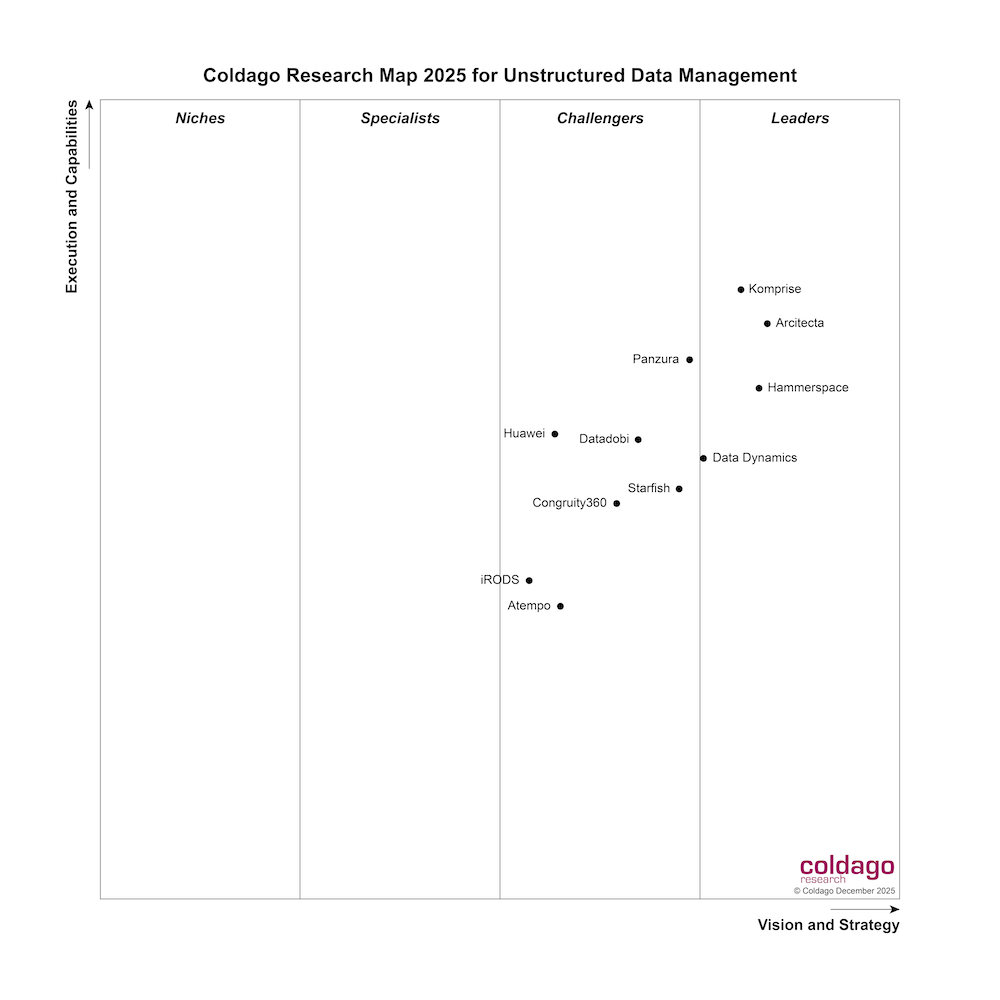
With one of the industry's most comprehensive portfolios for unstructured data management, Komprise appears well positioned to capitalize on the growing demand driven by AI initiatives. As market pressure continues to intensify, it would not be surprising to see significant corporate developments in the months ahead. It is also worth remembering that the company, founded 12 years ago, has now reached a level of maturity that could make it an attractive strategic asset.








 Subscribe to our free daily newsletter