







Weka Debuts NeuralMesh 6 to Power Enterprise and Agentic AI Workloads at Production Scale
The most significant software release in the company's history extends what's possible for agentic AI and other accelerated compute workloads
This is a Press Release edited by StorageNewsletter.com on July 23, 2026 at 2:01 pmWeka, an AI data and memory infrastructure company, announced Weka NeuralMesh 6, the most significant software release in the company’s history, delivering a purpose-built platform designed to help customers run production AI training, inference, and accelerated compute workloads at production scale on a single unified software stack. The release offers a robust set of capabilities that the AI infrastructure market has historically forced operators to assemble from separate vendors: native multi-tenancy at hyperscale, a full S3 protocol stack on NVMe, intelligent metadata-first data mobility that delivers async replication and remote caching, always-on data reduction with contractual guarantees, Kubernetes-native operations, and unified observability across every deployment.
Inference Costs Now Decide Which AI Companies Scale
The release arrives as the AI industry increasingly shifts decisively from training to production inference. Long-context reasoning, agentic workflows, and retrieval-driven AI workloads place sustained pressure on memory, metadata, and storage in ways traditional infrastructure architectures were not designed to handle. NeuralMesh 6 was built to deliver breakthrough inference economics at production scale for AI clouds, frontier model providers, government agencies, and large enterprises at the forefront of AI innovation.
Inference Economics Proven in Production on Oracle Cloud Infrastructure
NeuralMesh powers hyperscale AI inference in production today on Oracle Cloud Infrastructure (OCI). Leveraging Weka’s Augmented Memory Grid capability, which extends GPU memory by accelerating persistent KV cache access to NeuralMesh-managed NVMe storage, benchmarks on OCI H100 infrastructure have demonstrated 10x higher token throughput, 10x more concurrent users served, and 7x more tokens per GPU in production deployments.
“As agentic AI workloads push context windows and GPU utilization to new limits, Weka and Oracle Cloud Infrastructure are helping customers scale inference more efficiently without simply adding more GPUs,” said Pablo Selem, senior director, software development, Oracle Cloud Infrastructure. “Weka’s NeuralMesh platform with Augmented Memory Grid on OCI helps remove memory bottlenecks, delivering substantially more throughput and concurrent users from the same GPU footprint. For customers, that means higher ROI on infrastructure investments and a clearer path to cost-efficient AI at scale.”
Inside NeuralMesh 6
NeuralMesh 6 builds on this production foundation. Key features and capabilities include:
- Native Multi-Tenancy at Hyperscale
NeuralMesh 6 delivers the industry’s only multi-tenancy architecture that combines physical hardware isolation with logical network isolation on a single platform -
- Composable Clusters provide complete hardware-level isolation, dedicated CPU, memory, and storage drives per tenant for anchor tenants that require guaranteed resources, workload separation, and predictable performance under load
- Virtual Multi-Tenancy provides VPC-like network isolation through Weka’s Virtualized RDMA Data Fabric (VRDF), supporting private VLANs, overlapping IP address spaces, per-tenant quality of service (QoS), per-tenant encryption with independent KMS, and independent LDAP/AD authentication. Virtual MT scales to more than 1,000 isolated logical tenants per cluster, with new tenant provisioning in under 30 minutes
The two tiers compose. A single Weka hardware cluster running 50 Composable Clusters can support up to 50,000 logically isolated tenants on the same physical infrastructure – a path from dozens of tenants to tens of thousands without re-architecting.
- Full S3 Protocol Stack on NVMe
NeuralMesh 6 delivers a fully-featured, native S3 implementation in which the same physical data blocks are addressable via S3 and POSIX simultaneously – not a gateway that translates between protocols, but a single unified namespace. A file written via NFS or POSIX is immediately readable via S3, and vice versa, eliminating the multiple full-dataset copies that a conventional AI pipeline carries between the training, fine-tuning, and inference stages. The implementation is built for AI workload patterns: 2,000 to 5,000 concurrent S3 connections per node, roughly five times the concurrency of conventional S3 architectures. S3 over RDMA enables zero-copy data transfer directly to GPU memory. Object storage is no longer a secondary tier – it is a high-performance protocol native to the same platform that serves POSIX file workloads - Intelligent Replication for AI Workloads
GPU infrastructure is increasingly distributed across sites, clouds, and regions. Traditional replication architectures force organizations to wait for complete data copies before workloads can begin – a model that breaks down when GPU availability shifts in hours rather than weeks. NeuralMesh 6’s intelligent replication changes the model. The same foundation supports AI data mobility, cloudbursting, and multi-site collaboration. Metadata-first replication makes destination environments immediately browsable. Data hydrates on demand, only when accessed, reducing WAN traffic and eliminating unnecessary full-dataset copies. Organizations can place workloads where GPU capacity exists today rather than where data was originally written. In this first step towards complete federation and a global namespace, NeuralMesh 6 unlocks async replication and instantaneous remote caching functionality - Always-On Data Reduction with Performance Guarantees
NeuralMesh 6 introduces always-on data reduction, specifically designed for AI workloads, with fingerprinting, similarity hashing, de-dupe, and compression. It delivers less than 5% write overhead, up to 6x capacity savings on AI training data, and a contractual guarantee of both the data reduction ratio and the performance impact. The performance tax that has historically forced operators to choose between efficiency and speed is gone: data reduction is on by default, every deployment, every workload. Customer-specific pre-sales analysis can project workload-based reduction outcomes before deployment - AlloyFlash Automated TLC + QLC Flash Tiering
AlloyFlash enables combining TLC and QLC NVMe flash within a single cluster, transparently routing latency-sensitive operations to TLC while leveraging QLC at roughly 30-40% lower cost per terabyte for bulk-capacity workloads. AlloyFlash makes the highest-density WekaPOD configurations production-viable, not just capacity-on-paper.
Automatic, transparent, no customer configuration required - NeuralMesh Kubernetes Operator
NeuralMesh Kubernetes Operator automates cluster deployment and lifecycle management in Kubernetes environments. For neo-clouds and AI research labs running Kubernetes as their operational standard, Kubernetes Operator reduces deployment time from weeks to hours and brings NeuralMesh into the same declarative operational model their compute infrastructure already uses - NeuralMesh Observe
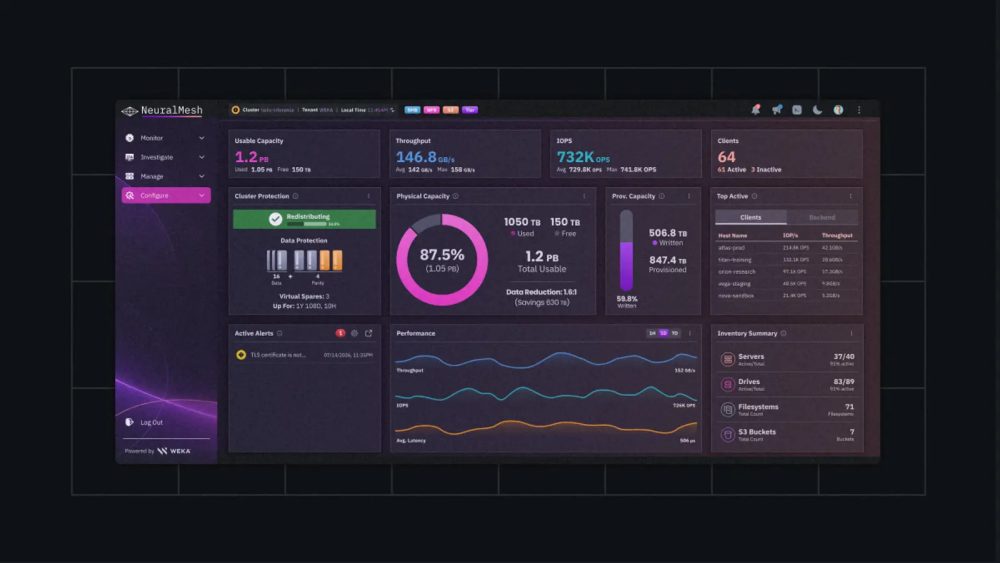
NeuralMesh Observe is SaaS-based observability built for high-performance AI storage. Unified multi-cluster dashboards, client-level diagnostics, intelligent alerting with configurable thresholds, and routing to Slack, PagerDuty, or email with direct links to relevant dashboards. Included with every NeuralMesh deployment at no additional cost.
“WhiteFiber is building a distributed GPU platform across multiple data centers connected by high-speed dark fiber. At our scale, data mobility isn’t a nice-to-have; it’s foundational,” said Sam Tabar, CEO, WhiteFiber. “NeuralMesh’s intelligent replication makes data mobility real at scale: we can make datasets visible across sites and pull exactly the data each job needs to the next GPU allocation as it becomes available. That shifts replication from a back-end protection function to a core part of how our distributed AI infrastructure needs to operate, improving workload mobility, capacity efficiency, and the resiliency our customers depend on. Weka’s data and memory infrastructure provides the foundation to scale our footprint without compromise. We’re excited to keep building on that together.”
“The infrastructure operators running production AI today have been forced to assemble platforms from vendors that were never designed to work together. Separate stacks for file and object, manual data movement between them, multi-tenancy bolted on after the fact. NeuralMesh 6 delivers what they’ve actually needed all along: a single platform that handles the high-performance file layer and the high-capacity object layer on the same blocks, with native multi-tenancy, intelligent data mobility, and always-on data efficiency built in from the start. This is what production inference infrastructure looks like when it’s designed for the workload, not retrofitted for it,” said Ajay Singh, CPO, Weka.
Availability
NeuralMesh 6 will be available in the second half of 2026. Existing Weka customers can upgrade to NeuralMesh 6 at no additional cost through standard upgrade channels and should contact their Customer Success representative for more details.
NeuralMesh x WekaPOD: Built to Run In Perfect Symmetry Together
Weka also announced the third generation of WekaPOD Nitro, WekaPOD Prime, and WekaPOD Prime Max, the first AI storage appliances built on Weka-designed and engineered hardware to optimize its NeuralMesh software platform. The systems deliver 1.1 exabytes of effective capacity per rack with multiple patents pending.
Comments
As many have probably noticed, Weka has repositioned itself as an AI infrastructure company focused on AI and memory-centric challenges. The term storage has largely disappeared from its messaging, reflecting the industry's broader shift toward a unified memory–storage continuum as AI reshapes virtually every aspect of IT, and increasingly, many industries beyond it.
At the same time, the economics of infrastructure have become more critical than ever. With NAND, DRAM, and HBM prices remaining exceptionally high, optimizing the balance between performance, capacity, and cost has become a strategic requirement rather than simply a technical consideration.
With the sixth major release of NeuralMesh, Weka delivers another significant milestone for a platform that has evolved rapidly since its introduction. From the beginning, the company embraced a software-defined architecture built around flash, NVMe, high-performance networking, containerization, parallel data, essentially file, access, intelligent tiering, Ethernet, and Linux. As AI workloads evolved, Weka expanded the platform with Axon, introducing a fusion architecture, porting the software to Nvidia BlueField-4 DPUs, and implementing a memory grid model that unifies memory and storage tiers into a single optimized data fabric. The company has consistently adapted its architecture to meet the demanding requirements of AI training and inference.
This latest release, an important step in Weka's evolution, introduces several notable enhancements. Among the most significant are:
- Multi-tenancy, enabling a single hardware cluster to host dozens of independent software-defined clusters capable of serving a very large number of tenants while maintaining strong isolation
- Unified file and object access over NVMe, allowing the same data to be accessed through both file and object protocols without additional copies. Users expected this for quite some time. This reduces storage consumption, processing overhead, latency, and overall costs. Support for S3 over RDMA further strengthens the case for using S3 in primary data workloads
- Advanced data mobility, featuring ultra-fast metadata propagation that provides a broader global view of data together with event-driven data hydration. This capability could naturally evolve toward more comprehensive global namespace and federation services
- Always-on data reduction, delivering advanced efficiency with only around 5% performance overhead
- Intelligent flash tiering across TLC and QLC media, optimizing both performance and the total cost of ownership of large-scale clusters
- A Kubernetes-native operational model, reinforcing the platform's container-first architecture
- Observe, a SaaS-based observability service offering dashboards, diagnostics, monitoring, alerting, and integration with widely used notification platforms
Combined with the newly announced WekaPOD, these innovations further strengthen the company's position and raise the competitive bar for the rest of the market.
Weka has also recently demonstrated compelling AI inference performance through deployments on Oracle Cloud Infrastructure (OCI), combining its KV cache architecture with GPU memory optimization to improve inference efficiency and scalability.
Click to enlarge
Alongside DDN, Huawei and Vast Data, Weka remains part of a small group of companies driving genuine innovation in high-performance AI data infrastructure from a storage point of view. By comparison, progress from several traditional storage vendors has been more incremental. Some have only recently adopted technologies such as pNFS, Dell with PowerScale, for example, also announced the mysterious Lightning FS, while others, including Pure Storage, we should say EverPure right?, with FlashBlade//EXA and NetApp with AFX, continue to evolve their existing architectures. At the same time, players such as Hammerspace and Peak:AIO are also seeking to disrupt the market with alternative approaches, intensifying competition in this rapidly changing landscape.
Next few months will be interesting to watch with the coming FMS conference early August in Santa Clara, CA, later SC in Chicago, IL in November and in the meantime some vendors ones.








 Subscribe to our free daily newsletter