








Kioxia and Dell Technologies First to Deliver High-Density Server with 9.8 PB of Flash Storage
Dell PowerEdge R7725xd Server with 40 KIOXIA LC9 Series 245.76 TB SSDs Sets New Benchmark for Storage Density in a 2U Server
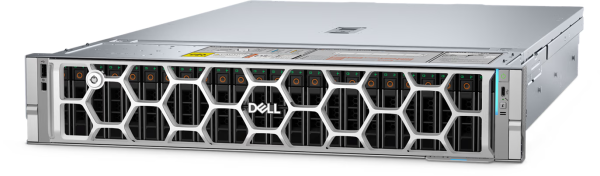
This is a Press Release edited by StorageNewsletter.com on May 18, 2026 at 2:01 pmKioxia Corp., a reference in memory solutions, announced a breakthrough in high-density storage infrastructure, collaborating with Dell Technologies to deliver a 2U server configuration capable of scaling to an unprecedented(1) 9.8PB of flash storage. By combining the Dell PowerEdge R7725xd server with AMD EPYC processors and 40 KIOXIA LC9 Series E3.L form factor 245.76TB NVMe SSDs, the companies are enabling a new class of storage-optimized platforms built to meet the demands of AI, large-scale data lakes, and data-intensive enterprise workloads.
Together, Dell Technologies and Kioxia have a long history of enabling scalable infrastructure for data-driven applications. This latest milestone underscores a shared commitment to advancing high-density architectures that improve performance, reduce energy consumption, and maximize data center efficiency.
“As AI workloads grow more demanding, the infrastructure supporting them must keep pace,” said Arun Narayanan, SVP, compute and networking, Dell Technologies. “The Dell PowerEdge R7725xd combined with KIOXIA’s high-capacity enterprise SSDs delivers the storage density and power efficiency our customers need to scale AI infrastructure without sacrificing performance.”
Dell PowerEdge R7725xd servers are built for modern AI and data-centric workloads, combining dense storage with powerful compute. These flexible, air-cooled storage configurations complement GPU-enabled servers, supporting AI data management and model training by delivering massive storage capacity across the AI lifecycle. These systems support up to 5x 400Gbps NICs, allowing users to fill and move data through pipelines more efficiently – ultimately making the most of their data. Paired with KIOXIA LC9 Series 245.76TB SSDs, these systems provide high-capacity, power-efficient solutions that reduce TCO and data center footprint.
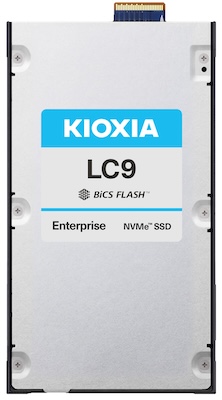
KIOXIA LC9 Series SSDs deliver up to 245.76TB of flash-based storage with PCIe 5.0 performance in a range of form factors, including 2.5-inch, E3.S, and E3.L(2). As the industry’s first(3) NVMe SSD at this capacity built for the demands of generative AI environments, the KIOXIA LC9 Series offers a compelling alternative to more commonly used 30.72TB capacity SSDs. A comparable 9.8PB configuration would require seven more servers carrying 280 additional drives, resulting in 8x the power consumption(4), as well as utilizing more rack space. This results in a more efficient use of space and power, enabling organizations to scale AI infrastructure without expanding their physical footprint or energy consumption.
“The combination of the Dell PowerEdge R7725xd server and the KIOXIA LC9 Series enterprise SSD isn’t just about high density, it’s a shift in how we architect AI infrastructures,” noted Akihiro Kimura, technology executive of the SSD division, Kioxia Corporation. “Customers will be able to deploy massive ingestion streams, scale data lakes effortlessly, and handle large backups in a fraction of the footprint, improving TCO to new levels.”
The solution highlights how tightly integrated compute and storage innovations can unlock new efficiencies for enterprise and hyperscale environments. By delivering extreme density without compromising performance or energy efficiency, Kioxia and Dell Technologies are helping organizations modernize infrastructure to keep pace with accelerating data growth and AI adoption.
Notes:
- As of May 15, 2026, based on a Kioxia survey
- The 245.76TB capacity is only available in the E3.L form factor. The 2.5” and E3.S form factors support capacities up to 122.88TB
- As of July 21, 2025, based on a Kioxia survey
- As of May 15, 2026, based on a comparison with the 30.72 TB KIOXIA LC9 Series SSD and server power consumption
– Definition of SSD capacity: Kioxia Corporation defines a kilobyte (KB) as 1,000 bytes, a megabyte (MB) as 1,000,000 bytes, a gigabyte (GB) as 1,000,000,000 bytes, a terabyte (TB) as 1,000,000,000,000 bytes, a petabyte (PB) as 1,000,000,000,000,000 bytes and a kibibyte (KiB) is 1,024 bytes. A computer operating system, however, reports storage capacity using powers of 2 for the definition of 1GB = 2^30 bytes = 1,073,741,824 bytes and 1TB = 2^40 bytes = 1,099,511,627,776 bytes and therefore shows less storage capacity. Available storage capacity (including examples of various media files) will vary based on file size, formatting, settings, software and operating system, and/or pre-installed software applications, or media content. Actual formatted capacity may vary
– The flash memory capacity is calculated as 1 terabit (1 Tb) = 1,099,511,627,776 (2^40) bits, and 1 terabyte (1 TB) = 1,099,511,627,776 (2^40) bytes
– 2.5-inch indicates the form factor of the SSD and not its physical size
– Dell Technologies, PowerEdge, Dell, and other trademarks are trademarks of Dell Inc. or its subsidiaries
– NVMe is a registered or unregistered trademark of NVM Express, Inc. in the United States and other countries
– PCIe is a registered trademark of PCI-SIG
– Other company names, product names, and service names may be trademarks of third-party companies
Comments
The key question here is what exactly is being promoted, the 2U form factor's capacity, or the fact that a single 2U server can be configured with 40 high capacity NVMe SSDs?
As SSD capacities continue to grow and all major SSD vendors have announced drives at this capacity, with many now becoming available, this type of announcement can essentially be replicated using any E3.L SSDs. We should therefore expect similar announcements from other SSD vendors and server manufacturers. While the density advantage is clear, at scale, one critical design consideration is the independence of resources and components to isolate failures. The performance of such a densely packed machine under heavy I/O workloads is debatable, as is the approach to data redundancy and protection. At the device level, of course, erasure coding is a interesting choice, but what about node failure like for any server obviously. But with that density, we hope the answer isn't simply to add another node, because in that case, why not use less dense nodes and multiply them to provide greater bandwidth and improved resiliency? That said, for high-density rack environments, this approach could make sense, and parallelism and redundancy can still be achieved at the rack level.
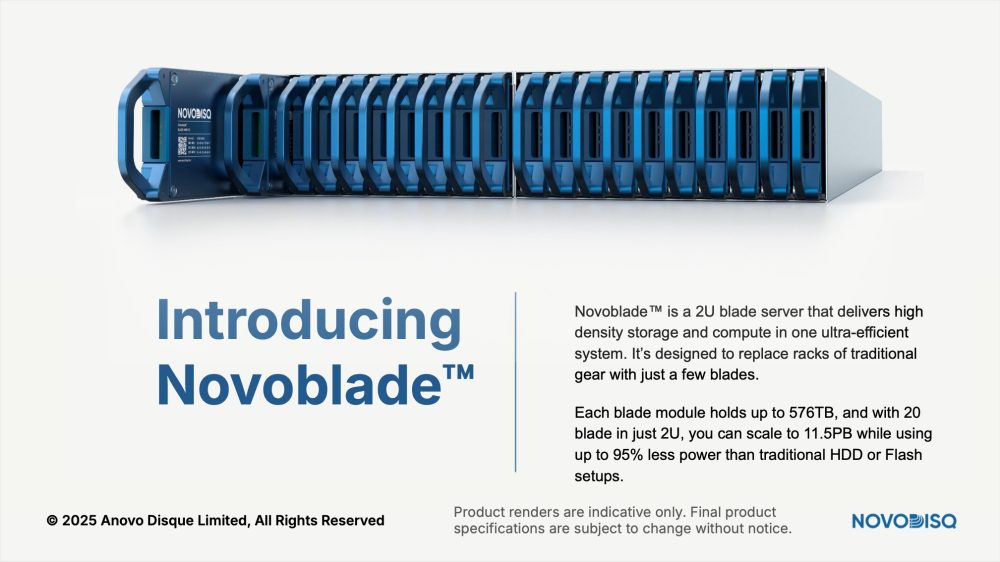
Now, regarding 2U storage density specifically, this is not the first such achievement. We unveiled Novodisq to the world a few months ago. That company offers 11.5PB raw in a 2U chassis, based on 20 blades per 2U enclosure, with each blade embedding 4x 144TB SSDs. Imagine that same blade configuration using that Kioxia drive, and you reach 19.6PB, exactly double this Dell server's capacity, while each blade also provides its own CPU, FPGA, and RDMA connectivity. With the Novodisq approach, users run 20 independent servers in 2U. More details are available here and here.
Click to enlarge
Ultimately, the real distinction to make is whether we are talking about a 2U storage server or 2U storage unit or entity as a broader category.







 Subscribe to our free daily newsletter