




Linux Kernel 7.0 is Out
A major release announced a few days ago
By Philippe Nicolas | April 21, 2026 at 2:01 pmDeclarative Released on April 12, 2026, version 7.0 is a landmark release for the IT industry, with particular significance for the data management and storage sectors. Linux Kernel 7.0, what’s new
Why 7.0?
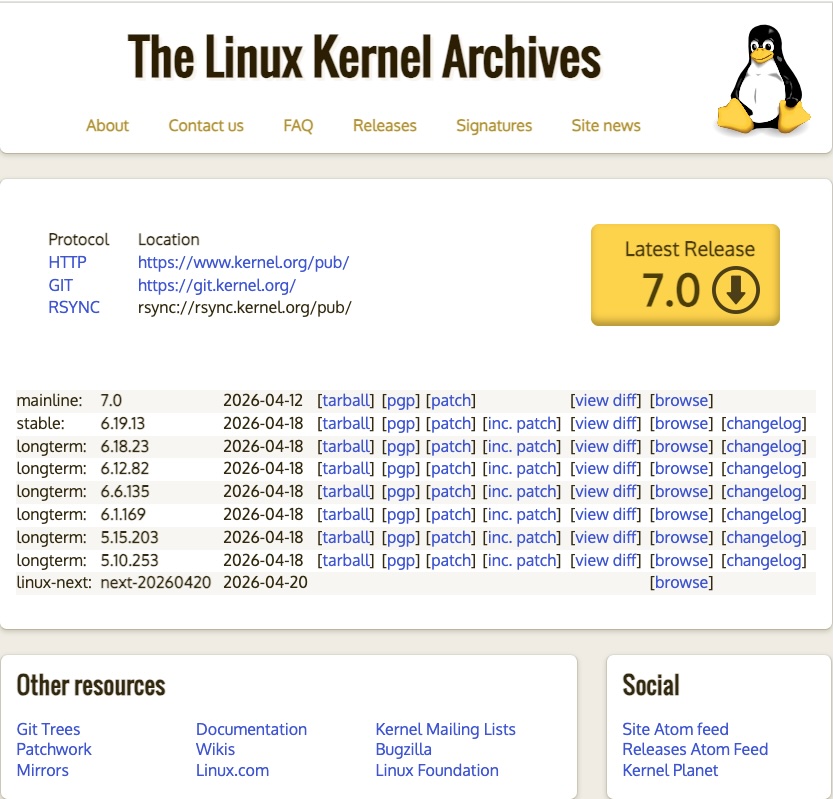
The most recent stable release of the Linux kernel is 7.0, released on April 12, 2026. The major version carries no intrinsic meaning, minor versions are capped around 20 to avoid the false perception that changes between large minor numbers would be smaller than between earlier ones. In short, it follows 6.19 by convention, not revolution.
🦀 Rust, now officially stable
Linux kernel 7.0 finally promotes Rust support to stable. The “Rust experiment” was concluded at the 2025 Linux Kernel Maintainers Summit, and Rust is here to stay. Rust-based drivers and kernel modules are now considered first-class citizens in the kernel tree. The Rust kernel API now covers PCI device enumeration, interrupt handling, DMA mapping, and platform device registration, the foundational building blocks needed for real hardware driver development.
📁 Filesystems & storage
The Btrfs filesystem received support for direct I/O when a block size is bigger than the page size and initial support for the remap-tree feature.
The XFS filesystem received autonomous self-healing support, and there’s a new immutable root filesystem called “nullfs”. LZMA compression has been enabled by default for the EROFS filesystem, and there’s a new API for file I/O error reporting to filesystems.
Improved EXT4 write performance for concurrent direct I/O writes is also included, along with standardized generic I/O error reporting for the Linux kernel.
⚡ Performance improvements
The memory management subsystem got a major overhaul. Allocation time for large memory blocks dropped from 3.6 seconds down to 0.43 seconds. A cleanup in how the kernel handles swapping delivered a measured 20% speed improvement in Redis benchmarks.
Container creation is 40% faster thanks to a new feature called OPEN_TREE_NAMESPACE that copies only the specific mount tree a container actually needs.
Thread creation and teardown is 10–16% faster thanks to PID allocation improvements, with file open/close operations 4–16% quicker on multi-core machines.
🖥️ CPU scheduler
Linux 7.0 fixes a decade-old scheduler problem. Previously, the CPU could yank a thread off the processor mid-task even if it was in the middle of a critical process, causing micro-stutter and hiccups during heavy workloads.
A new feature called Time Slice Extension uses the Restartable Sequences (RSEQ) feature to give threads more time to finish before being preempted.
🔒 Security
A key security-related change is the addition of ML-DSA post-quantum signatures for kernel module authentication, while support for SHA-1-based module-signing schemes has been removed.
Linux 7.0 enables support for non-circular io_uring queues for better cache performance, and adds support for cBPF filters for io_uring, giving administrators improved control in restricted environments.
🏗️ Hardware support
Intel Transactional Synchronization Extensions (TSX) now defaults to “auto” mode on capable CPUs without known TSX security issues, helping with out-of-the-box performance compared to the prior off-by-default mode.
Initial hardware enablement for upcoming AMD Radeon graphics hardware and continued enablement work on Intel Crescent Island and Nova Lake graphics are also included.
GCN 1.0 and 1.1-era Radeon GPUs see further stability fixes, and the open-source NVK driver for newer Nvidia GPUs gets improved performance thanks to restored large page support. Intel Arc B-series (Battlemage) discrete GPUs no longer block D3cold, the deepest PCIe power-saving state.
The kernel also includes more sophisticated support for KVM virtual machines on AMD EPYC 5 CPUs.
🌐 Networking & virtualization
The kernel enables AccECN for general use, adds multiqueue support to CAKE for improved traffic shaping across CPUs, and introduces network-namespace support for VSOCK sockets in virtual machines. Initial groundwork for Wi-Fi 8 (802.11bn) is also included.
NFSD now features a dynamically adjustable thread pool, and NFS v4.1 is the default protocol.
A nice UDP network performance boost was achieved by inlining a function.
🤖 AI’s growing role in kernel development
Linus Torvalds noted in his release announcement: “I suspect it’s a lot of AI tool use that will keep finding corner cases for us for a while, so this may be the ‘new normal’.”
Kernel dev Greg Kroah-Hartman also observed that AI has become a truly useful bug-spotter for the kernel maintenance crew.
📦 Distribution availability
Kernel 7.0 ships as the default kernel in Ubuntu 26.04 LTS, releasing April 23, 2026.
FOSS Linux Fedora 44 is sticking with kernel 6.19 for its April release, but Fedora 45, scheduled for October, should have kernel 7.x. Rolling release distros get kernel 7.0 as soon as it dropped.
Click to enlarge








 Subscribe to our free daily newsletter