





IT Press Tour 67: StorPool Storage
Confirming its pretty unique Software-Defined Storage approach
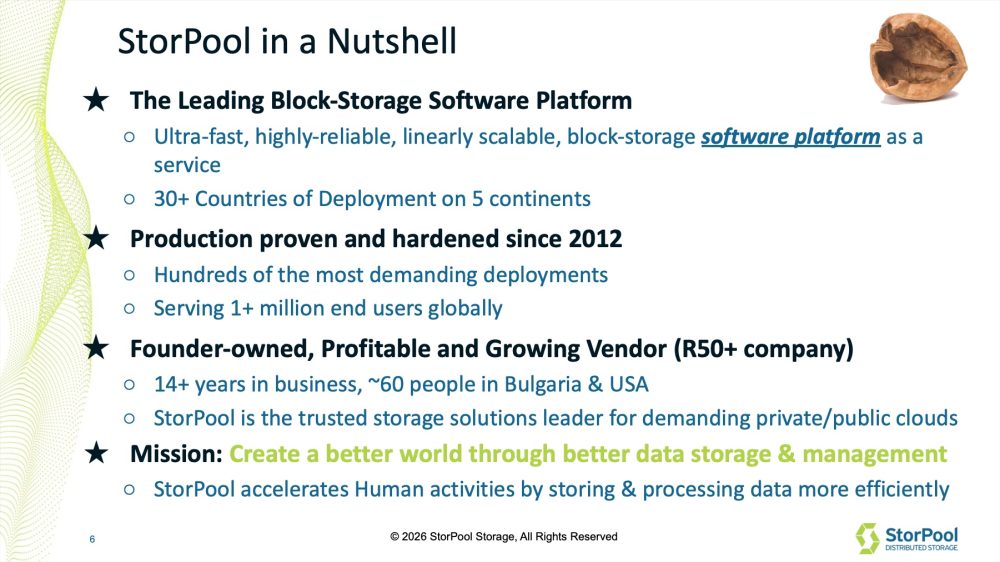
By Philippe Nicolas | April 8, 2026 at 2:01 pmWe had the opportunity to meet StorPool Storage for the 4th time during the recent 67th edition of The IT Press Tour held last week in Sofia, Bulgaria. StorPool Storage, founded in 2011 in Bulgaria, positions itself as the leader in modern Software-Defined Storage (SDS), covering essentially the block storage part. The company is entirely self-funded, profitable, and growing, with roughly 60 employees across Bulgaria and the USA. It serves over 1 million end users globally across 30+ countries on 5 continents. Its mission is straightforward: create a better world through better data storage and management. Being in Sofia, we had the opportunity to have multiple executives from the company presenting at the event, Boyan Ivanov, CEO, Boyan Krosnov, CTO, and Alexander Ivanov, head of products.
Click to enlarge
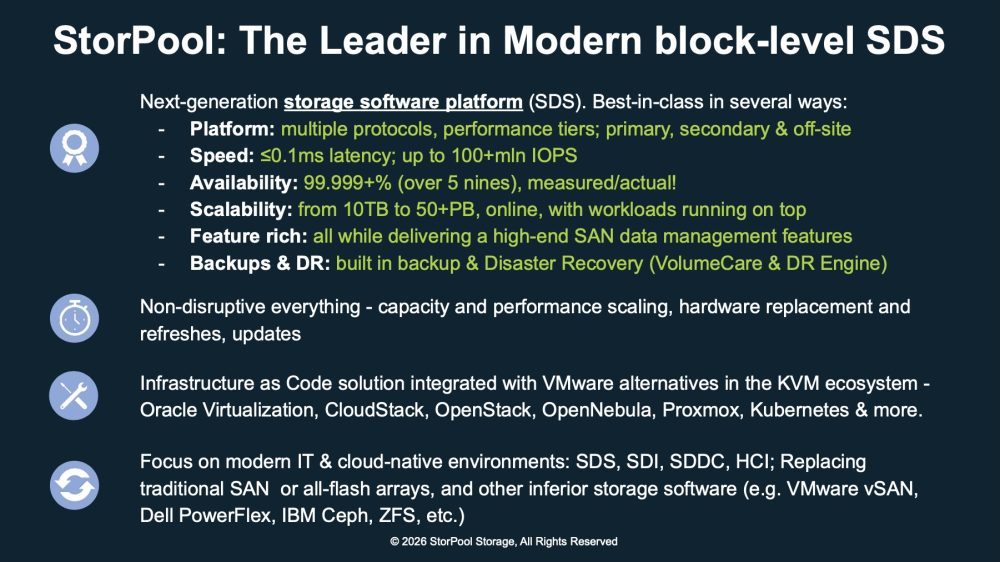
At its core, StorPool offers an ultra-fast, highly reliable, and linearly scalable block-storage software platform delivered as a service. Key technical highlights include latency below 0.1ms, up to 100+ million IOPS, availability exceeding 99.999% (five nines), and scalability ranging from 10TB to 50+ petabytes, all while workloads remain running. The platform includes built-in backup and disaster recovery tools (VolumeCare and DR Engine), and integrates with major KVM-ecosystem platforms such as OpenStack, CloudStack, Proxmox, OpenNebula, Oracle Virtualization, and Kubernetes.
Click to enlarge
- Trend 1 – The VMware Exit. Broadcom’s acquisition of VMware triggered a wave of customers seeking alternatives due to dramatic price increases and tightening lock-in
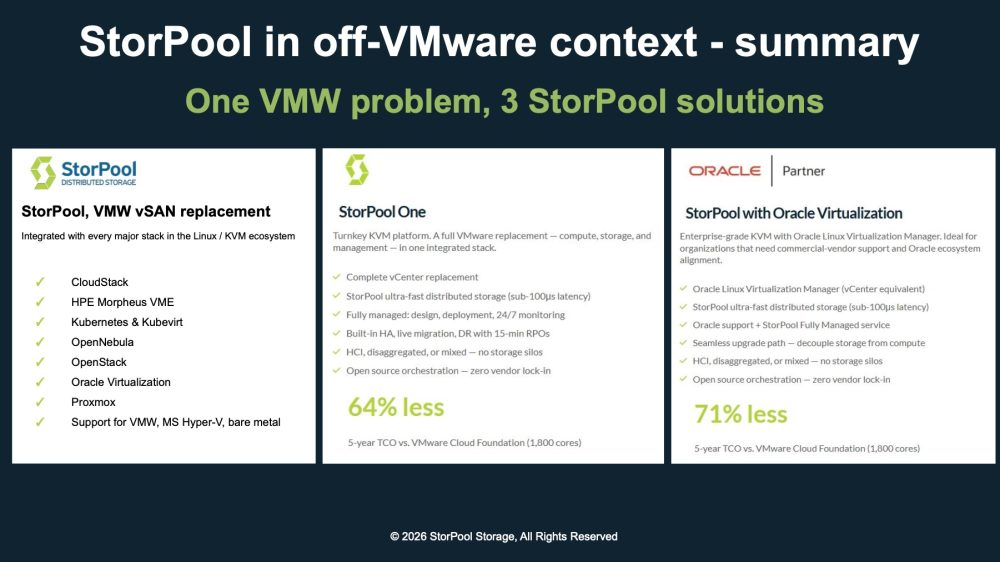
StorPool addresses this with three distinct offerings:- a drop-in vSAN replacement within the KVM stack,
- StorPool One, a fully managed, all-in-one KVM platform replacing the entire VMware Cloud Foundation stack at 64% lower five-year TCO, and
- StorPool combined with Oracle Virtualization, yielding 71% savings versus VMware Cloud Foundation over five years. The migration window is considered urgent, with most moves expected between 2025 and 2027
- Trend 2 – EU Data Sovereignty and Sovereign Clouds. Growing European regulatory pressure and geopolitical concerns are driving demand for infrastructure that remains under European control. StorPool responds as a fully European company (not US-owned), offering complete sovereign cloud designs and participation in the EuroStack Pack initiative, a multi-vendor European stack covering infrastructure, hypervisor, network, storage, identity management, and observability
- Trend 3 – AI Workloads. The surge in AI is creating new storage demands, particularly for inference, Retrieval-Augmented Generation (RAG), and vector databases. StorPool powers GPU-as-a-Service platforms and AI infrastructure for customers such as IG1, Cloudalize, and Redmond.ai, providing the fast, reliable storage layer that AI workloads require
- Trend 4 – Hardware Price Hikes and Supply Constraints. With server and component costs rising sharply, StorPool helps customers do more with less. Its HCI mode consumes only 10–15% of CPU and RAM overhead, reduces SSD wear by 16% over five years of database workloads, consolidates 20+ physical components down to 7, and can run approximately 3,000 virtual machines on just 10 servers
Click to enlarge
StorPool frames its value not merely as storage optimization but as a ripple effect that improves the economics of the entire data center, from compute and networking to datacenter rack space, utilities, and ultimately the company’s profit margins. Notable customer outcomes include a 15% margin increase for CloudSigma, 60% higher per-rack VM density for Namecheap, a reduction from 50 to just 5 storage staff at Dustin, and elimination of downtime and hardware refresh cycles at Atos. Customers such as Katapult have used StorPool to build what they claim is the fastest public cloud. End-user workloads running on StorPool-powered infrastructure include those of NASA, ESA, CERN, Siemens, and Deutsche Börse Group.
The company also emphasizes that SDS represents a broader operational transformation, moving organizations from traditional siloed, ticket-based, manually operated IT toward modern, API-driven, automated, always-on infrastructure.
The full presentation is available here.







 Subscribe to our free daily newsletter