







Toshiba Begins Sampling of 30-34TB SMR Nearline 3.5-Inch HDDs
M12 SMR HDDs reach maximum data transfer rate of 282MB/s, an improvement of approximately 8%, while power consumption efficiency per terabyte (W/TB) is approximately 18% lower than previous-gen
This is a Press Release edited by StorageNewsletter.com on April 7, 2026 at 2:02 pmToshiba Electronic Devices & Storage Corp. has announced the M12 Series of 3.5-inch [1] nearline HDDs for hyperscale and cloud service providers.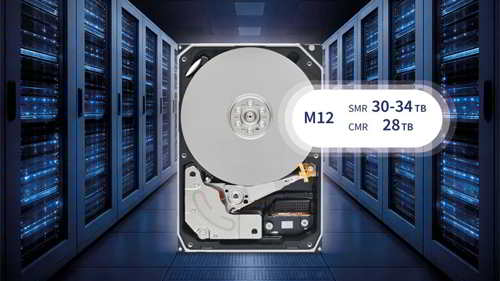 The new M12 HDDs employ Shingled Magnetic Recording (SMR) technology to deliver storage capacities [2] ranging from 30 to 34TB [3]. Sample shipments of SMR-based HDDs have begun with plans to begin sample shipments of Conventional Magnetic Recording-based (CMR) models with capacities up to 28TB to commence in the 3rd quarter of 2026.
March 31 happens to be World Backup Day, the annual international initiative to remind companies and individuals of the importance of backing up and protecting their data. That need is now more important than ever given the widespread adoption of cloud services, video content, and most recently, the emergence of data-centric AI technology. All of factors are fueling the explosive growth of digital content and the amount of data stored.
The requirement from data centers, the repositories for most of the world’s digital data, is for higher-capacity, better performing HDDs to support more efficient system configurations. The M12 Series is designed to meet these requirements by significantly increasing storage capacity in the standard 3.5-inch nearline HDD form factor.
M12 Series HDDs leverage the company’s proprietary design and analysis technologies cultivated through the development of slimmer and more compact components. Additionally, the new M12 is the 1st glass substrate nearline HDD for Toshiba, and the use of glass substrates increases the HDD’s durability while enabling thinner designs. The HDDs are enclosed in helium and combine the firm’s proprietary Flux Control Microwave-Assisted Magnetic Recording (FC‑MAMR) technology with SMR to achieve storage capacities of 30 to 34TB. SMR technology increases recording density by overlapping data tracks similar to roof shingles; however, overlapping process degrades random write operations. To overcome this, M12 HDDs utilize a host-managed SMR architecture, in which the host system manages data placement and rewriting within the drive. This approach improves data handling and reduces performance degradation in server and storage system environments.
The M12 SMR HDDs reach a maximum data transfer rate of 282MB/s [ 4], an improvement of approximately 8%, while power consumption efficiency per terabyte (W/TB) is approximately 18% lower than previous-gen. Designed for continuous 24/7 operation, the M12 Series supports an annual workload [5] rating of 550TB and offers an MTTF/MTBF [6] of 2.5 million hours with an annualized failure rate (AFR) of 0.35%.
To meet the growing storage demand of data centers, Toshiba plans to introduce next-gen products based on Heat Assisted Magnetic Recording (HAMR) and 12-disk configurations [7] in upcoming quarters.
[1] “3.5-inch” means the form factor of HDDs, and is not the HDD’s physical size
[2] Range of storage capacity with variable capacity formatting applied
[3] Definition of capacity: One terabyte (TB) = one trillion bytes, but actually available storage capacity may vary, depending on operating environment and formatting. Available storage capacity (including examples of various media files) will vary based on file size, formatting, settings, software and OS and/or pre-installed software applications, or media content. Actual formatted capacity may vary
[4] Read and write speeds may vary depending on the host device, read and write conditions, and file size
[5] Workload is a measure of data throughput in a year, and it is defined as the amount of data written, read or verified by commands from the host system
[6] MTTF/MTBF (mean time to failure/mean time between failure) is not a guarantee or estimate of the product life; rather it is a statistical value related to mean failure rates for a large number of products which may not accurately reflect actual operation. The actual product life of the product may vary
[7] Toshiba First in Industry to Verify 12-Disk Stacking Technology for Hard Disk Drives announced on October 14, 2025
Comments
Seagate, Toshiba, and Western Digital, listed here in alphabetical order, continue to deliver strong results, driven by hyperscaler demand and a clear evolution in the storage hierarchy across a growing variety of HDD use cases. The pressure exerted by flash and SSD vendors, combined with increasingly demanding workloads, has pushed HDD manufacturers to reinvent themselves through innovation across multiple dimensions: areal density, platter count, read/write heads, helium-filled enclosures, availability, recording techniques, and energy efficiency.
While HDDs have effectively conceded the capacity-per-dollar battle against SSDs at the high-performance tier, recent announcements- and this one in particular, remain strategically important for the industry. SMR technology delivers a 20–25% capacity increase over CMR drives at comparable price points, with compelling characteristics for the right workloads. Among the notable recent advances in HDD technology, it is worth highlighting autonomous drive regeneration, head depopulation, and NVMe support introduced with the v2 specification.
Some vendors have gone further by rethinking how drives are managed at the system level. Disk Archive, using conventional HDDs, and Leil, leveraging HM-SMR drives, have both deployed sophisticated disk management approaches that reinvent the MAID concept with a thoroughly modern architecture.
The table below summarizes the current high-capacity SMR HDD offerings from Seagate, Toshiba and Western Digital:
| Spec | Seagate Exos M 36TB | Seagate Exos M 32TB | Toshiba MG12 34TB | Toshiba MA11 28TB | WD Ultrastar DC HC690 | WD Ultrastar DC HC680 |
|---|---|---|---|---|---|---|
| Capacity | 36 TB | 32 TB | 34 TB | 28 TB | 32 TB | 28 TB |
| Recording Tech | HAMR + SMR | HAMR + SMR | FC-MAMR + SMR | FC-MAMR + SMR | ePMR + UltraSMR | ePMR + UltraSMR |
| Form Factor | 3.5" | 3.5" | 3.5" | 3.5" | 3.5" | 3.5" |
| Platters | 10 | 10 | 11 | 10 | 11 | 10 |
| Areal Density | ~4.4 TB/platter | ~4.0 TB/platter | ~3.09 TB/platter | ~2.8 TB/platter | ~2.9 TB/platter | ~2.8 TB/platter |
| Spindle Speed | 7,200 RPM | 7,200 RPM | 7,200 RPM | 7,200 RPM | 7,200 RPM | 7,200 RPM |
| Interface | SATA 6Gb/s / SAS 12Gb/s | SATA 6Gb/s / SAS 12Gb/s | SATA 6Gb/s / SAS 12Gb/s | SATA 6Gb/s / SAS 12Gb/s | SATA 6Gb/s / SAS 12Gb/s | SATA 6Gb/s / SAS 12Gb/s |
| Transfer Rate | ~285 MB/s | ~285 MB/s | ~281 MB/s | ~268 MB/s | 257 MB/s | 265 MB/s |
| Cache | 256 MB | 256 MB | 256 MB | 256 MB | 256 MB | 256 MB |
| MTBF | 2.5M hours | 2.5M hours | 2.5M hours | 2.5M hours | 2.5M hours | 2.5M hours |
| Workload Rating | 550 TB/yr | 550 TB/yr | 550 TB/yr | 550 TB/yr | 550 TB/yr | 550 TB/yr |
| Encryption | SED optional | SED optional | SED optional | SED optional | SED / FIPS optional | SED / FIPS optional |
| Target Use | Hyperscaler / Cloud | Hyperscaler / Cloud | Hyperscaler / Cloud | Hyperscaler / Cloud | Data Center / AI | Data Center / Archive |
| Availability | GA (2025) | GA (2025) | Sampling (Q1 2026) | GA (2024) | GA (2024) | GA (2023) |
| SMR Type | Host-Managed | Host-Managed | Host-Managed | Host-Managed | Host-Managed (UltraSMR) | Host-Managed (UltraSMR) |







 Subscribe to our free daily newsletter