






Company Profile: InfoScale
Continuing the strong Veritas Software trajectory
By Philippe Nicolas | March 11, 2026 at 2:01 pmCompany name:
InfoScale (business entity wholly owned by Cloud Software Group)

Legal name:
InfoScale
HQ and offices:
San Ramon, California
Global presence:
Enterprise operations worldwide through Cloud Software Group
Website:
infoscale.com
Date founded:
December 2025
Ownership:
Cloud Software Group
Leaders:
 Bhooshan Thakar, SVP & GM
LinkedIn profile
Company Trajectory:
Building Intelligent, Real-Time Resilience for the Enterprises That Can’t Stop
Enterprise technology is at a moment when the old risk mitigation standards no longer apply. Systems are more distributed. Dependencies have multiplied. The cost of operational disruptions are more impactful and painful than ever. Resilience was once defined by how fast you recover but today it must be defined by how well you avoid disruption altogether.
InfoScale was built to deliver at this moment.
Acquired in December 2025 as a standalone company under Cloud Software Group, InfoScale is building on a 30 year expertise in enterprise storage, availability, and data management to deliver the future of resilience. Intelligent, real-time data and uptime protection for enterprises operating in an always-on, AI-driven world at global scale.
For decades, InfoScale has protected some of the world’s most critical workloads. More than 1,700 enterprises including major financial institutions, telecommunications providers, and public-sector organizations have relied on the solution to keep essential systems running without interruption. That heritage matters. But the market InfoScale is addressing today looks fundamentally different from the one it served even a few years ago.
Enterprise operations now span hybrid and multi-cloud environments. Data moves continuously across regions, architectures, and AI pipelines. Intelligent threats and cascading failures have turned single incidents into global disruptions within seconds. In this environment, recovery alone is no longer enough.
InfoScale’s conviction is that resilience must move upstream, from reactive recovery to real-time intelligence that anticipates, adapts, and intervenes before outages occur. This shift defines how the company sees the next wave of enterprise challenges unfolding and how it intends to lead.
Cloud Software Group views InfoScale as central to this future. Commenting on the company’s launch, Tom Krause, CEO, Cloud Software Group, said: “InfoScale provides unmatched data resiliency for the world’s most demanding enterprises, protecting vital revenue streams with a 99.999% uptime guarantee that spans the entire hybrid multi-cloud stack. It’s a perfect fit for Cloud Software Group.”
The statement reflects both the scale of ambition behind InfoScale and its role within Cloud Software Group’s portfolio of mission-critical software businesses.
Financial backing:
No funding as the Cloud Software Group is the parent company.
Employee numbers:
Several hundred employees globally. Strong concentration of senior engineers, architects, and enterprise operators with deep experience in availability, data management, and large-scale systems.
Revenue:
Established enterprise revenue base. Large installed footprint across mission-critical and regulated industries.
Technology:
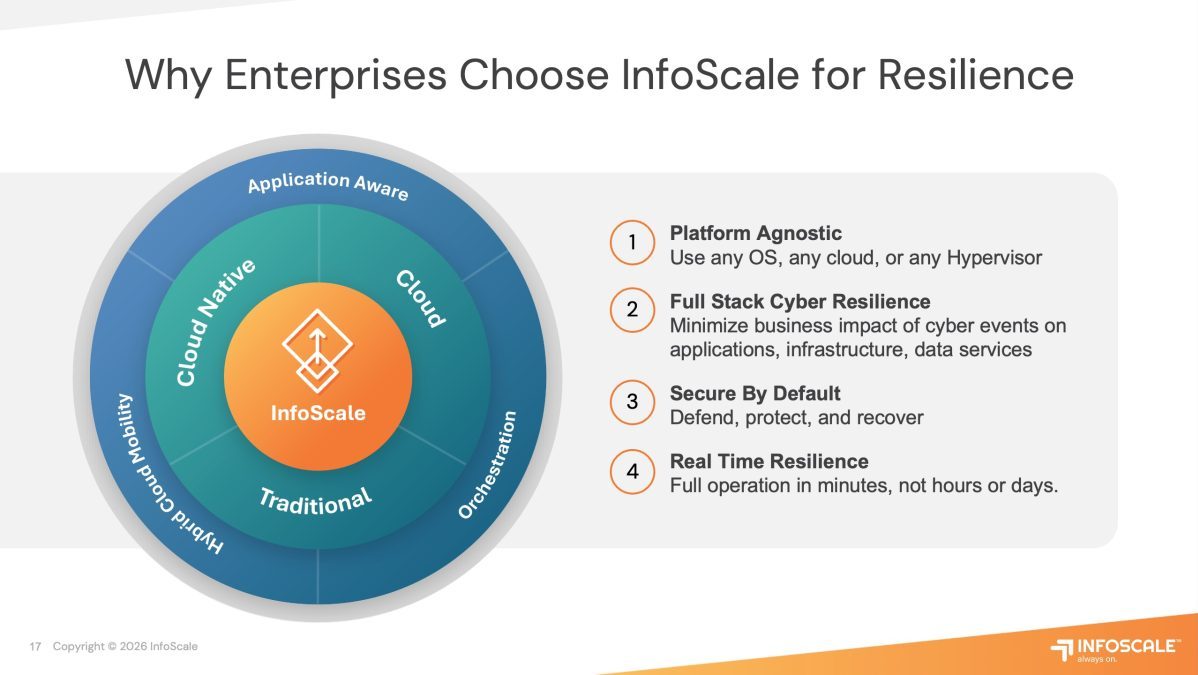
InfoScale delivers a full-stack platform for intelligent, real-time operational resilience, designed to protect applications, data, and infrastructure across hybrid and multi-cloud environments. The solution is built around a set of core beliefs shaped by how enterprise operations are evolving:
- Every workload matters. In highly distributed environments, even small services can have outsized impact. Resilience must span the entire stack – from infrastructure and data to applications and orchestration layers
- Autonomy is no longer optional. AI agents, machine identities, and automated systems require resilience that operates at machine speed, without human intervention
- Prediction and response beats reaction. Scheduled failovers and post-incident recovery are insufficient in a world of continuous risk. Enterprises need real-time intelligence that senses disruption early and responds automatically
InfoScale embeds these principles directly into its architecture, enabling resilience that is context-aware, automated, and continuously active – not something that is switched on only during a crisis.
Click to enlarge

Products:
InfoScale provides an integrated enterprise solution delivering:
- Real-time resilience
- Application availability and clustering
- Disaster recovery orchestration
- Data and storage management
- Policy-driven automation across hybrid and multi-cloud environments
The platform is engineered for environments where downtime is not a nuisance, but a direct threat to revenue, safety, or trust.
Click to enlarge

Customers:
InfoScale serves enterprises with zero tolerance for disruption, including organizations in:
- Financial services
- Telecommunications
- Healthcare
- Energy and utilities
- Public sector and regulated industries
These customers depend on InfoScale to protect the systems that underpin essential services and global operations.
Click to enlarge
Workloads / Use cases:
- Mission-critical databases, applications, and transactional platforms
- Real-time data and uptime protection across hybrid and multi-cloud enterprise infrastructures
- Vendor agnostic data management and optimization at scale
Business-critical services requiring deterministic uptime and data protection
Target market:
Large enterprises seeking:
- Intelligent, real-time operational resilience
- Continuous application availability
- Secure, scalable data management
- Proven solutions validated in production at global scale
Competition:
InfoScale operates in a market that includes vendors such as Veeam, Zerto, SIOS, and native cloud availability services. Its differentiation lies in enterprise depth, hybrid consistency, and operational maturity, particularly for organizations running complex, interconnected systems where disruption cascades quickly and consequences are severe.
Comments:
InfoScale enters the market at a time when enterprise operations are becoming both more powerful and more fragile. AI accelerates innovation, but also increases interdependence. Hybrid architectures create flexibility, but add complexity. In this environment, resilience must become intelligent, autonomous, and always on.
With Cloud Software Group backing, a large global customer base, and a platform designed for real-time intervention rather than after-the-fact recovery, InfoScale is positioning itself not just to respond to the next disruption – but to prevent it from happening in the first place.
Resilience, in this new era, is no longer about bouncing back. It’s about never going down at all.
Comments
InfoScale can be seen as a return to the origins of the product line. Some of us still remember the original products from VERITAS Software: VERITAS File System (VxFS) and VERITAS Volume Manager (VxVM), combined within Foundation Suite - later renamed Storage Foundation - along with Database and NFS Edition. The portfolio also included FirstWatch, coming from the acquisition of Tidalwave Technologies in 1994, and VERITAS Cluster Server (VCS).
This was before 1997, the year VERITAS acquired OpenVision Technologies, bringing NetBackup into its portfolio - another product that has changed ownership several times over the years. At the time, NetBackup was actually Mark Leslie’s second choice, as VERITAS had failed to reach an agreement with Lou Cole, CEO of Legato, for NetWorker. Legato was later acquired by EMC, which went on to build a comprehensive data protection portfolio around it, notably adding Avamar and Data Domain.
Click to enlarge

The landscape has evolved significantly since those early days. Veritas once dominated storage management for production data - what we now call primary storage - with widespread adoption of VxFS and VxVM across Unix platforms, thanks to several features that became essential over time. For instance, Logical Storage Manager (LSM) on Digital Unix was VxVM, while JFS (Journaled File System) on HP-UX was based on VxFS. In total, there were probably more than 30 agreements with Unix vendors to integrate VxFS and/or VxVM. VxVM was also adapted for Windows under the name LDM (Logical Disk Manager).
With the rise of Linux, the landscape shifted again. A new generation of users - strongly oriented toward open source - did not grow up with the Veritas ecosystem, instead adopting alternatives such as ext2/3, XFS, and even ZFS.
More recently, efforts have been made to reestablish a presence in this environment - first by Veritas Technologies, then Arctera, and now with InfoScale - through collaborations with Red Hat and integration with OpenShift.
The original Veritas trajectory was interrupted when Symantec acquired the company in 2005. Symantec came from a very different background - focused on high-volume software sales, security (particularly antivirus), and the dominance of the Windows platform. The acquisition came as a shock, and the Veritas business was significantly affected.
For example, under Symantec's control, Veritas never delivered an object storage software product, even though everything was in place: the teams, the talent, and the technology. The initiative was eventually revealed later, but it was then discontinued - far too late to make an impact.
Meanwhile, NetBackup continued to evolve and ultimately became a leading product with one of the broadest market footprints. This context helps explain why Sanjay Poonen, CEO of Cohesity, a former Veritas executive, sought to capture that asset to complement the growing - but still smaller - platform of Cohesity.
Veritas was also a serious contender to acquire VMware, but eventually withdrew from the bidding process. As we know, EMC Corporation ultimately acquired VMware. One can only imagine how the IT industry might have evolved if VMware had been combined with Veritas' widely deployed technologies - it could have led to a very different landscape. IBM was also in the race at the time but eventually stepped away from the competition as well.
Cohesity marked the beginning of this return, even though it was not yet apparent at the time that Cloud Software Group (CSG) intended to take over Arctera, the remaining entity following the separation of NetBackup. During the summer of 2025, CSG acquired Arctera. Later, in December, the company decided to split the business into three entities: one centered on Backup Exec, the second on Arctera products, and the third built around InfoScale and its related portfolio.
During the recent IT Press Tour in January, at the InfoScale session held at CSG headquarters, we learned that Tom Krause, CEO of CSG, had been considering the acquisition of Veritas assets for quite some time.
Today, the focus is clearly on the availability and resiliency aspects of IT production across both on-premises and cloud infrastructures, supporting deployments on bare metal, virtual machines, and containers. It remains to be seen how this positioning will be promoted and how the market will ultimately respond.







 Subscribe to our free daily newsletter