







VxRail Alternatives and VMware Exits
Another path exists...
By Philippe Nicolas | January 19, 2026 at 2:00 pmBlog written by George Crump, CMO, VergeIO published Jan. 7, 2026
Organizations looking for VxRail alternatives and VMware Exits face a forced reset after Dell announced that VxRail customers should transition toward Dell Private Cloud. What Dell once positioned as a stable, long-term private cloud foundation, they now position as a transitional platform with a stated end of life. VxRail customers now face two gaps simultaneously. The first is finding an alternative to VMware. The second is finding an alternative to vSAN.
The question most teams now face is whether Dell Private Cloud is the right landing zone, or whether a less disruptive path exists that avoids turning a software decision into a full infrastructure rebuild.
The original VxRail promise
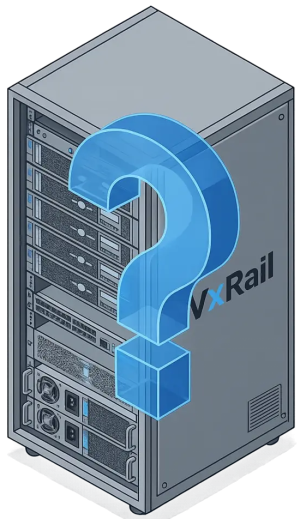 VMware vSAN promised simplicity, but many DIY deployments struggled with performance consistency, lifecycle coordination, and accountability for support. VxRail addressed those gaps by delivering a pre-engineered vSAN stack on Dell PowerEdge servers, validated as a complete system and backed by Dell support.
That experience came at a cost. To compensate for vSAN’s sensitivity to latency and contention, Dell over-provisions VxRail configurations. Dell added extra CPU, additional memory, and higher-performance storage media to deliver more consistent performance. This approach worked – it reduced operational risk and delivered something close to a private cloud experience – but many of the economic advantages of converged infrastructure disappeared. Organizations gave up hardware choice, accepted higher costs, and lost the flexibility that made converged infrastructure attractive in the first place.
Many organizations accepted that tradeoff. Predictability mattered more than theoretical efficiency. Vendor accountability mattered more than component choice.
The VxRail promise began to unravel after VMware changed ownership. Broadcom’s licensing model, pricing structure, and product direction introduced cost volatility and long-term uncertainty. VxRail customers started looking for an exit, and Dell recognized it needed to provide an alternative. That alternative is Dell Private Cloud, a platform intended to recreate a private cloud experience by coordinating across multiple products rather than a single integrated stack.
Dell Private Cloud as a VxRail alternative?
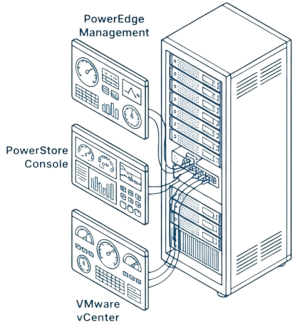 Dell Private Cloud is Dell’s strategic answer for customers looking for VxRail alternatives and VMware Exits. Rather than a tightly integrated, VMware-only appliance, Dell positions its Private Cloud as a vendor-coordinated private cloud stack built from Dell servers, Dell storage platforms, and Dell lifecycle automation. It shifts Dell’s private cloud strategy away from a single engineered system toward a disaggregated model in which Dell assembles and manages compute, storage, and the virtualization layer as separate components rather than as a single delivered product.
At the center of Dell Private Cloud sits Dell’s Automation Platform, delivered through APEX-oriented tooling and consumption models. Dell uses this platform to standardize design, deployment, firmware alignment, and ongoing lifecycle operations across multiple infrastructure components. Hypervisor choice forms a core part of the positioning. Dell presents Dell Private Cloud as hypervisor-flexible, allowing customers to select VMware or other cloud operating systems as Dell develops support for them.
The intent is straightforward. Dell wants to preserve the private cloud experience that VxRail customers expected, while removing VMware exclusivity and reasserting Dell’s role as the primary server and storage vendor. Instead of co-engineering an appliance with VMware, Dell now coordinates multiple software and hardware layers under its own operational framework.
For existing customers looking for VxRail alternatives and VMware Exits, this shift introduces a different set of tradeoffs. It changes the scope and complexity of what was previously a contained platform decision. In practice, three challenges emerge.
The hypervisor problem
Dell positions Dell Private Cloud as hypervisor-agnostic, but that flexibility depends on Dell-developed templates, validation work, and operational tooling. At present, ironically, VMware is the only fully supported hypervisor. Nutanix AHV and Red Hat OpenShift will arrive next, but availability and maturity lag behind the messaging.
 The practical result is that Dell Private Cloud will eventually be a VxRail alternative for VMware exit. It functions as a continuation strategy, offering the promise of future options. Even when those alternatives arrive, they introduce new tradeoffs. Nutanix AHV often costs as much as VMware once teams fully license and support it. OpenShift represents a different operating model, with a steeper learning curve and a focus that extends beyond traditional virtualization.
For VxRail customers seeking relief from VMware pricing and licensing pressure, Dell Private Cloud delays resolution rather than providing it.
The server problem
VxRail systems are Dell PowerEdge servers configured with additional CPU and memory to support vSAN. From a technical perspective, little prevents these systems from continuing to run virtualized workloads on a different platform.
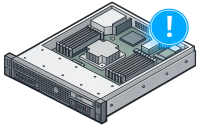
Dell has not stated that existing VxRail hardware qualifies for Dell Private Cloud. Documentation emphasizes new deployments and new configurations. VxRail customers evaluating Dell Private Cloud should assume new servers will be included in their plans.
This shift matters because it converts a software decision into a capital event. Customers who invested heavily in VxRail hardware to stabilize vSAN now face the prospect of retiring usable assets simply to exit VMware.
The storage problem
For customers looking for VxRail alternatives and VMware exits, storage becomes the most disruptive element when exploring Dell Private Cloud. Dell’s direction is explicit. Dell expects customers to move away from converged storage and adopt external Dell storage platforms, with PowerStore positioned as the primary option. vSAN no longer fits the architecture.
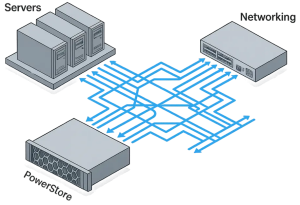
For VxRail customers, this creates three consequences. First, the internal SSDs in their servers become stranded assets. Second, organizations must purchase a new external storage system. This external storage system is likely an all-flash array, which exposes the organization to the AFA tax. Third, teams must adopt a new storage architecture and operational model.
The combination of unused capacity, new capital expense, and new skills creates friction that is difficult to justify. Organizations already purchased, deployed, and operated storage. Dell Private Cloud renders it unusable in pursuit of a different business objective.
VergeOS as a VMware exit for VxRail customers
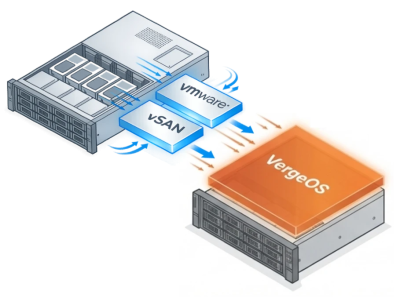 VergeOS approaches the VxRail alternative, and VMware Exit challenges from a different direction. Instead of replacing vSAN with an external storage system and replacing VMware with another hypervisor, VergeOS replaces the appliance model itself with a single infrastructure operating system.
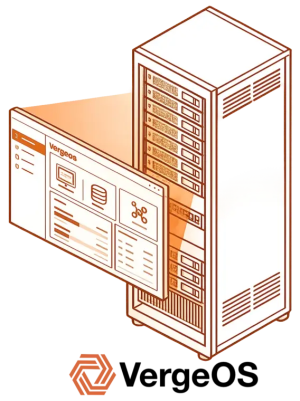
VergeOS integrates compute virtualization, distributed storage, networking, and data protection into a single control plane. Storage remains local to the servers but operates as a distributed system rather than through vSAN. No external array exists. No SAN layer exists. No separate storage lifecycle exists.
You can listen to multiple former VxRail customers, such as Alinsco Insurance and Topgolf, who have already validated the move to VergeOS. These organizations used VergeOS as their VMware and vSAN exit strategy without forcing an immediate hardware refresh. The critical difference is scope. The VMware exit with VergeOS does not require rebuilding storage, introducing a new SAN platform, or re-architecting the data center. Some environments continue running on existing VxRail servers and internal SSDs for years. Others added new servers gradually as capacity or performance requirements justified it. The result was a faster exit timeline, lower capital outlay, and a simpler operational model.
 This matters because it collapses two migrations into one. Teams do not need to migrate off vSAN before migrating off VMware. VergeOS removes both dependencies simultaneously without introducing a new one. Hardware evolution becomes optional and incremental rather than mandatory and front-loaded.
Operationally, VergeOS behaves like an infrastructure operating system. Upgrades roll through the system non-disruptively. The platform supports mixed hardware generations by design. Storage policies, snapshots, replication, and recovery function as native capabilities rather than bolt-on features. Teams manage a single system rather than coordinating multiple products.
For organizations that adopted VxRail to reduce operational risk, this is the central point. VergeOS preserves the original goal of simplicity while improving flexibility and cost control. It delivers a private cloud experience without forcing customers to overbuy hardware, replace storage, or relearn their environment.
The Two Paths VxRail alternatives present
Dell Private Cloud and VergeOS represent fundamentally different answers to the VxRail alternatives, and VMware’s exit paradox. VxRail customers need to exit VMware and vSAN without incurring significant business disruption. Dell Private Cloud disaggregates what VxRail unified, requiring new servers, external storage arrays, and coordination across multiple product lifecycles. VergeOS consolidates VMware, vSAN, networking, and data protection into a single platform that runs on existing hardware, treating the VMware exit as a software replacement rather than an infrastructure rebuild.
| Criteria | Dell Private Cloud | VergeOS |
|---|---|---|
| Hardware Use | New capital required | Existing assets preserved |
| New Storage Hardware | Strongly Reccomended | Not required |
| Lifecycle Model | Complex, multi-product | Integrated |
| Operational Simplicity | More interfaces | Single interface |
| Growth Model | Front-loaded | Incremental |
The decision comes down to whether VxRail customers want to preserve their original objective or abandon it. Organizations willing to trade simplicity for vendor relationships will find Dell Private Cloud familiar. Organizations that want to protect their hardware investment, avoid storage migration projects, and reduce long-term operational burden will find that VergeOS fully delivers on the original VxRail promise.







 Subscribe to our free daily newsletter