






Actiphy ActiveImage Protector Software Update with Proxmox Support
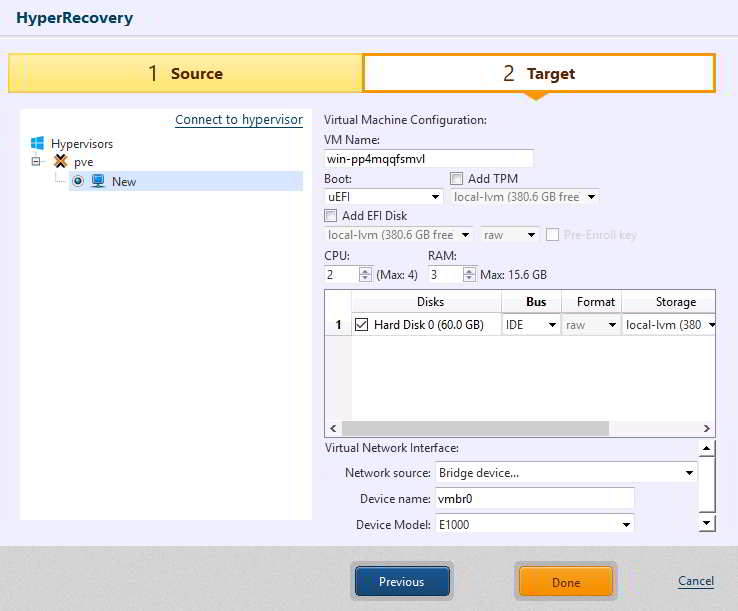
HyperRecovery target configuration screen showing VM settings for recovery to Proxmox hypervisor, including boot mode, CPU, memory, disk mapping, storage location, and network interface options prior to completing recovery process
This is a Press Release edited by StorageNewsletter.com on January 15, 2026 at 2:01 pmActiphy Inc., a global provider of backup, DR, and virtualization software, announced the release of a new version of ActiveImage Protector that adds support for the open-source Proxmox virtualization platform.

In recent years, changes to VMware’s licensing model – including the transition to subscription-based licensing, price increases, and product restructuring – have significantly increased infrastructure costs for many organizations. As a result, enterprises are increasingly evaluating alternative virtualization platforms.
Proxmox Server Solutions GmbH has gained momentum for its low licensing costs, unified management of virtual machines (KVM) and containers (LXC), and vendor-independent architecture that helps organizations avoid lock-in. With the addition of Proxmox support, ActiveImage Protector further expands its role as a comprehensive multi-hypervisor backup solution.
While Proxmox offers its own open-source backup solution, Proxmox Backup Server, many enterprises require the stability, professional support, and centralized management capabilities of a commercial backup product – particularly in business-critical environments where uptime and recovery time objectives are essential.
Organizations with mixed virtualization environments – such as VMware, Hyper-V, and Proxmox – often face greater complexity when managing backup solutions. By supporting Proxmox, ActiveImage Protector facilitates centralized backup and recovery across diverse environments, reducing operational complexity and the risk of human error.
New Features in ActiveImage Protector:
- Proxmox Virtualization Support
Agentless backup (HyperBack) and recovery to a virtual environment (HyperRecovery) are now available directly on the Proxmox platform. - Enhanced Virtual Conversion for KVM
Expanded Virtual Conversion and new Virtualization Adapter features enable migration to KVM environments, including Virtual-to-Cloud (V2C) recovery from Windows systems to Oracle Cloud Infrastructure (OCI) or Google Cloud Platform (GCP). - Restore Across Agentless and Agent-Based Environments
Agentless backup images of VMs can be restored to standalone VMs or physical systems without a hypervisor, enabling smooth restores across both agentless and agent-based deployments. - Improved RescueBoot Usability
RescueBoot, which allows systems to boot directly from an internal disk without external media, can now be created and launched directly from the Utilities menu – significantly improving usability.
Expanded KVM Support for Standby and Virtualization
HyperStandby (virtual standby from backup images), vStandby (virtual standby from disks), and virtualization (P2V) now support KVM environments.
Key Features of ActiveImage Protector:
- Comprehensive System Protection: Back up the entire system – including OSs, configurations, applications, and data – into a single image for fast, reliable recovery.
- Flexible Backup and Recovery: Supports disk, volume, file, and folder backups, including incremental backups for optimized storage efficiency.
- Ransomware-Resilient Protection (ImageIsolate): Automatically disconnects backup storage from the network after backup completion to protect against ransomware and malware attacks.
- Distributed Storage and Offsite Replication: Securely replicating data to remote locations improves data availability and disaster recovery readiness.
- Broad Cloud Storage Support: Compatible with S3-compatible object storage and Microsoft Azure Storage.
- Inline Data Deduplication and Compression (IDDC): Reduces storage consumption by eliminating duplicate data and compressing it simultaneously.
- Cross-Platform Consistency: Delivers consistent functionality across physical, virtual, and cloud environments.
- System Migration and DR: Supports P2V, V2V, and V2C migrations to ensure rapid recovery and business continuity.







 Subscribe to our free daily newsletter