









Panzura Powers Future of Exabyte-Scale Data as Member of Single Namespace Working Group
Panzura Symphony heterogeneous orchestration aligns with the principles of the SNS initiative for seamless data mobility
This is a Press Release edited by StorageNewsletter.com on December 22, 2025 at 2:00 pmSummary:
- Panzura is a member of the recently launched Single Namespace Working Group (SNS), a 34-member consortium working to establish OASIS-backed standards for exabyte-scale data access and interoperability
- Panzura’s participation in this initiative centers on the Panzura Symphony data services platform, which enables seamless data accessibility and vendor neutrality, preservation of customer choice, and AI readiness
- Panzura’s SNS membership reflects its commitment to solving global data challenges. With Symphony, which aligns with SNS principles, the company is uniquely suited to support the initiative’s transformative potential
Data volumes are exploding, and teams demand access to distributed datasets. The technology industry has reached an inflection point. That’s why we’re pleased that Panzura joined the SNS, a recently announced 34-member consortium led by Guardant Health that’s driving a standard for exabyte-scale datasets and cross-platform interoperability.
This initiative, which includes technology leaders like NetApp, Seagate, IBM, and DDN, alongside innovators like Genentech and Lawrence Livermore National Laboratory, represents a framework for how organizations will manage, access, and derive value from massive, distributed datasets.
SNS is actively transitioning its open standard specifications to the international standards body OASIS (Organization for the Advancement of Structured Information Standards) to ensure vendor neutrality and widespread adoption.
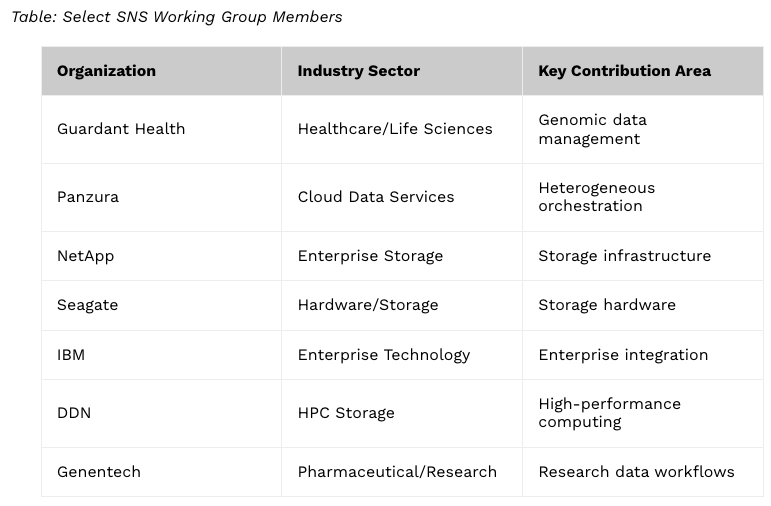
Our participation in this initiative centers on Panzura Symphony, our advanced data services platform, which enables seamless data accessibility and vendor neutrality, preservation of customer choice, and AI readiness.
The Exabyte Challenge: Why Single Namespace Matters
To understand the significance of the SNS initiative, it’s important to first grasp the magnitude of the data challenge facing modern enterprises. An exabyte – that’s one billion gigabytes – was once an unimaginable amount of data.
Now, research institutions and global enterprises routinely manage datasets approaching or exceeding this volume. Genomic data, for example, can represent a single whole genome sequence consisting of hundreds of gigabytes or more. Multiply this by millions of patients, add longitudinal studies, and incorporate multi-modal data types, and you quickly reach exabyte scale.
According to Towards Healthcare’s 2025 analysis, the global genomics market is projected to grow from $44.72 billion in 2025 to $171.41 billion by 2034, driven by a CAGR of 16.1%. Grand View Research reports that 48% of businesses store their most important data in the cloud, with the number of genomes studied predicted to reach more than 50 million this year alone. This directly correlates with the storage challenges organizations face, as each genome sequence contributes to the data deluge.
The traditional approach to managing such massive datasets via siloed storage systems, manual data movement, and platform-specific access methods has slowed innovation. Researchers lose time navigating between systems, technologists struggle with data migration projects that can take months. The disruption, time consumption, and prohibitive cost of managing massive data sets across different storage platforms are precisely the challenges the SNS initiative aims to resolve.
SNS is creating an open standard that treats distributed data as if it exists in one seamless, unified location. According to a report cited by Growin, over 92% of large enterprises now operate in a multi-cloud environment, with 89% of enterprises embracing multi-cloud strategies according to Flexera. This widespread multi-cloud adoption without unified data access creates inefficiencies that can multiply costs and complexity.
When Symphony was first developed, we anticipated this evolution in data management requirements. Symphony has been architected to provide dynamic data placement, data insights, and total cost of ownership (TCO) reduction. This enables Symphony to meet the scalability expectations of the SNS initiative.
How Does Symphony Align with SNS Principles?
Let’s take a deeper look into how Symphony aligns with SNS principles. While a single namespace seeks to make data location transparent to users, precise data placement remains critical for performance and cost optimization. Symphony’s data placement engine analyzes access patterns, compliance requirements, and cost factors to optimize data storage. Hot data can be placed on high-performance tiers, cold data moved to cost-effective archives, and compliance-sensitive data can remain in appropriate jurisdictions.
The SNS consortium’s transition to OASIS represents a milestone with the objective of making single namespace capabilities an industry standard. As a member, Panzura is participating in the development of the draft specifications expected next year.
Our experience with real-world deployments across diverse industries provides a valuable perspective. The lessons learned from managing petabytes of data, supporting global operations, and enabling AI readiness all demonstrate the practical applications envisaged by SNS goals.
In fact, we see the SNS initiative as a key moment in how the industry thinks about data management. Traditional boundary lines between storage systems, cloud providers, and data silos are blurring. What matters is fast, secure access to relevant data.
For organizations evaluating their data strategy, SNS will provide a clear direction:
- Invest in Interoperability: Single-vendor solutions will become increasingly untenable should the standard gain adoption. Platforms like Symphony that embrace open interoperability will be essential to this ecosystem
- Prepare for AI at Scale: The future belongs to organizations that can leverage AI across all their data, not just carefully curated subsets. Single namespace capabilities are prerequisite for AI at scale
- Think Beyond Storage: Data management is evolving. The question isn’t just where to store data, but how to make it accessible, understandable, and actionable all while preserving customer choice and driving down costs
Panzura’s participation as a member of the Single Namespace Working Group reflects our commitment to solving the world’s most challenging data problems. With Symphony, we’re uniquely suited to support the initiative’s transformative potential across healthcare, life sciences, research, and beyond. The draft specifications expected in early 2026 will mark the beginning of a new chapter.








 Subscribe to our free daily newsletter