









Hitachi and NTT Com Join Forces
To demonstrate world's first real-time data synchronization over 600 km using storage virtualization technology and IOWN APN
This is a Press Release edited by StorageNewsletter.com on December 10, 2024 at 2:54 pmHitachi, Ltd. and NTT Communications Corp. jointly announced the demonstration of their planned distributed data center infrastructure, verifying its technical viability.
Click to enlarge
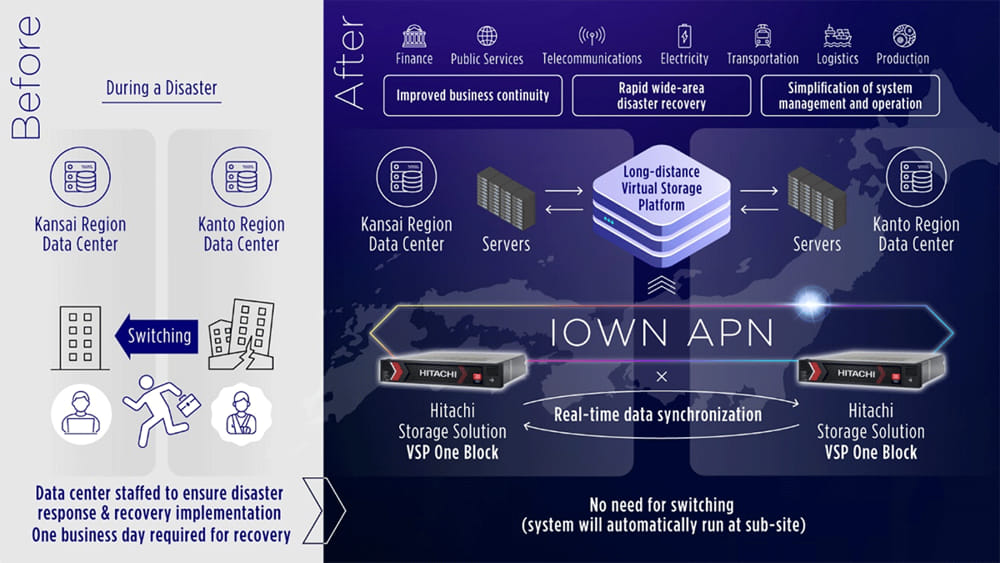
The infrastructure deploys the Hitachi Virtual Storage Platform One Block (VSP One Block) provided by Hitachi Vantara (1) and the IOWN All-Photonics Network (APN) (2), a core technology of the IOWN initiative (3) that achieves ultra-high-speed and low power consumption.
VSP One Block is a storage solution that uses virtualization to manage multiple storage units across locations as a single entity, ensuring reliable BC during disasters. Recognized for its exceptional capabilities, it leverages synchronous data replication and advanced protection technologies to enable recovery and continuous operations.
The IOWN APN, developed by the NTT Group, is a network technology that offers low power consumption, high capacity, low latency, and high-quality communication. During the demonstration, the combination of these 2 innovative solutions achieved round-trip times for long-distance data synchronization well within the times recommended by Hitachi, confirming that system recovery is possible even during disasters.
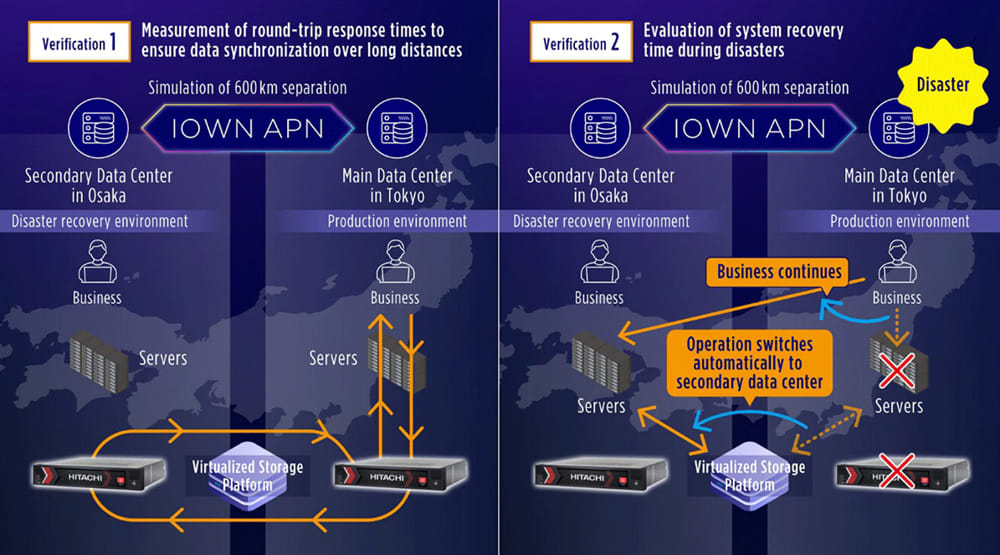
An IOWN APN was used during the demonstration to connect 2 VSP One Block storage systems, creating a virtual environment with a simulated separation of 600 km, equivalent to the distance between Tokyo and Osaka. Data synchronization times were measured using Hitachi’s Global-Active Device storage technology (4).
By improving the network’s response times through the superior network latency and reduced jitter (5) of the IOWN APN resulted in a round-trip response time (within 20ms) was achieved that far exceeded Hitachi’s recommended network response time (6). This confirms that stable data synchronization can be established over such distances, verifying their practical feasibility. It is believed to be the first time anywhere in the world that constant data synchronization has been achieved over a distance of 600km (7).
Clustering technology, typically deployed within just a single data center, was used during the demonstration to evaluate likely system recovery times following a disaster. Redundancy was established between the 2 data centers, and a simulated failure was introduced at the main site to test whether operations could continue using the backup site. Full system availability was automatically restored at the backup site without any loss of data, confirming that BC is possible even after a disaster.
The demonstration also highlighted that, during such times, there will be no need for system engineers to perform such tasks as switching from the main site to the sub-site or recovering lost data, thereby reducing staff workload. In addition, as there will no longer be a need to maintain multiple data sets asynchronously and back them up, storage capacity can be reduced, resulting in lower IT infrastructure maintenance costs and reduced power consumption.
Click to enlarge
Demonstration was conducted collaboratively, with each company fulfilling following roles:
- Hitachi / Hitachi Vantara: Virtual storage connection and evaluation of VSP One Block connectivity to the IOWN APN verification equipment
- NTT Com: APN functionality and performance evaluation using the IOWN APN verification setup.
The increased frequency of major natural disasters in Japan and the corresponding need to strengthen resilience have accelerated the adoption of DR systems among corporations in mission-critical sectors such as finance and infrastructure. However, the rising costs of system construction and maintenance, the need to ensure BC during a disaster, and the extensive recovery times remain major burdens for companies in these sectors.
Simultaneously, the rise of generative AI is driving explosive growth in the demand for data processing, intensifying the environmental impact due to increased energy consumption. As a result, there are high expectations for the realization of distributed data centers across Japan that make use of green energy.
This technical verification forms part of the efforts to enable real-time connectivity between geographically distant data centers, allowing businesses to use them as if they were a single, unified data center. By connecting data centers over long distances, it becomes possible to strategically locate them in regions with more space and renewable energy resources, thereby avoiding the concentration of data centers in urban areas.
Achieving the IOWN vision of a rich, inclusive society that embraces diversity requires the adoption of innovative technologies, such as optical networks and generative AI. Realizing sustainable data centers to support these advancements is critical to this goal.
Going forward, the combination of Hitachi Vantara and IOWN APN’s storage solutions aims to deliver next gen IT infrastructure capable of real-time data synchronization over long distances. The system will cater to mission-critical industries, including financial institutions, telecommunications, energy, transportation companies, and cloud service operators. Additionally, Hitachi and NTT Com will continue to advance solutions that help achieve the efficient operation of distributed data centers and their joint efforts to create an environmentally friendly and resilient society.
(1) A storage solution provided by Hitachi Vantara, featuring advanced data compression and protection technologies to streamline the management of growing data volumes and ensure stable system operation. It also reduces environmental impact throughout its product lifecycle. Please refer here for information on Hitachi’s storage solutions.
(2) A key technology of the IOWN initiative. This joint demonstration utilized NTT’s APN verification setup.
(3) Innovative Optical Wireless Network, NTT’s next gen communication infrastructure initiative targeted for practical application around 2030. Utilizing groundbreaking optical and wireless technologies, it aims to surpass the limitations of existing infrastructure, optimize systems based on diverse information, and foster an inclusive and prosperous society.
(4) A technology that maintains constant synchronization between 2 storage systems, enhancing data availability.
(5) Fluctuations in network latency. Small fluctuations are referred to as ‘low jitter.‘
(6) Write speed: 7.5ms, Read speed: 0.1ms or less confirmed
(7) Based on research conducted by NTT Com and Hitachi, as of November 2024.








 Subscribe to our free daily newsletter