









From University of Pennsylvania, Turning Up Heat on Storage
Developed heat-resistant memory device that can withstand temperatures over 600°C or 1,000°F.
This is a Press Release edited by StorageNewsletter.com on May 10, 2024 at 2:01 pmResearchers from Penn have developed a heat-resistant memory device that can withstand temperatures over 1,000°F. Their findings pave the way for AI computing in extreme environments.
Researchers led by Deep Jariwala and Roy Olsson have developed
first-of-its-kind high-temperature-resistant memory device
that can reliably store data at temperatures as high as 600°C.
A smartphone shutting down on a sweltering day is an all-too-common annoyance that may accompany a trip to the beach on a sunny afternoon. Electronic memory within these devices isn’t built to handle extreme heat.
As temperatures climb, the electrons that store data become unstable and begin to escape, leading to device failure and loss of information. But what if gadgets could withstand not just a hot summer day but the searing conditions of a jet engine or the harsh surface of Venus?
In a paper published in the journal Nature Electronics, Deep Jariwala and Roy Olsson of the University of Pennsylvania and their teams at the School of Engineering and Applied Science demonstrated memory technology capable of enduring temperatures as high as 600°C – more than 2x the tolerance of any commercial drives on the market – and these characteristics were maintained for more than 60h, indicating exceptional stability and reliability.
The team’s findings not only pave the way for better sensors for tools that need to operate in extreme environments but also open the door for AI systems adept at data-heavy computing in harsh conditions.
“From deep-earth drilling to space exploration, our high-temperature memory devices could lead to advanced computing where other electronics and memory devices would falter,” Jariwala says. “This isn’t just about improving devices; it’s about enabling new frontiers in science and technology.”
The team developed a device that’s classified as non-volatile, meaning it retains the information stored on it without needing an active power supply the like of which is used daily in consumer electronics in any device with a hard drive or flash drives. However, unlike other traditional silicon-based flash drive devices that start to fail at around 200°C (392°F), the researchers designed theirs using a material known as ferroelectric aluminum scandium nitride (AlScN).
The researchers explain that AlScN confers a storage benefit by virtue of its ability to retain a given state of electrical state – the ‘on’ or ‘off’ representing 1s and 0s of digital data – after an external electric field is removed and at significantly higher temperatures, among other desirable properties.
“AlScN’s crystal structure also gives it notably more stable and strong bonds between atoms, meaning it’s not just heat-resistant but also pretty durable,” says Dhiren Pradhan, the paper’s first author and a postdoctoral researcher in the Jariwala and Olsson labs. “But more notably, our memory device design and properties allow for fast switching between electrical states, which is crucial for writing and reading data at high speed.”
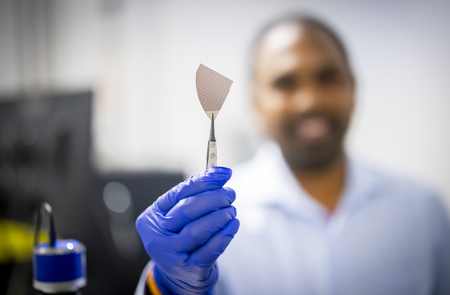
Dhiren Pradham, postdoctoral researcher in Deep Jariwala and Roy Olsson’s labs,
holds an aluminium scandium nitride information storage device
capable of operating at temperatures higher than 600°C.
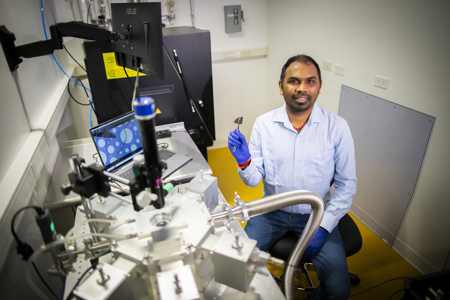
The memory device consists of a metal–insulator–metal structure, incorporating nickel and platinum electrodes with a thin (45 nanometers) layer of AlScN, and thickness is a key consideration here,
Jariwala says, because at elevated temperatures particles move more erratically: “If it’s too thin, the increased activity can drive diffusion and degrade a material. If too thick, there goes the ferroelectric switching we were looking for, since the switching voltage scales with thickness and there is a limitation to that in practical operating environments. So, my lab and Roy Olsson’s lab worked together for months to find this Goldilocks thickness.”
This structural configuration also ensures compatibility with high-temperature silicon carbide logic devices, allowing the team’s memory device to function in conjunction with high-performance computing systems designed for extreme temperatures.
Beyond building a robust storage device for terrestrial and extraterrestrial exploration, Jariwala and team also see this new technology’s potential to enable more sophisticated forms of computation in extreme environments.
Jariwala explains that their device could also address a critical gap in current computing architectures where the separation of the central processing unit and memory creates inefficiencies, in that data must travel between these components, causing bottlenecks especially critical in artificial intelligence applications that process vast amounts of data rapidly.
“Conventional devices using small silicon transistors have a tough time working in high-temperature environments, a limitation that restricts silicon processors, so, instead, silicon carbide is used,” he says. “While silicon carbide technology is great, it is nowhere close to the processing power of silicon processors, so advanced processing and data-heavy computing such as AI can’t really be done in high-temperature or any harsh environments. The stability of our memory device could allow integration of memory and processing more closely together, enhancing speed, complexity, and efficiency of computing. We call this ‘memory-enhanced compute’ and are working with other teams to set the stage for AI in new environments.”
Deep Jariwala and Roy Olsson are associate professors, School of Engineering and Applied Science, University of Pennsylvania. Dhiren Pradhan is a postdoctoral researcher in the Jariwala and Olsson Labs at Penn Engineering. Other authors are Penn Engineering’s Gwangwoo Kim, Yunfei He, Pariasadat Musavigharavi, Kwan-Ho Kim, Nishant Sharma, Zirun Han, Xingyu Du, and Eric Stach and the Air Force Research Laboratory’s David C. Moore, Venkata S. Puli, W. Joshua Kennedy, and Nicholas R. Galvin.
This work was supported by the Air Force Research Laboratory and Air Force Office of Scientific Research (FA9550-23-1-0391), Vagelos Institute for Energy Science and Technology, and National Science Foundation (grants NNCI-1542153 and DMR-2309043).
Article: A scalable ferroelectric non-volatile memory operating at 600 °C
Nature Electronics has published an article written by Dhiren K. Pradhan, Department of Electrical and Systems Engineering, University of Pennsylvania, Philadelphia, PA, USA, David C. Moore, Materials and Manufacturing Directorate, Air Force Research Laboratory, Wright-Patterson AFB, Dayton, OH, USA, Gwangwoo Kim, present address: Department of Engineering Chemistry, Chungbuk National University, Cheongju, Republic of Korea, Department of Electrical and Systems Engineering, University of Pennsylvania, Philadelphia, PA, USA, Yunfei He, Department of Electrical and Systems Engineering, University of Pennsylvania, Philadelphia, PA, USA, Pariasadat Musavigharavi, present address: Department of Materials Science and Engineering, University of Central Florida, Orlando, FL, USA, Department of Electrical and Systems Engineering, University of Pennsylvania, Philadelphia, PA, USA, and Department of Materials Science and Engineering, University of Pennsylvania, Philadelphia, PA, USA, Kwan-Ho Kim, Department of Electrical and Systems Engineering, University of Pennsylvania, Philadelphia, PA, USA , Nishant Sharma, Department of Electrical and Systems Engineering, University of Pennsylvania, Philadelphia, PA, USA , Zirun Han, Department of Electrical and Systems Engineering, University of Pennsylvania, Philadelphia, PA, USA, and Department of Physics and Astronomy, University of Pennsylvania, Philadelphia, PA, USA, Xingyu Du, Department of Electrical and Systems Engineering, University of Pennsylvania, Philadelphia, PA, USA, Venkata S. Puli, Materials and Manufacturing Directorate, Air Force Research Laboratory, Wright-Patterson AFB, Dayton, OH, USA , Eric A. Stach, Department of Materials Science and Engineering, University of Pennsylvania, Philadelphia, PA, USA, W. Joshua Kennedy, Nicholas R. Glavin, Materials and Manufacturing Directorate, Air Force Research Laboratory, Wright-Patterson AFB, Dayton, OH, USA, Roy H. Olsson III, and Deep Jariwala, Department of Electrical and Systems Engineering, University of Pennsylvania, Philadelphia, PA, USA.
Abstract: “Non-volatile memory devices that can operate reliably at high temperature are required for the development of extreme environment electronics. However, creating such devices remains challenging. Here we report a non-volatile memory device that is based on an aluminium scandium nitride (Al0.68Sc0.32N) ferroelectric diode and can operate at temperatures of up to 600 °C. The devices are composed of metal–insulator–metal structures of nickel/AlScN/platinum grown on 4-inch silicon wafers. They exhibit clear ferroelectric switching up to 600°C with distinct on and off states. At 600 °C, the devices exhibit one million read cycles and readable on–off ratios above 1 for over 60h. The operating voltages of the AlScN ferrodiodes are less than 15V at 600 °C and are thus compatible with silicon-carbide-based high-temperature logic technology.“








 Subscribe to our free daily newsletter