









From National Institute for Materials Science, Proof-of-Principle Demonstration of 3D Magnetic Recording
Using media model that mimics microstructure and magnetic properties of fabricated media
This is a Press Release edited by StorageNewsletter.com on April 10, 2024 at 2:01 pmResearch groups from NIMS ((National Institute for Materials Science), Seagate Technology LLC, and Tohoku University have made a breakthrough in the field of HDD by demonstrating the feasibility of multi-level recording using a 3D magnetic recording medium to store digital information.
Figure. Schematic view of (top) currently used HAMR and (bottom) 3D magnetic recording systems. In the 3Dmagnetic recording system, the Curie temperature of each recording layer differs by about 100,000 and data are written to each layer by adjusting the laser power.
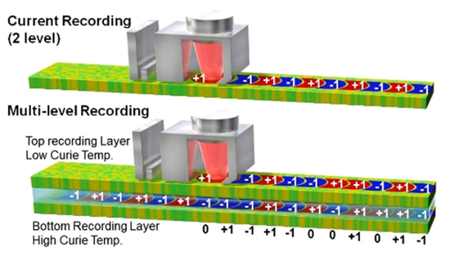
The research groups have shown that this technology can be used to increase the storage capacity of HDDs, which could lead to more efficient and cost-effective storage solutions in the future.
Data centers are increasingly storing vast amounts of data on HDDs that use PMR to store information at areal densities of around 1.5Tbit/in². However, to transition to higher areal densities, a high anisotropy magnetic recording medium consisting of FePt grains combined with heat-assisted laser writing is required. This method, known as HAMR, is capable of sustaining areal recording densities of up to 10Tbit/in². Furthermore, densities of larger than 10Tbit/in² are possible based on a new principle demonstrated by storing multiple recording levels of 3 or 4 compared with the binary level used in HDD technology.
In this study, researchers succeeded in arranging the FePt recording layers 3 dimensionally, by fabricating lattice-matched, FePt/Ru/FePt multilayer films, with Ru as a spacer layer. Measurements of the magnetization show the 2 FePt layers have different Curie temperatures. This means that 3D recording becomes possible by adjusting the laser power when writing. In addition, we have demonstrated the principle of 3D recording through recording simulations, using a media model that mimics the microstructure and magnetic properties of the fabricated media.
The 3D magnetic recording method can increase recording capacity by stacking recording layers in 3 dimensions. This means that more digital information can be stored with fewer HDDs, leading to energy savings for data centers. In the future, researchers plan to develop processes to reduce the size of FePt grains, to improve the orientation and magnetic anisotropy, and to stack more FePt layers to realize a media structure suitable for practical use as a high-density HDD.
This research was conducted by Dr. P. Tozman, distinguished researcher, and Dr. Yukiko Takahashi, group leader, NIMS Center for Magnetic and Spintronics Materials Research, Dr. T.Y. Chang, researcher, Seagate Technology, and Prof. S.J. Greaves, Tohoku University. This work was supported by Japan Science and Technology Agency (JST) Strategic Basic Research Programs (CREST) ‘Integrated Devices and Systems Utilizing Information Carriers’ JPMJCR22C3.
This research was published in Acta Materialia on March 24, 2024.
Article: Dual-layer FePt-C granular media for multi-level heat-assisted magnetic recording
Acta Materialia has published an article written by P. Tozman, S. Isogami, I. Suzuki, A. Bolyachkin, H. Sepehri-Amin, National Institute for Materials Science, Tsukuba, Ibaraki, 305-0047, Japan, S.J. Greaves, Research Institute of Electrical Communications Tohoku University, Sendai, Japan, H. Suto, Y. Sasaki, National Institute for Materials Science, Tsukuba, Ibaraki, 305-0047, Japann T.Y. Chang, Y. Kubota, P. Steiner, P.-W. Huang, Seagate Technology, Recording Media Organization, Fremont, CA, 94538, USA, K. Hono, and Y.K. Takahashi, National Institute for Materials Science, Tsukuba, Ibaraki, 305-0047, Japan.
Abstract: “Multi-level magnetic recording is a new concept for increasing the data storage capacity of hard disk drives. However, its implementation has been limited by a lack of suitable media capable of storing information at multiple levels. Herein, we overcome this problem by developing dual FePt-C nanogranular films separated by a Ru-C breaking layer with a cubic crystal structure. The FePt grains in the bottom and top layers of the developed media exhibited different effective magnetocrystalline anisotropies and Curie temperatures. The former is realized by different degrees of ordering in the L10-FePt grains, whereas the latter was attributed to the diffusion of Ru, thereby enabling separate magnetic recording on each layer under different magnetic fields and temperatures. Furthermore, magnetic measurements and heat-assisted magnetic recording simulations showed that these media enabled 3-level recording and could potentially be extended to 4-level recording, as the ↑↓ and ↓↑ states exhibited non-zero magnetization.“








 Subscribe to our free daily newsletter