








Argonne National Laboratory: Ultrasmall Swirling Magnetic Vortices Detected in Iron-Containing Material
Discovery could be applicable to information storage, such as computer memory and high-efficiency microelectronics.
This is a Press Release edited by StorageNewsletter.com on April 14, 2023 at 2:01 pm By Joseph E. Harmon, member, communications and public affairs, Argonne National Laboratory
A multi-institutional team discovered surprising properties in a magnetic material. This discovery could be applicable to information storage, such as computer memory and high-efficiency microelectronics.
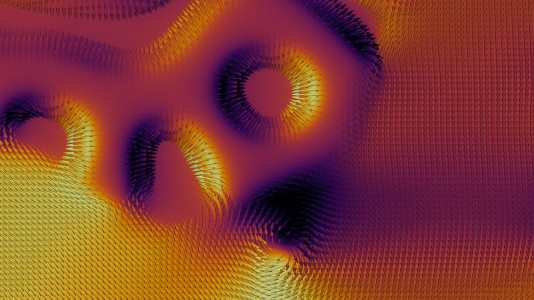
Simulation capturing the different swirling textures of skyrmions
and merons observed in ferromagnet thin film.
(Image by University of Edinburgh/based on microscopy images
collected by Argonne on samples prepared at MagLab)
Microelectronics forms the foundation of much modern technology today, including smartphones, laptops and even supercomputers. It is based on the ability to allow and stop the flow of electrons through a material. Spin electronics, or spintronics, is a spinoff. It is based on the spin of electrons, and the fact that the electron spin along with the electric charge creates a magnetic field.
“This property could be exploited for building blocks in future computer memory storage, brain-like and other novel computing systems, and high-efficiency microelectronics,” said Charudatta Phatak, group leader, materials science division, U.S. Department of Energy’s (DOE) Argonne National Laboratory.
A team including researchers at Argonne and the National High Magnetic Field Laboratory (MagLab) discovered surprising properties in a magnetic material of iron, germanium and tellurium. This material is in the form of a thin sheet that is only 10 atoms in thickness. It is called a 2D ferromagnet.
The team discovered that 2 kinds of magnetic fields can coexist in this ultra-thin material. Scientists call them merons and skyrmions. They are like miniature swirling storm systems dotting the flat landscape of the ferromagnet. But they differ in their size and swirling behavior.
“This [magnetic] property could be exploited for building blocks in future computer memory storage, brain-like and other novel computing systems, and high-efficiency microelectronics.” said Charudatta Phatak, group leader, materials science division, Argonne.
Known and studied for about 15 years, skyrmions are about 100 nanometers in size – approximately the same as a single virus molecule – and their magnetic fields flow in complicated patterns, resembling those of the strands of a knot in a rope. Only recently discovered, merons are roughly the same size and have magnetic fields that swirl around like whirlpools.
“Both skyrmions and merons are very stable because like firmly tied knots, they are difficult to untangle,” said Luis Balicas, who holds a joint appointment at MagLab and Florida State University. “This stability along with their magnetic properties makes them attractive as carriers of information.”
The team is the first to observe both of these magnetic textures in a thin film at the same time at low temperature, from minus 280 to minus 155°F. Also, merons remained present up to room temperature, an important consideration to exploit them in practical devices. In the past, they had only been observed at much lower temperature in different materials.
The team also showed that skyrmions and merons are detectable from their effect on an applied current, by measuring the voltage. This feature means they are adaptable to the binary code used in all digital computers. This code consists of combinations of 1 and 0. In a spintronic device, a 1 would be indicated by an electrical signal detecting a skyrmion or meron. The absence of an electrical signal would then convey a 0.
Detecting and characterizing the different magnetic textures in a film fewer than 10 atoms thick required a special scientific tool.
Yue Li, Argonne physicist, led that challenging task using an instrument called a Lorentz transmission electron microscope (TEM). This microscope includes aberration correction technology to improve its resolution. This TEM can visualize the magnetization of materials at the nanoscale under different magnetic fields over a wide temperature range, a unique capability available at Argonne. The range extends from minus 280°F to room temperature.
The team performed additional magnetic and other imaging at Argonne’s Center for Nanoscale Materials, a DOE Office of Science user facility.
“Much more basic research is needed to fully understand the behavior of skyrmions and merons under different conditions, and how to employ them in coding information,” Balicas said. “Many seemingly science fiction schemes are out there. We cannot predict the future, but it seems likely that one or more might come to fruition.”
This research was published in Advanced Materials. Argonne contributors include Yue Li, Amanda Petford-Long and Charudatta Phatak. Contributors from MagLab are Brian Casas, Alex Moon, Yan Xin, Juan Macy, Eun Sang Choi and Luis Balicas. Also contributing from University of Edinburgh are Conor McKever and Elton Santos. (see below)
Funding from this project came from DOE Basic Energy Sciences, National Science Foundation, Office of Naval Research, State of Florida, University of Edinburgh and Spanish Ministry of Science.
Article: Coexistence of Merons with Skyrmions in the Centrosymmetric Van Der Waals Ferromagnet Fe5–xGeTe2
Advanced Materials has published an article written by Brian W. Casas, National High Magnetic Field Laboratory, Tallahassee, FL, 32310 USA , Yue Li,Materials Science Division, Argonne National Laboratory, Lemont, IL, 60439 USA, Alex Moon,National High Magnetic Field Laboratory, Tallahassee, FL, 32310 USA, and Department of Physics, Florida State University, Tallahassee, FL, 32306 USA, Yan Xin, National High Magnetic Field Laboratory, Tallahassee, FL, 32310 USA , Conor McKeever, Institute for Condensed Matter and Complex Systems, School of Physics and Astronomy, The University of Edinburgh, Edinburgh, EH9 3FD UK, Juan Macy, National High Magnetic Field Laboratory, Tallahassee, FL, 32310 USA, and Department of Physics, Florida State University, Tallahassee, FL, 32306 USA, Amanda K. Petford-Long, Charudatta M. Phatak, Materials Science Division, Argonne National Laboratory, Lemont, IL, 60439 USA, and Department of Materials Science and Engineering, Northwestern University, Evanston, IL, 60208 USA, Elton J. G. Santos, Institute for Condensed Matter and Complex Systems, School of Physics and Astronomy, The University of Edinburgh, Edinburgh, EH9 3FD UK, and Higgs Centre for Theoretical Physics, The University of Edinburgh, Edinburgh, EH9 3FD UK, Eun Sang Choi, and Luis Balicas, National High Magnetic Field Laboratory, Tallahassee, FL, 32310 USA, and Department of Physics, Florida State University, Tallahassee, FL, 32306 USA
Abstract: “Fe5–xGeTe2 is a centrosymmetric, layered van der Waals (vdW) ferromagnet that displays Curie temperatures Tc (270–330 K) that are within the useful range for spintronic applications. However, little is known about the interplay between its topological spin textures (e.g., merons, skyrmions) with technologically relevant transport properties such as the topological Hall effect (THE) or topological thermal transport. Here, via high-resolution Lorentz transmission electron microscopy, it is shown that merons and anti-meron pairs coexist with Néel skyrmions in Fe5–xGeTe2 over a wide range of temperatures and probe their effects on thermal and electrical transport. A THE is detected, even at room T, that senses merons at higher T’s, as well as their coexistence with skyrmions as T is lowered, indicating an on-demand thermally driven formation of either type of spin texture. Remarkably, an unconventional THE is also observed in absence of Lorentz force, and it is attributed to the interaction between charge carriers and magnetic field-induced chiral spin textures. These results expose Fe5–xGeTe2 as a promising candidate for the development of applications in skyrmionics/meronics due to the interplay between distinct but coexisting topological magnetic textures and unconventional transport of charge/heat carriers.“








 Subscribe to our free daily newsletter