









EDNS Domains DeDrive to Try to Disrupt Storage with Privacy and Security
Hybrid storage solution that leverages blockchain technology and employs user-centric architecture
This is a Press Release edited by StorageNewsletter.com on February 16, 2023 at 2:01 pmEDNS Domains PTE Ltd. is launching DeDrive soon to disrupt storage and address the increasing concerns for data privacy and security.
Recently, the storage market sees users shifting from decade-old centralized storage solutions to Web3 storage ones. The idea of decentralization in storage has gained impetus since it became apparent that the centralized storage systems undermined basic yet vital values like privacy and security.

Over the recent past, businesses have been relying on centralized storage solutions to manage the high influx of data. Big clouds (e.g. Alibaba Cloud, Huawei Cloud, Amazon) are now joining forces with blockchain projects to explore Web3 and unleash its potential to change storage. Decentralized storage solutions (e.g. Filecoin, IPFS, and Storj) are here to make far-reaching changes in storage. Decentralized storage has the potential to perform better and scale to greater heights than the novel centralized storage in the near future.
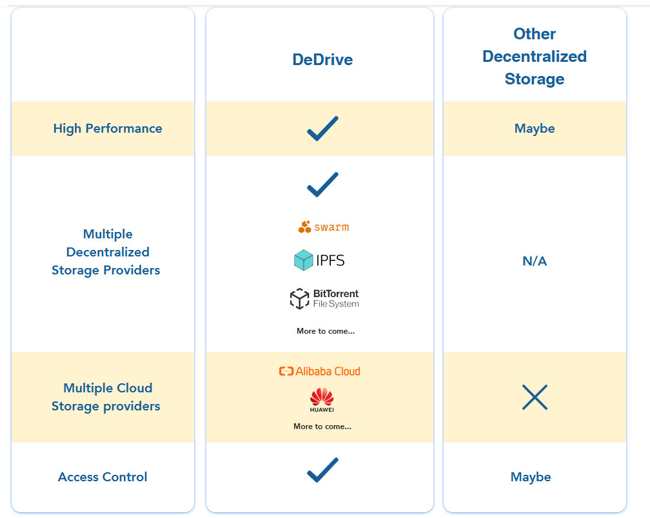
DeDrive single interface to multiple Web2 and Web3 storage providers
Click to enlarge
DeDrive Web3 storage disruption
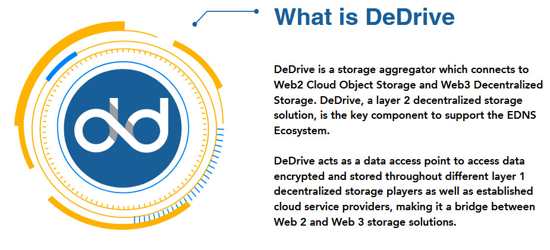
DeDrive is a hybrid storage solution that leverages blockchain technology and employs a user-centric architecture. It is a layer 2 decentralized storage solution to support the other 2 key pillars – Web3 communication and Web3 domains of the EDNS ecosystem.
DeDrive implements the best Web2 and Web3 infrastructure and solutions that you can rely on to scale with you. It presents an array of benefits when it comes to storage and management, it offers a bulletproof solution that is immutable, transparent, and secure, liberates user data, and increases data integrity.
Features of DeDrive:
-
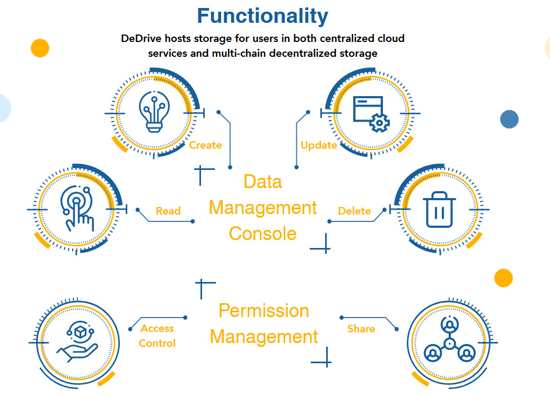
Management console: It offers a management console to its users to manage data and set permissions. Users also have full control over the entire file system limiting who can access it, edit it, and share it.
-
Flexibility of storage options: It is integrated with the hybrid Web3 and Web2 storage providers giving users more options for storage. Most importantly, the it is designed to enable storage in different chains, not limited to providers like IPFS, BTFS, BZZ, Filecoin, and Storj. With the multiple storage choices with different prices, it’s all up to the user to select a combination that perfectly suits his budget and needs. The flexibility of DeDrive goes far beyond what any Web2 storage provider will guarantee you.
-
HA: The availability of a data set is related to the accessibility of the data set and depends on its storage location. Therefore, any attack on the storage could prevent data access for the system actors without redundancy. This may cause loss of the stored data sets and replication of data is close to impossible. DeDrive, with a Web3 storage solution, increases data availability as it provides redundancy by replicating the data in more than one storage providers. DeDrive which is a layer 2 storage solution, employs a CDN (Content Delivery Network) to improve data availability, stability, and performance. A CDN is a distributed proxy server that distributes the service spatially to end users providing data availability and performance.
-
Better data exchange between Web2 and Web3: It bridges the gap between Web2 and Web3 allowing users to send and receive data from a decentralized storage provider to a Web2 storage provider. Users will be able to upload files from a Web2 storage to a decentralized storage provider through DeDrive.
Sneak peek into DeDrive
With a management console, DeDrive is able to execute the CRUD (create, read, update, and delete) functionality. Now, let’s upload an item to decentralized storage(s) at the intuitive interface on DeDrive.
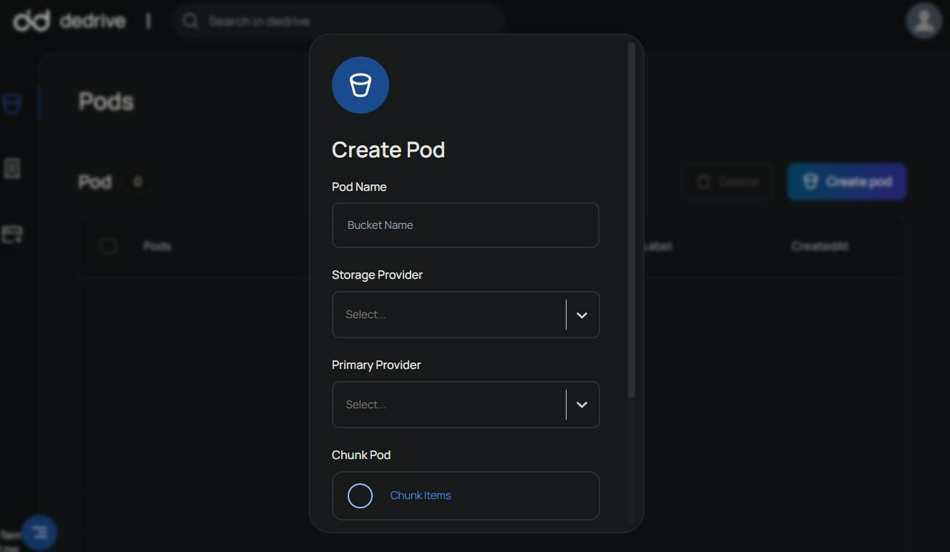
Firstly, you will need to create a pod. On the DeDerive dashboard, tap on the ‘Create Pod’ option. Name your pod and select a storage provider from the options provided (currently IPFS, BTFS and BZZ) as well as a primary provider (e.g. IPFS). With the access control option, you can limit who can access your files, you can either label it as private making you the sole editor, or public.
When a user uploads an item to a pod, the item will first be uploaded to a centralized temporary storage which is then uploaded to the storage providers that have been designated on the pod. Such upload operation is asynchronous since the uploading performance to different storage providers, especially decentralized ones, is decided by the status of each storage provider. DeDrive will eventually monitor and make sure all of the data is synchronized across all different storage providers.
Conclusion
Centralized storage providers may have served for years, but their failings are becoming apparent. As demands for efficient data storage spikes, we can expect decentralized storage models, especially a hybrid storage model like DeDrive that allows users the flexibility of choosing storage options, will become indispensable for users and enterprises.
Further, DeDrive serves as the backbone of the EDNS ecosystem, it powers the firm’s products like the EDNS wallet and SendBlock (Web3 Communication Tool) which are launching soon. It is also expanding its utility to Web3 Web Building and Hosting – an upcoming function within the EDNS landscape. With DeDrive on board, all products deliver security to all user’s data and assets since it leverages the leading blockchain and cloud storage services.
Ms. Joey Lam, CEO, commented: “We are enthusiastic about the upcoming launch of DeDrive, a product that will change people’s storage preference, as well as a product that offers a similar Web2 user experience to users but with higher security. We are actively inviting our community members who are eager to learn about the new generation of storage to give it a try!” He is very positive about the future of decentralized storage saying, “By partnering with the world’s leading cloud providers like Ali Cloud and Huawei Cloud, as well as other well-known Web3 storage providers, we believe in the success of disruption on data storage.“
About EDNS Domains
It is a decentralized name service built on Polygon, which is a side-chain and scaling solution on top of Ethereum, allowing users to translate their machine byte-code to a human-readable name. It provides a Decentralized Domain Naming Service for Web3-related demands, including NFT, Cryptocurrency Wallet, Web hosting & builder, DeFi ID, and GameFi ID in the Digital world. Moreover, to serve a wider range of users, EDNS will expand to support more blockchains, and ultimately become a multichain platform.







 Subscribe to our free daily newsletter