









From University of Gothenburg: Magnetic Storage That Runs on Light
Magnetic storage operating with light, making it more energy efficient, smaller, and about 10,000 times faster than what is currently available
This is a Press Release edited by StorageNewsletter.com on December 31, 2021 at 2:00 pmResearchers at department of physics, University of Gothenburg, have carried out projects to make magnetic storage operate with light, making it more energy efficient, smaller, and about 10,000 times faster than what is currently available.
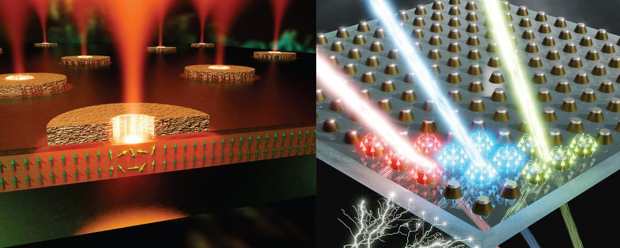
“To achieve this, we take the primely efficient light concentrators, optical nanoantennas, and make them channel light to the nanoscale, where we put magnetic materials,” says Alexandre Dmitriev, professor, department of physics, University of Gothenburg,.
The researchers have tested two related concepts. In one work, the researchers shrink TbCo rare-earth transition-metal alloy magnets, making them nanosized, to in the future be able to switch their magnetisation with femtosecond light pulses. At the same time, they manage to maintain their critical characteristic for switching with light, out-of-plane magnetic anisotropy.
They then build arrays of such nanoantennas with magnetic nanoelements, and test how nanoantennas channel light to the ferrimagnets, and how the eventual magnetic state could be read-out.
In the other work, optical nanoantennas are placed on top of a continuous nanothin film of TbCo alloy. Shaped as rings, the antennas funnel femtosecond light pulses into the film. The researchers then detect how the film in these spots are demagnetised, a first step in the memory writing process.
Both works show a step towards nanoscale magnetic memory operated with ultrafast light pulses.
“Our society has an unquenchable thirst for data, so data storage is rising exponentially. The required energy for that already amounts to 5% of the global energy consumption and is projected to reach 30% in the coming years. That is, energy-efficient data storage is essential for the sustainable future,” says Alexandre Dmitriev.
The works has recently been published on the covers of two research journals, Nanoscale (article link) and Advanced Photonic Research (article link), and are the result of a collaboration between University of Gothenburg, Uppsala University, nanoGUNE research institute (San Sebastian, Spain) and Radboud University (The Netherlands).
Publications:
Title: Direction-Sensitive Magnetophotonic Surface Crystals
Scientific magazine: Advanced Photonic Research
Title: Ultrafast demagnetization in a ferrimagnet under electromagnetic field funneling
Scientific magazine: Nanoscale
Resources:
Femtoterabyte Research project
Femtoterabyte develops the conceptually new paradigm for ultra-dense and ultrafast magnetic storage that is envisioned to bring the technological frontier in the storage density to tens of Terabytes per inch2, while taking the operation speed for read-write into the THz. We foresee to achieve this in an all-optical platform that allows deterministic, non-thermal, low-energy, ultrafast magnetization switching at few nanometers and potentially down to a molecular length-scale.
The main building block of this technology is the antenna for light, able to operate with the optical angular momenta at a nanoscale. The project is set to develop the fundamentals for such a memory unit, and to demonstrate it in practice and in operation, mapping its suitability for future upscaling towards industrial implementation in devices.
New avenues for ultrafast magnetic memory, ultra-performance sensing and low-energy computing








 Subscribe to our free daily newsletter