









History (1997): Seagate Buys Quinta For as Much as $325 Million
But why?
By Jean Jacques Maleval | October 25, 2021 at 1:01 pmSeagate Technology has agreed to buy an unknown start-up, the San Jose, CA-based Quinta Corp. for an amount that is far from negligible, $325 million.
The storage manufacturing giant will pay $230 million in cash, followed by another $95 million if the new subsidiary meets development goals for its technology.
Formed in April 1996, Quinta raised over $50 million before the acquisition to finance initial development of what it calls “ultra-high capacity disk drives.” The firm’s leading venture capital firm is the Silicon- based Sierra Ventures. Other investors include Seagate (already!), as well as Read Rite, the WW leader in the independent market of Winchester heads, while some of the others represent traditional investors in the storage industry. They include Victory Ventures, Citicorp, Hambrecht & Quist and Lehman Brothers.
Maxtor alums
The managing team is impressive, a majority of them are former Maxtor veterans, with, as CEO and president, Steve Kitrosser, who previously held the same posts at Micronics and more notably, Maxoptix. Before taking charge of spin at Maxoptix, Kitrosser was VP WW operations at Maxtor.
Quinta’s new VP and CFO is Bob Teal, a co-founder of both Quantum and Maxtor, who also played significant management roles in shaping Shugart Associates and Control Data into big powers in the storage market.
If that weren’t enough, as VP of product development comes Dr. Joseph Davis, who was VP of product development and advanced products at Maxtor and founder and president of Iota Memories, a former subsidiary of SyQuest.
Not to mention Dr. Jeffrey Wilde, manager of optical technology, who is cofounder of Quinta, and who previously conducted technology research at Stanford University, as well as managing a company that conducted fundamental research in holographic storage.
Pushing the limits of the current magnetic technology
What new development could possibly command such a price from Seagate? None other than OAW (Optical Assisted Winchester), described below. With this new technology, Quinta expects to achieve and maintain a density at least 3 to 5x higher than Winchester technology, with greater reliability, a lower cost and long term potential growth.
What’s OAW?
Optical Assisted Winchester technology combines both optical and magnetic elements, but has nothing to do with traditional MO technology, nor is it connected with the new technology recently proposed by TeraStor.
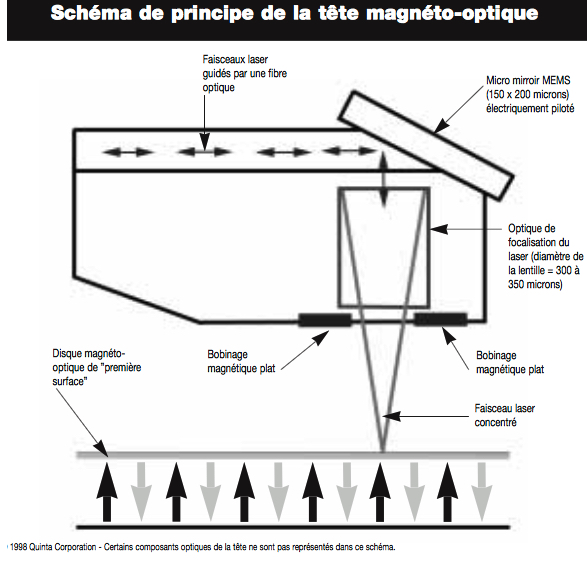
At the core of OAW is a laser – not for reading or writing, but uniquely as a servo guide for the magnetic head, giving much more precise guiding which in turn leads to superior areal densities. In a certain sense, OAW can be compared to Insite Peripheral’s technology, later acquired by OR Technology and Imation, where the optical head functioned simultaneously as a servo, with the exception that on the LS-120 or SuperDisk floppy drive, the diskette is pre-perforated with tiny holes that allow the laser beam to find the tracks more precisely.
Despite these differences, it is undeniable that the current trend is for a stronger alliance between optical and magnetic technology in order to attain higher and higher capacities, with particular reliance on optical components that are manufactured en masse today, given the proliferation of audio CDs and other 12cm optical computer storage formats.
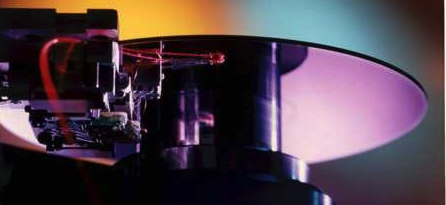
Here is haw the start-up describes its new OAW technology: It is a new head design that integrates optical elements into a Winchester style flying head. The lens, utilizing conventional optics, focuses a laser beam onto the media to assist in the writing, reading and tracking processes. A focused laser produces a smaller spot size than the analogous data mark from an MR head, from whence the ability to record more data in a given area.
OAW includes a fine servo and advanced light delivery system which helps to support the use of multiple heads. According to Quinta, OAW assures greater reliability than current HDDs, since, thanks largely to the optical elements, the head is able to fly at a level almost ten times higher than a typical MR head. The relatively high flying height (15 microinches) and dynamic loading and unloading reduce the head/disk interface issues that are plaguing today’s Winchesters.
Finally, the new approach paves the way for continued growth in areal density over the next decade without pushing the limits of head flying height, or switching over to quasi-contact or near-field recording.
Like TeraStor, Quinta hasn’t revealed all of its secrets, and in particular, the method employed to direct the laser beam on one or 2 sides of one or several magnetic platters.
And as with TeraStor, one can wonder about the access times of the new hybrid products, to the extent that the weight of the new heads, with both magnetic and optical elements, may be greater than that of current all-magnetic units.
As a result, although optical technology coupled with magnetic may bring considerable capacity gains, it is not at all certain to satisfy all performance needs, which means that the final product is more likely to take on tape and optical drives than traditional HDDs, except in those existing computer applications that require capacity more than high performance.
(Source: Mosarca)
This article is an abstract of news published on issue 115 on August 1997 from the former paper version of Computer Data Storage Newsletter.








 Subscribe to our free daily newsletter